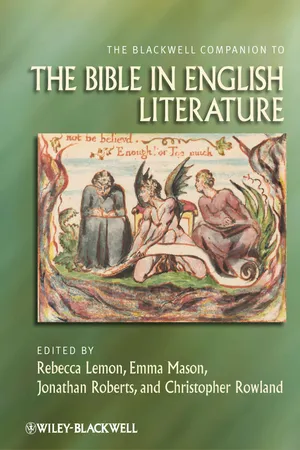
- An ambitious overview of the Bible's impact on English literature – as arguably the most powerful work of literature in history – from the medieval period through to the twentieth-century
- Includes introductory sections to each period giving background information about the Bible as a source text in English literature, and placing writers in their historical context
- Draws on examples from medieval, early-modern, eighteenth-century and Romantic, Victorian, and Modernist literature
- Includes many 'secular' or 'anti-clerical' writers alongside their 'Christian' contemporaries, revealing how the Bible's text shifts and changes in the writing of each author who reads and studies it
eBook - ePub
The Blackwell Companion to the Bible in English Literature
- English
- ePUB (mobile friendly)
- Available on iOS & Android
eBook - ePub
The Blackwell Companion to the Bible in English Literature
About this book
This Companion explores the Bible's role and influence on individual writers, whilst tracing the key developments of Biblical themes and literary theory through the ages.
Information
PART I
Introduction
Introduction
1 General Introduction
Rebecca Lemon, Emma Mason, and Jonathan Roberts
2 The Literature of the Bible
Christopher Rowland
3 Biblical Hermeneutics and Literary Theory
David Jasper
CHAPTER 1
General Introduction
“The Bible and literature” is a more specific field than it might first appear, and differs significantly from the ostensibly similar fields of: (a) “literature and theology”; (b) “Christianity and literature”; (c) “religion and literature”; and (d) “the Bible as literature.” We begin by taking a moment to differentiate these projects as a means to showing where this volume sits in relation to them.
Literature and Theology
A writer can be theologically complex but have comparatively little of the Bible in his or her work (for example, T. S. Eliot), or, by contrast, may freely deploy biblical allusion but have little obvious theology (such as Virginia Woolf). For this reason there is only a partial intersection between “theology and literature” and “the Bible and literature.” Studies within the former field are often strongly theorized, not least because of the symbiotic relationship between literary studies and theology. The theo-philosophical work of thinkers such as Paul Tillich, Paul Ricoeur, Hans Georg Gadamer, Walter Benjamin, Jacques Derrida, Hélène Cixous, and Martin Buber, for example, has foreshadowed a modern theoretical re-evaluation of literature that in turn has given way to a renewed interest in religious questions. The religiously inflected critical inquiry of writers such as Geoffrey Hartman, Luce Irigaray, J. Hillis Miller, Terry Eagleton, and John Schad has developed this tradition further, and provoked Stanley Fish, writing in The Chronicle of Higher Education (2005), to declare that religion might “succeed high theory and race, gender and class as the centre of intellectual energy in academe.” The field is well served by the journal Literature and Theology, as well as the recent Oxford Handbook of English Literature and Theology.
Christianity and Literature
“Christianity and literature” is distinct from “the Bible and literature” both because the former (like “literature and theology”) need not address the Bible itself, and because “Christianity and literature” implies a focus on a faith perspective, whereas “the Bible and literature” does not (one need not identify as Jewish or Christian to draw on the Bible). “Christianity and literature” has a different range from “literature and theology” because the former might consider, for example, ecclesiastical or liturgical matters that do not necessarily coincide with theology. The presence of vicars and parsonage life in eighteenth- and nineteenth-century fiction may have much to say about the lived experience of Christianity as life under a social institution, but does not necessarily entail discussion of conventional theological concerns such as the Incarnation, Trinity, or Resurrection. In practice, however, the faith orientation of “Christianity and literature” does tend to press it in a more reflective, didactic, or occasionally evangelizing direction. In one sense, the field is as old as the New Testament, as Christian writers (such as Paul) can be seen rereading Jewish Scripture in the light of their new faith within the Bible itself. These early typological readings are extended through a long history of attempts to read Christian echoes in texts from The Odyssey through to The Lord of the Rings. In the twentieth century, J. R. R. Tolkien and C. S. Lewis became both proponents and subjects of this approach, as Lewis’s 1944 essay “Myth Became Fact” and Joseph Pearce’s 1998 Tolkien: Man and Myth exemplify.
As with “literature and theology,” in addition to these author-based studies, there are numerous journals dedicated to the topic: “The Conference on Christianity and Literature” and its associated journal Christianity and Literature is one of the longest-standing. There have also been numerous anthologies of essays in this field including David Barratt et al, The Discerning Reader: Christian Perspectives on Literature and Theory (1995), and, more recently, Paul Cavill and Heather Ward’s The Christian Tradition in English Literature: Poetry, Plays, and Shorter Prose (2007).
Religion and Literature
“Religion and literature” is of a different order of magnitude, as it no longer deals with one religious text, but potentially with many texts, many gods, and many varieties of religious experience. It overlaps with “literature and theology” but goes beyond the Judeo-Christian traditions into the major world religions (see Tomoko Masuzawa’s The Invention of World Religions for a helpful introduction to this area). The most inclusive of the categories discussed here, this area also includes work on psychology (Carl Jung), belief (Slavoj Žižek and John D. Caputo), and ethics (Richard Rorty and Donna Haraway). Journals such as Religion and Literature have long been connected with this field, while new series like Continuum’s eclectic “New Directions in Religion and Literature” are suggestive of the evolving range of approaches and relevant texts opened up by the interplay between the two disciplines.
The Bible as Literature
The ongoing debate over the relationship between literature and the Bible is not a historical curiosity, but is grounded in the fact that the Bible itself is literature. As writers such as Murray Roston (Prophet and Poet: the Bible and the Growth of Romanticism, 1965) argue, this idea materialized in the sixteenth century with the translation of the Bible into the vernacular, and again in the eighteenth century due to a newfound interest in the principles of Hebrew poetics. The story of that rediscovery can be found in this volume (see Stephen Prickett’s introduction to the eighteenth century), but the reception of the Bible as a book of (among other things) poetry seems to have been a discovery for – and a surprise to – every generation since. The Romantic recognition of the biblical prophets as poets (and therefore Romantic poets’ self-recognition as prophets) segued into newly articulated forms of agnosticism in the nineteenth and twentieth centuries that found “the Bible as literature” an agreeable solution to a text at the center of their culture, the nature of which had gradually come to seem less clear. One result of this is that the Bible itself comes to be repackaged in editions such as Charles Allen Dinsmore’s The English Bible as Literature (1931) and Ernest Sutherland Bates’s The Bible Designed to be Read as Literature (1937).
The current sustained wave of interest in the Bible as literature owes much to Frank Kermode and Robert Alter’s Literary Guide to the Bible (1987), which was preceded by Kermode’s The Genesis of Secrecy (1979) and Alter’s The Art of Biblical Narrative (1981). At a time when literary theory was at the height of its influence in the 1980s, Kermode and Alter’s work showed that it was of equal significance to the work of biblical scholars, and that the Bible is composed of many diverse and disruptive examples of linguistic play and meaning.
“The Bible and Literature”
The range of studies pertaining to the fields outlined above is extensive. Nonetheless, many of the works (particularly academic monographs) written on “religion” and particular authors would not fall into any of these categories. This is because while religion has been the subject of an increasing focus in literary studies in recent years, this has taken place primarily via the recovery of historical contexts and period discourses. To take one example, the past decade or so has witnessed the publication of many books on Romantic religion. These books, however, have focused almost exclusively on the recovery of, for instance, the dissenting cultures of William Blake’s London, rather than his engagement with the Bible itself. This is a generalization, but indicates a trend. So, while the recovery of a history and hermeneutics of religion has been wide-ranging and essential to the very field of religion and literature to which this volume speaks, consideration of the uses that specific writers have found for the Bible has been comparatively underplayed. The foundations for this collection, David Lyle Jeffrey’s A Dictionary of Biblical Tradition in English Literature (1992), Stephen Prickett and David Jasper’s The Bible and Literature: A Reader (1999) and David Norton’s A History of the Bible as Literature (2000), have begun to redress this anomaly. Jeffrey presents the reader with an encyclopedic resource book detailing the appearance of biblical images and characters in later literature; Prickett and Jasper construct a helpful teaching book, offering groupings of extracts of literary texts by theme; and Norton provides a thorough historical trajectory of the subject. The present volume supplements these works by offering sustained and detailed analyses of the use of the Bible by specific authors, the majority of whom receive an entire chapter written by an expert on that particular writer. This volume also supplements these earlier studies by providing discussions, within many of the chapters, of the versions of the Bible available to, and influential on, these authors. As a result of this historical attention to Bible translation, both terms – “Bible” and “literature” – as engaged in this volume are capacious and mobile: there are varieties of Bibles influencing these authors, just as there are varieties of literature (drama, poetry, prose, memoir). The descriptor “the Bible and literature,” then, is a means to taking a kind of textual engagement as a common denominator, rather than any more qualitative judgment grounded in adherence to a particular tradition, or maintenance of a particular belief.
Accessibility has been a key aim of this volume, and we have attempted to commission essays that will be usable by the widest audience. As the principal audience is expected to be students of literature, we have sought to include authors who typically appear on undergraduate syllabi; this has meant a selection that could certainly be described as canonical, and located within a specific geography, since we have concentrated on writers who are British or who worked substantially in the British Isles. We hope that this volume might help to inspire scholars and/or students to undertake other, complementary studies of literature and the Bible, in languages other than English, in countries outside of Britain, and through a selection of authors more wide-ranging than we could undertake here. We thus offer this volume as an aid in understanding the vast influence of the Bible on English literature, rather than as a definitive and exhaustive study of the topic. There are, inevitably, omissions: while in the case of some authors, we would have liked to invite several scholars to have written on them, in the case of others, we had great difficulty commissioning anyone at all. This was an unexpected but instructive aspect of compiling the volume. We learned that the authors whom one might most quickly identify as “religious” and in whose critical reception “religion” has featured may not, in fact, have stimulated much (if any) discussion of their biblical usages; and often it is the least religious (or at least the most anti-clerical) writers – Byron, Blake, Lawrence, for example – who are the most biblical.
Perhaps the most difficult editorial decision concerned the date range of the volume. After much discussion and consultation we decided to stop at what is sometimes called “high modernism”: the writer born latest in the collection is T. S. Eliot. However, this was not, perhaps surprisingly, due to a diminished interest in the Bible among later twentieth and twenty-first century writers. Quite the reverse: had we gone later, there would be a wealth of choices: Douglas Coupland, William Golding, Graham Greene, Elizabeth Jennings, David Jones, C. S. Lewis, Philip Roth, J. R. R. Tolkien, and Jeanette Winterson, to name just a few. Amidst this range it would be difficult to make the sort of canonical selection that characterizes the rest of the volume; and length restrictions would mean that looking at some of the more interesting modern authors here would mean losing authors from earlier periods. As mentioned above, here too we hope that the volume offers a foundation for further study and research both into those authors we were unable to include and into new perspectives on those writers that are discussed here.
One of the most illuminating aspects of editing the collection has been seeing the different approaches that our contributors have taken to the subject matter. Without wishing to attempt to provide a typology of approaches, a selection of the chapters that follow is noted here to indicate the variety of critical approaches to be found in this collection.
Catherine Clarke’s essay on Old English poetry begins the medieval section, offering a history of the Bible as an object of aristocratic exchange. Clarke’s approach helps to illuminate how, to a large degree, the study of the Bible and literature concerns the history of the book itself. In contrast to her attention to book and manuscript circulation in England, other authors such as Douglas Gray (the medieval religious lyric), Christiania Whitehead (Chaucer), and Carol Kaske (Spenser) illuminate the range of specific ways in which authors engage with the Bible in their literary production. We see how historical authors draw on the Bible in numerous ways: typologically, allegorically, figuratively, affectively, and liturgically, to name only a few. These chapters are suggestive of the flexibility of biblical engagement, which extends beyond intertextual reference. Yet close attention to the nature of intertextual reference is itself revealing and ...
Table of contents
- Cover
- Praise for The Blackwell Companion to the Bible in English Literature
- Wiley-Blackwell Companions to Religion
- Title page
- Copyright page
- Contributors
- PART I: Introduction
- PART II: Medieval
- PART III: Early Modern
- PART IV: Eighteenth Century and Romantic
- PART V: Victorian
- PART VI: Modernist
- Index
Trusted by 375,005 students
Access to over 1.5 million titles for a fair monthly price.
Study more efficiently using our study tools.
Frequently asked questions
Yes, you can cancel anytime from the Subscription tab in your account settings on the Perlego website. Your subscription will stay active until the end of your current billing period. Learn how to cancel your subscription
No, books cannot be downloaded as external files, such as PDFs, for use outside of Perlego. However, you can download books within the Perlego app for offline reading on mobile or tablet. Learn how to download books offline
Perlego offers two plans: Essential and Complete
- Essential is ideal for learners and professionals who enjoy exploring a wide range of subjects. Access the Essential Library with 800,000+ trusted titles and best-sellers across business, personal growth, and the humanities. Includes unlimited reading time and Standard Read Aloud voice.
- Complete: Perfect for advanced learners and researchers needing full, unrestricted access. Unlock 1.5M+ books across hundreds of subjects, including academic and specialized titles. The Complete Plan also includes advanced features like Premium Read Aloud and Research Assistant.
We are an online textbook subscription service, where you can get access to an entire online library for less than the price of a single book per month. With over 1.5 million books across 990+ topics, we’ve got you covered! Learn about our mission
Look out for the read-aloud symbol on your next book to see if you can listen to it. The read-aloud tool reads text aloud for you, highlighting the text as it is being read. You can pause it, speed it up and slow it down. Learn more about Read Aloud
Yes! You can use the Perlego app on both iOS and Android devices to read anytime, anywhere — even offline. Perfect for commutes or when you’re on the go.
Please note we cannot support devices running on iOS 13 and Android 7 or earlier. Learn more about using the app
Please note we cannot support devices running on iOS 13 and Android 7 or earlier. Learn more about using the app
Yes, you can access The Blackwell Companion to the Bible in English Literature by Rebecca Lemon, Emma Mason, Jonathan Roberts, Christopher Rowland, Rebecca Lemon,Emma Mason,Jonathan Roberts,Christopher Rowland in PDF and/or ePUB format, as well as other popular books in Teología y religión & Crítica e interpretación bíblicas. We have over 1.5 million books available in our catalogue for you to explore.