![]()
Chapter One
Vision Without Execution Is Hallucination
Once upon a time, not so many years ago, strategy was king. Leaders immersed themselves in the matter of planning how best to achieve their company’s goals. The subject of strategy dominated the attention of senior executives and the writings of consultants and management gurus. Experts of various stripes weighed in on how to put strategic planning processes in place and transform employees at all levels into strategic thinkers.
Naturally, leaders assumed all this strategizing would pay off. And yet, for too many organizations the results promised to flow from these well-crafted visions went unrealized.
Quite simply, they couldn’t execute.
Now, strategy’s hey-day has passed. The business world has shifted its focus to execution—execution of plans and initiatives and the consistent delivery of results. If an organization can’t execute, nothing else matters: not the most solid, well-thought-out strategy, not the most innovative business model, not even the invention of technology that could transform an industry.
Thomas Edison famously said: “Vision without execution is hallucination.” It’s true. And as the hallucinations of countless business leaders have proved, knowing what you want to do or where you want the company to be in three to five years may be less than half the battle.
So what’s the problem? Why—given all the buzz about having a clear and compelling vision and a realistic and feasible strategy—can’t some leaders seem to execute?
This is a question I pondered for a very long time. My work with senior teams made me curious about why, despite having a sound strategic planning process in place and teams made up of smart, experienced professionals, many organizations still struggled and were unable to get things done and deliver results.
It seemed obvious there was a gap between planning and execution. And while much had been written on the need for leaders to improve their ability to execute, I could find very little information on what causes this gap and why it exists in some organizations but not in others. In addition, specific guidelines for solving this problem were even more elusive.
So my company, Onpoint Consulting, set out to gather specific information on what it takes to effectively execute plans and initiatives. We designed a study to answer three questions:
• Is there a gap between an organization’s ability to formulate a vision and strategy and achieve business results?
• What differentiates organizations that are more effective at execution from those that are less effective?
• What can leaders do to enhance their organization’s ability to close the strategy-execution gap and achieve business results?
We asked leaders in the pharmaceuticals, chemical, healthcare, insurance, financial services, and manufacturing industries to complete an online survey designed around these three questions. Response choices ranged from 5 = Strongly Agree to 1 = Strongly Disagree, and a “Don’t Know” option was also provided.
In addition, we asked leaders whether they believe there is a gap between the ability of their companies to develop and communicate a sound strategy and implement the strategy successfully. Participating companies had more than one hundred employees and more than $10M in revenue. A total of 409 middle- and senior-level leaders responded.
As part of our analysis—a very important part—we looked at the differences between the most-successful and least-successful companies. We asked respondents to indicate the extent to which sales, revenue, and net earnings had increased or decreased over the last three years. We used a performance composite score based on net sales and net earnings to identify the most successful companies (see the Appendix).
The chapter you’re reading is all about what we learned.
Yes, There Is an Execution Gap—But That’s Only the Tip of the Iceberg!
We expected some percentage of leaders to report a gap between their organization’s ability to formulate and communicate a vision and strategy and its ability to deliver results. Anecdotal evidence suggested that the number was fairly substantial. And our suspicions were confirmed: nearly half of the 409 leaders we surveyed (49 percent) believed there was a strategy-execution gap in their organizations.
Here’s what really surprised us: only 36 percent of leaders responded positively to the question, “I have confidence in my organization’s ability to close the gap between strategy and execution.” Said another way, a staggering 64 percent of leaders who indicated there was a strategy-execution gap lack confidence that it can be closed.
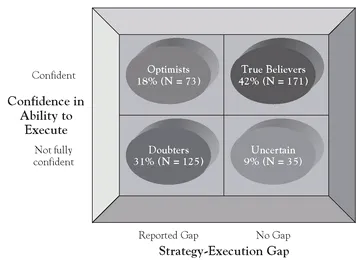
To provide further insight, we segmented survey respondents into four categories (see Figure 1.1).
•
True Believers: Those who believe that their organizations are executing effectively and are not struggling with a strategy-execution gap
Figure 1.1 Doubters, Optimists, and True Believers
• Doubters: Those who reported a gap and lack confidence it can be closed
• Optimists: Those who reported a gap, but are confident that the gap can be closed
• Uncertain: Those who did not report a strategy-execution gap but who did indicate that they lack confidence in their organizations’ ability to effectively execute
We found that only 42 percent of those who participated in the study were “True Believers.” This finding—coupled with the high percentage of leaders who don’t believe their organizations can close the gap—underscores the magnitude of the strategy-execution problem.
If people’s perceptions of their company can be trusted—and it stands to reason that the men and women responsible for getting things done day to day have the clearest viewpoint of all—this confidence problem is troubling. It suggests that most organizations simply aren’t set up to execute well.
Right now you may be thinking, “Okay, I know my organization suffers from an execution problem. I’ve known for some time. But what can we do about it? What’s the secret to ensuring effective execution—and consequently, gaining people’s confidence that the organization is capable of achieving its intended business results?”
“Conventional Wisdom”: Maybe Not So Wise!
If you’re like many leaders, you’ve bought into the conventional wisdom about strategy execution. It goes something like this: communicate an inspiring vision and realistic strategies, make sure you have an engaged and committed workforce with the skills to do the job, provide high-quality products and services, and focus on the customer to ensure success. Admittedly, it sounds good. But all evidence indicates that something is missing from the equation.
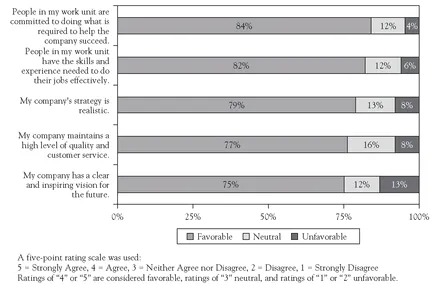
It’s true that these baseline practices are necessary and relevant. Unfortunately, they are not sufficient to ensure successful implementation. Most of the organizations in our study—those afflicted with a strategy-execution gap and those who are not—have these practices in place. In fact, the five items contained in the “conventional wisdom” statement above and shown in Figure 1.2 were among the highest-rated in our study. Plus, these factors are also reported to be in place in top-performing and less-successful companies alike.
Here are some of the things we learned from our study regarding “conventional wisdom”:
Companies Have “Vision” and “Strategy” in Abundance
As the baseline practices show, organizations reporting a strategy-execution gap don’t trace the issue back to an unclear vision or an unrealistic business strategy. In fact, despite the high percentage of leaders our study turned up who perceive there is an execution gap, a large majority of respondents believe their companies have clear and inspiring visions (75 percent) and realistic strategies (79 percent).
Figure 1.2 Top Five Items
Of the leaders reporting a gap, 63 percent believe their companies’ visions are clear and inspiring, and 69 percent believe their strategies are realistic. Even in less-successful companies, a high percentage of respondents believe the visions are clear and inspiring (56 percent) and the strategies are realistic (67 percent).
Few would argue that a clear, inspiring vision and a realistic strategy are fundamental for business success. (That they are central to success is supported by the fact that respondents in top-performing companies provided significantly higher ratings on these items.) However, our study indicates that effective execution and performance results are not guaranteed by having these factors in place. Crafting a realistic, inspiring vision and gaining employee buy-in is clearly just a first step.
Lack of Employee Commitment Isn’t the Problem, Either
It’s widely believed that employee commitment is a critical component of an organization’s ability to execute effectively. And it does make sense: employees who care will naturally exert more effort to get the job done than employees who don’t. Although our results do support this premise, we found commitment not to be a differentiator. All organizations—those with gaps and those without, the successful and the not-so-successful—report that they are staffed by committed employees.
We used two questions to measure commitment: “People in my work unit are committed to doing what is required to help the company succeed” and (to measure discretionary effort) “People in my work unit look for new and better ways of doing things.”
The former question is one of the five highest-rated items in our survey: even among those who reported strategy-execution gaps, 79 percent provided favorable ratings. The latter was one of the ten highest-rated items, and 70 percent of people reporting gaps provided favorable ratings. The upshot is that these items did not differentiate the “Gap” from the “No Gap” companies, nor did they differentiate the top-performers from their less-successful counterparts.
We Found No Shortage of Skills
Obviously, in order to execute well, people must have the skills and experience needed to perform their jobs. And evidently, most do. Our results indicate that all organizations—those that execute well, those that are struggling with a gap, the top performers, and the less-successful—have this factor in place. Not only was “skills and experience” one of the top five highest-rated items in our survey, but among those who reported a strategy-execution gap, 76 percent gave it a favorable score. Like commitment, while it is a prerequisite for success, it doesn’t appear to be a differentiator.
The Customer Isn’t Being Neglected
Our study also revealed that the strategy-execution gap is likely not related to shoddy quality or second-rate customer service. Despite the high percentage of leaders reporting a gap, this item was rated among the top five, with 77 percent of leaders providing favorable ratings overall. And even among leaders who reported gaps, 65 percent gave this item high marks.
So here’s the question: If these five factors—a clear and inspiring vision, a realistic strategy, employee commitment, a workforce with the skills to do their jobs, and high levels of quality and customer service—are prerequisites for successful execution, what is it that puts organizations over the top? What sets the best apart from the rest?
The Five Bridges: Gap-Closers That Make the Difference
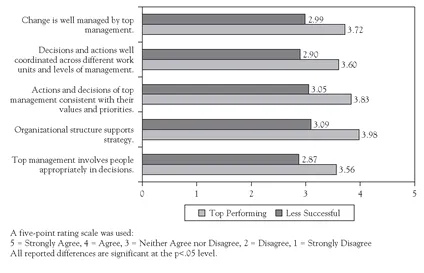
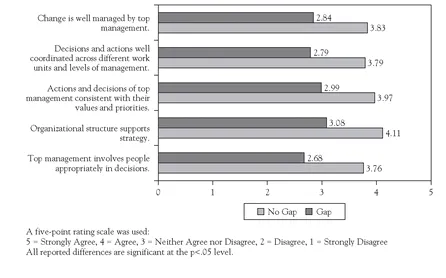
First, take a look at Figures 1.3 and 1.4. You’ll see that five factors set apart the organizations with the best performance results and the companies more effective at execution. That is, they differentiated the “No Gaps” from the “Gaps.” And this is interesting: in companies whose leaders did report gaps, the presence of these factors contributed to confidence that the gap could be closed (Figure 1.5).
Figure 1.3 Good Versus Great
Figure 1.4 No Gap Versus Gap
I think of these differentiating factors as “The Five Bridges.” If you have them in place in your company, you are more likely to be able to keep the strategy execution gap from forming to begin with, or close the gap once it has formed.
One important disclaimer: these bridges are not permanent. Once you’ve built them, you must keep vigilant watch over them and work hard to maintain them over time. It’s quite possible for a company to have a bridge in place one year, only to discover that over time it’s weakened or even crumbled and is no longer able to help your people traverse the gap.
As we get further into the book, we’ll discuss specific actions—meant to be taken at the indiv...