Probably Not
eBook - ePub

Probably Not

Future Prediction Using Probability and Statistical Inference

  1. English
  2. ePUB (mobile friendly)
  3. Available on iOS & Android
eBook - ePub

Probably Not

Future Prediction Using Probability and Statistical Inference

About this book

A revised edition that explores random numbers, probability, and statistical inference at an introductory mathematical level

Written in an engaging and entertaining manner, the revised and updated second edition of Probably Not continues to offer an informative guide to probability and prediction. The expanded second edition contains problem and solution sets. In addition, the book's illustrative examples reveal how we are living in a statistical world, what we can expect, what we really know based upon the information at hand and explains when we only think we know something.

The author introduces the principles of probability and explains probability distribution functions. The book covers combined and conditional probabilities and contains a new section on Bayes Theorem and Bayesian Statistics, which features some simple examples including the Presecutor's Paradox, and Bayesian vs. Frequentist thinking about statistics. New to this edition is a chapter on Benford's Law that explores measuring the compliance and financial fraud detection using Benford's Law. This book:

  • Contains relevant mathematics and examples that demonstrate how to use the concepts presented
  • Features a new chapter on Benford's Law that explains why we find Benford's law upheld in so many, but not all, natural situations
  • Presents updated Life insurance tables
  • Contains updates on the Gantt Chart example that further develops the discussion of random events
  • Offers a companion site featuring solutions to the problem sets within the book

Written for mathematics and statistics students and professionals, the updated edition of Probably Not: Future Prediction Using Probability and Statistical Inference, Second Edition combines the mathematics of probability with real-world examples.

LAWRENCE N. DWORSKY, PhD, is a retired Vice President of the Technical Staff and Director of Motorola's Components Research Laboratory in Schaumburg, Illinois, USA. He is the author of Introduction to Numerical Electrostatics Using MATLAB from Wiley.

Frequently asked questions

Yes, you can cancel anytime from the Subscription tab in your account settings on the Perlego website. Your subscription will stay active until the end of your current billing period. Learn how to cancel your subscription.
No, books cannot be downloaded as external files, such as PDFs, for use outside of Perlego. However, you can download books within the Perlego app for offline reading on mobile or tablet. Learn more here.
Perlego offers two plans: Essential and Complete
  • Essential is ideal for learners and professionals who enjoy exploring a wide range of subjects. Access the Essential Library with 800,000+ trusted titles and best-sellers across business, personal growth, and the humanities. Includes unlimited reading time and Standard Read Aloud voice.
  • Complete: Perfect for advanced learners and researchers needing full, unrestricted access. Unlock 1.4M+ books across hundreds of subjects, including academic and specialized titles. The Complete Plan also includes advanced features like Premium Read Aloud and Research Assistant.
Both plans are available with monthly, semester, or annual billing cycles.
We are an online textbook subscription service, where you can get access to an entire online library for less than the price of a single book per month. With over 1 million books across 1000+ topics, we’ve got you covered! Learn more here.
Look out for the read-aloud symbol on your next book to see if you can listen to it. The read-aloud tool reads text aloud for you, highlighting the text as it is being read. You can pause it, speed it up and slow it down. Learn more here.
Yes! You can use the Perlego app on both iOS or Android devices to read anytime, anywhere — even offline. Perfect for commutes or when you’re on the go.
Please note we cannot support devices running on iOS 13 and Android 7 or earlier. Learn more about using the app.
Yes, you can access Probably Not by Lawrence N. Dworsky in PDF and/or ePUB format, as well as other popular books in Mathematics & Probability & Statistics. We have over one million books available in our catalogue for you to explore.

Information

Publisher
Wiley
Year
2019
Print ISBN
9781119518105
eBook ISBN
9781119518129

1
An Introduction to Probability

Predicting the Future

The term Predicting the Future conjures up images of veiled women staring into hazy crystal balls or bearded men with darting eyes passing their hands over cups of tea leaves or something else equally humorously mysterious. We call these people fortune tellers, and relegate their professions to the regime of carnival side‐show entertainment, along with snake charmers and the like. For party entertainment, we bring out a Ouija board; everyone sits around the board in a circle and watches the board extract its mysterious energy from our hands while it answers questions about things‐to‐come.
On the one hand, we all seem to have firm ideas about the future based on consistent patterns of events that we have observed. We are pretty sure that there will be a tomorrow, and that our clocks will all run at the same rate tomorrow as they did today. If we look in the newspaper (or these days, on the Internet), we can find out what time the sun will rise and set tomorrow – and it would be difficult to find someone willing to place a bet that this information is not accurate. On the other hand, whether or not you will meet the love of your life tomorrow is not something you expect to see accurately predicted in the newspaper.
We seem willing to classify predictions of future events into categories of the knowable and the unknowable. The latter category is left to carnival fortune tellers to illuminate. The former category includes predictions of when you'll next need a haircut, how much weight you'll gain if you keep eating so much pizza, etc.
But, there does seem to be an intermediate area of knowledge of the future. Nobody knows for certain when you're going to die. An insurance company, however, seems able to consult its mystical Actuarial Tables and decide how much to charge you for a life insurance policy. How can an insurance company do this if nobody knows when you're going to die? The answer seems to lie in the fact that if you study thousands of people similar in age, health, life style, etc., you can calculate an average life span – and that if the insurance company sells enough insurance policies with rates based upon this average, in a financial sense this is as good as if the insurance company knows exactly when you are going to die. There is, therefore, a way to describe life expectancies in terms of the expected behavior of large groups of people of similar circumstances.
When predicting future events, you often find yourself in these situations. You know something about future trends but you do not know exactly what is going to happen. If you flip a coin, you know you'll get either heads or tails, but you don't know which. If you flip 100 coins, or equivalently flip one coin 100 times, however, you'd expect to get approximately 50 heads and 50 tails.
If you roll a pair of dice1 you know that you'll get some number between two and twelve, but you don't know which number you'll get. You do know that it's more likely that you'll get six than that you'll get two.
When you buy a new light bulb, you may see written on the package “estimated lifetime 10,000 hours.” You know that this light bulb might last 10 346 hours, 11 211 hours, 9587 hours, 12 094 hours, or any other number of hours. If the bulb turns out to last 11 434 hours you won't be surprised, but if it only lasts 1000 hours you'd probably switch to a different brand of light bulbs.
There is a hint in each of these examples which shows that even though you couldn't accurately predict the future, you could find some kind of pattern that teaches you something about the nature of the future. Finding these patterns, working with them, and learning what knowledge can and cannot be inferred from them is the subject matter of the study of probability and statistics.
We can separate our study into two classes of problems. The first of these classes is understanding the likelihood that something might occur. We'll need a rigorous definition of likelihood so that we can be consistent in our evaluations. With this definition in hand, we can look at problems such as “How likely is it that you can make money in a simple coin flipping game?” or “How likely is it that a certain medicine will do you more good than harm in alleviating some specific ailment?” We'll have to define and discuss random events and the patterns that these events fall into, called Probability Distribution Functions (PDFs). This study is the study of Probability.
The second class of problems involves understanding how well you really know something. We will only discuss quantifiable issues, not “does she really love me?” or “is this sculpture a fine work of art?”
The uncertainties in how well we know something can come from various sources. Let's return to the example of light bulbs. Suppose you're the manufacturer of these light bulbs. Due to variations in materials and...
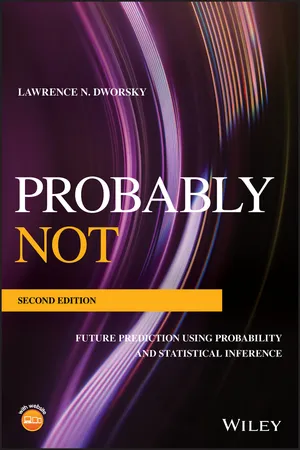
Table of contents

  1. Cover
  2. Table of Contents
  3. Acknowledgments
  4. About the Companion Website
  5. Introduction
  6. 1 An Introduction to Probability
  7. 2 Probability Distribution Functionsand Some Math Basics
  8. 3 Building a Bell
  9. 4 Random Walks
  10. 5 Life Insurance
  11. 6 The Binomial Theorem
  12. 7 Pseudorandom Numbers and Monte Carlo Simulations
  13. 8 Some Gambling Games in Detail
  14. 9 Scheduling and Waiting
  15. 10 Combined and Conditional Probabilities
  16. 11 Bayesian Statistics
  17. 12 Estimation Problems
  18. 13 Two Paradoxes
  19. 14 Benford's Law
  20. 15 Networks, Infectious Diseases, and Chain Letters
  21. 16 Introduction to Frequentist Statistical Inference
  22. 17 Statistical Mechanics and Thermodynamics
  23. 18 Chaos and Quanta
  24. Appendix
  25. Index
  26. End User License Agreement