![]()
HABIT 1: CONNECT
MANAGING ATTENTION
Give People What They Want and Value So They’ll Tune In
10 SIGNS
YOU MAY BE A WEAK CONNECTOR
Do You Do This?
1 You have trouble getting people to listen to you, pay attention to your ideas, or return phone calls or e-mails.
ISSUE: CONNECTING ESSENTIALS
FIND HELP: page 11
2 You’re impatient, easily distracted, or often multitask while communicating.
ISSUE: STAY IN THEIR MOMENT—STAY RIGHT HERE, RIGHT NOW
FIND HELP: page 19
3 You don’t listen well, interrupt frequently, dominate discussions, or start most conversations with what matters most to you.
ISSUE: STAY IN THEIR MOMENT—LISTEN FOR INTENT
FIND HELP: page 21
Are You a Weak Connector?
4 You’re preoccupied with how others may be judging you.
ISSUE: STAY IN THEIR MOMENT—AVOID CODE RED FIND HELP: page 23
5 You frequently ramble, take too long to get to the point, or have been told that you’re dull or boring.
ISSUE: FRONTLOAD—NAIL THE BIG IDEA
FIND HELP: page 31
6 You automatically use the same method of communication to reach everyone—the method that you prefer.
ISSUE: FRONTLOAD—CHOOSE THEIR PREFERRED METHOD OF COMMUNICATION (PMOC)
FIND HELP: page 34
7 You’re not good at reading people’s body language, or you have trouble reading between the lines of what they say.
ISSUE: FRONTLOAD—DEFUSE DEFENSIVENESS
FIND HELP: page 37
8 You’re often judgmental or critical of others in public.
ISSUE: GOLDILOCKS CANDOR—DON’T DEMORALIZE
FIND HELP: page 47
9 You sugarcoat, sidestep, or hold back to avoid conflict or criticism.
ISSUE: GOLDILOCKS CANDOR—DON’T SUGARCOAT
FIND HELP: page 49
10 People don’t share honest, timely feedback with you.
ISSUE: GOLDILOCKS CANDOR—CREATE A CANDID CULTURE
FIND HELP: page 50
![]()
1
Why Connect?
Attention Management
Does this sound familiar? You’re sharing an idea in a meeting when a sinking feeling washes over you that no one is paying attention. A quick scan of the room confirms it. Some people are distractedly thumbing BlackBerry devices under the table. Others have dashed out to take phone calls. Still others are fidgeting with text messages. The few who are not ignoring you are so impatient that they cut you off and talk over you.
That’s what happened to David, an emerging leader at a global consumer product company. It was happening in everyday conversations, but it really upset him when it occurred during a presentation.
David was puzzled, thinking what went wrong? He’d spent endless hours preparing for his big moment—gathering information, confirming facts, and painstakingly creating dozens of difficult slides. He had immersed himself in preparation.
Yet, when he stood in front of his audience to deliver the message, he lost them at hello.
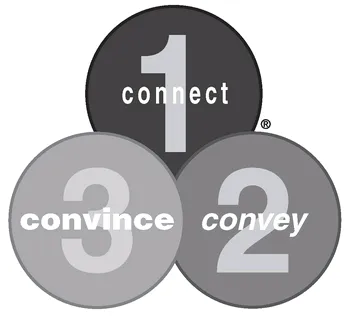
David experienced the most common communication breakdown facing business professionals today: he failed to connect. He didn’t manage his audience’s attention. As a result, he had no chance to convey his message so they’d clearly understand it, or convince others to make decisions and take action.
Chances are this has happened to you today, in a conversation, a phone call that wasn’t returned, or even an ignored e-mail. In this chapter, you’ll discover the first step for communicating at your highest performance level in a distracted, attention-deficit world. You’ll learn how to capture people’s hearts and minds so you don’t lose their attention or drive them to distraction.
Have you noticed that some people are natural connectors? They seem to attract attention like magnets. Why? The world’s top communicators make connecting a habit.
The difference between the masters and the rest of us is that they’ve learned to make connecting automatic—they do it every time, with every person. They make engaging people and managing their attention a priority.
Perhaps you have the gift—this power to draw attention. If not, don’t worry. Connecting is a learnable skill. It’s not like singing ability. You can learn to be an A-list connector even if you’ve spent your whole life skipping this step and ending up ignored or tuned out.
Connecting is the ability to engage and manage people’s attention in today’s busy world. It’s changed profoundly. It’s no longer enough to make contact. Now you must give people what they want and value in order to earn their attention, or they’ll tune you out. Connecting used to be a “nice to have” competence, but it’s now a make-or-break skill. That’s because there’s been a monumental power shift in communication. The listeners now hold the power. It’s as if they hold the remote control and you’re just one of many TV channels. They have options, so if you want to be Must-See TV, you must connect smartly.
Today’s Make-or-Break Skill
The people you’re communicating with can zap you at any moment with their internal remotes, lured away by more appealing distractions such as e-mail, text messages, cell phone calls, or Web surfing. People have become so impatient in our fast-faster-fastest world that they don’t even wait for you to finish a sentence—they cut you off and talk right over you.
Our attention-deficit world also encourages people to disconnect from in-person conversations:
• Have you ever been talking with someone when their cell phone rings and they choose to answer it and leave you hanging?
• Has the person in the next cubicle ever shot you an e-mail instead of walking over to talk to you?
• Are people keeping you at arm’s length with e-mail and text messages instead of returning calls or talking face-to-face?
Blame the lure of instant gratification. Think about it: we’re now conditioned to get what we want, pronto. For example, there’s GPS, speed dating, instant messaging, quick weight loss surgery, spray tans, ten-minute whitening strips—the list is endless. You don’t even have to pay professional dues anymore, with shortcut shows like American Idol around to catapult you to the top. We’ve become a shortcut society.
That means you have to win people over in a hurry as attention spans shrink. It’s vital to connect with people on their terms. So how do you do this? Simple: Give people what they want and value right up front. That’s my definition of smart connecting: Give people what they want and value so you keep their attention.
Biggest Blunders: Self-Absorption and Aimless Schmoozing
Think of a time when you failed to engage someone. Why did you fail to connect? There are countless reasons. Among them, perhaps you:
• Took too long to get to the point
• Chose the wrong method
• Didn’t focus on the person
• Failed to grasp their true resistance
• Misjudged what they wanted or valued
• Lost your head and came across badly
• Sugarcoated a subject or demoralized someone
• Weren’t specific enough
• Used a one-size-fits-all approach
All of these scenarios cause tune-out in today’s short-attention-span, self-absorbed society. What’s the solution? Give people what they want and value, quickly. If you simply zero in on what matters most to your audience, they’ll reward you by paying attention. Like Tom Cruise in the movie Jerry Maguire, you’ll have them at hello.
Now that you realize connecting is critical in our instant-gratification society, it’s time to start putting this attention-grabbing rule to work so you can advance toward conveying important information and convincing people to act. The first section of the book will focus on smart connecting strategies and techniques that you can start using today to manage the attention of your audience, enabling you to perform at your highest level and make your ratings soar.
![]()
2
Stay in Their Moment
Be Fully Present
Staying in their moment means fully focusing on the needs of the people with whom you’re communicating. It means first managing your own attention in order to win other people’s interest. This triggers a positive gut reaction that engages people and keeps their attention focused on you and your message. Use this strategy and you’ll attract, not distract.
Fully Focus on Their Needs
Linda, an up-and-coming corporate executive, learned to stay in their moment after her self-absorption led to disastrous results. It happened at 7:30 on a Monday morning. As Linda was checking e-mail and reviewing her schedule of wall-to-wall meetings, her phone rang. It was the CEO of another organization. “I’ve heard great things about you and I’d like to explore having you join our leadership team,” he said. However, as the conversation unfolded, the CEO didn’t like what he was hearing.
Linda came across as distracted and rushed. She interrupted him and talked over him. The CEO got the impression that Linda was self-absorbed and too unfocused to be an effective leader on his executive team. He quickly crossed her name off his short list of prospects.
Linda learned her lesson. What specifically did she change about her communication approach in order to stay in the moment? She stopped reading e-mail when she was on the telephone and disciplined herself to focus on the conversation at hand.
John, a sales executive at a large consumer goods company, saved his biggest account by staying in their moment. In a meeting with a longtime c...