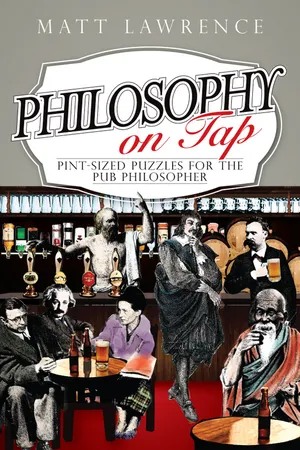
- Features a unique presentation of philosophical puzzles, paradoxes, and debates by considering 48 of life's biggest questions in the context of 48 distinctive beers from around the world
- Provides a highly engaging and sociable approach to the classic philosophical problems as well as a unique look at the conundrums that directly affect the beer drinker
- Combines a philosopher's insights with thematic humor and trivia to explore issues such as free will, God's existence, the nature of the soul, time travel, the aesthetics of taste, the role of beer in the good life, and the infamous "beer goggles" paradox
- For beer drinkers who enjoy philosophy, philosophers who enjoy beer, and anyone who has ever pondered the meaning of life over a pint of ale
- English
- ePUB (mobile friendly)
- Available on iOS & Android
eBook - ePub
About this book
When beer starts to flow, philosophical discussions naturally follow. Philosophy on Tap takes pub philosophy to the next level, pairing 48 of life's greatest philosophical questions with 48 of the world's best beers.
Information
Chapter 1
Transporter Troubles
Shall we beam up another round?
Pint of the Puzzle: Guinness Extra Stout
Incredibly dark and rich, with hints of smokiness and coffee, Guinness Extra Stout is a perennial favorite among pub philosophers. In fact, a 2057 AD Gallup Poll will show that philosophers tend to beam up a pint of Guinness Extra Stout more frequently than any other beer.
If you have ever seen the classic television show Star Trek, you are surely familiar with Captain Kirk's famous line, “Beam me up, Scotty.” As the Chief Engineer aboard the Starship Enterprise, Mr Scott would use the ship's transporter to make crew members disappear in one location and reappear in another. Since Star Trek's debut in 1966, “teleportation” has become a staple of science fiction films.
Although teleportation is strictly science fiction today, it may one day become possible – perhaps in our lifetimes. If so, would you use this technology? Of course it sounds great. Who wouldn't want to have a fresh Guinness Stout transported straight to their easy chair from the St. James Gate Brewery in Dublin, Ireland? Or, better yet, why not transport yourself over to Dublin to take the brewery tour? (FYI: Everyone who takes the tour gets a complimentary pint of Guinness at its conclusion.) Well, before “beaming” yourself across the globe, perhaps you should first consider how these teleportation devices might work.
According to Star Trek: Next Generation Technical Manual, the Star Trek's transporter works by scanning and recording the state of all of the subatomic particles within your body. The scan destroys the atomic bonds that hold the particles together and then sends the particles to your chosen location by way of a subatomically de-bonded matter stream. Upon arrival, your subatomic particles are reassembled using the atomic blueprint that was recorded by the scan. Suppose that 20 years from now a transporter is invented using this type of process. Thousands of people have now tried it out and there have never been any injuries. Everyone who has been transported agrees that they look and feel totally normal when they reach their destination. Would you give it a try? One possible reason for hesitation is the fact that the transporter is going to KILL YOU! By tearing apart all your subatomic particles, the transporter will quite literally blow you to bits. On the upside, of course, it will put you back together again, as good as new. Death and resurrection all within a few microseconds.
There are some other ways in which a transporter might work. Suppose that instead of sending your subatomic particles to your chosen destination, the transporter simply destroys them. What it sends is just the recorded scan of your atomic blueprint. Then, at your destination, the transporter reassembles your body using all new subatomic particles. In this case, you awaken at your destination with a completely new body – although it will look and feel exactly like your old one.
Consider one more possibility inspired by the Oxford philosopher Derek Parfit. Suppose that you are beaming from Los Angeles to Dublin. You've used transporters many times before, so you're not the least bit nervous. You step onto the pad and give the engineer the “ready” signal. You watch as she flips the switch and the blue light of the scanner moves down your body. You expect the usual “flicker” of unconsciousness before finding yourself in Dublin's St. James Gate Brewery Transport Center, but it never happens.
You look at your engineer inquisitively, and she says “Okay, you're all set. Please step off the pad and down the stairs on your left.”
Puzzled, you reply, “But I'm supposed to be in Dublin – this is LA!”
“Oh, but you are in Dublin,” she says. “Just look at the monitor.”
To your amazement, you look up at the monitor and see yourself in the St. James Gate Brewery Transport Center stepping off the “arrivals” platform. The engineer explains: “You must not have known that this is the new ST101 Transporting System. As with many of the older systems, we send only your body scan to your chosen destination. In Dublin you were reassembled using entirely new particles. Of course, things went perfectly, and you are feeling quite yourself in Dublin.” See, look again at the monitor. You're lining up for the Guinness tour.
“Yes, but I'm still here,” you protest.
“That's the difference with the ST101,” she continues. “While some of the older machines would destroy your body right here in order to use its atomic energy to deliver your body scan at light speed, the ST101 doesn't require that much energy. So instead, what I need you to do is to follow the yellow line to the elevator. Once inside, the red button will take you down to the power-plant level. When the door opens, your body will be instantly obliterated for you. Sorry about the extra wait, but this will allow us to use your atomic energy for Los Angeles's ever-increasing energy needs.”
Slowly you walk to the elevator. Inside there is only one button, the red one. You know that by pushing it you will be delivered to your death. You know that the obliteration will be painless, and try to take comfort in the fact that your “new self” is already in Dublin soaking up the sights and sounds of the Guinness Storehouse. Nevertheless, it seems pretty obvious that “you” are still here, and are about to die.
Will you push the red button?
What do you think?
- The ST101 requires you to walk voluntarily to your own death, but isn't that true of the first two examples as well? Is the ST101 any “worse” than the other methods of teleportation?
- Would you push the red button?
- If you were to push the red button, would that be your death? Suppose that your friends were waiting for you in Dublin. What would they think?
- If your body is reassembled using all new particles, is that body still “yours?”
- Do you have a soul? If so, how is it related to your body? Would your soul travel to Dublin, or would it be “reborn” there? Or, would only some kind of mindless zombie arrive at the Guinness Storehouse?
Did you know?
- In June 2002 a team of scientists at the Australian National University successfully teleported the photons of a laser beam. Using a process called quantum entanglement, the team effectively teleported a radio signal contained in the laser beam from its location to a location one meter away. While this was the teleportation of photons, as of yet no one has been able to teleport a material object.
- David Page Mitchell's 1877 story “The Man Without A Body” may be the earliest use of the concept of teleportation in science fiction. His story told of a scientist who discovered a way to disassemble a cat's atoms, transmit them over a telegraph wire, and then reassemble them at a new location. When the scientist tried transporting himself, however, the telegraph's battery died when only his head had been transmitted.
- The Bible tells a story of what might be called the “miraculous teleportation” of Philip from Gaza to Azotus. In Acts 8:36–40 we find the following: “Then both Philip and the eunuch went down into the water and Philip baptized him. When they came up out of the water, the Spirit of the Lord suddenly took Philip away, and the eunuch did not see him again, but went on his way rejoicing. Philip, however, appeared at Azotus and traveled about, preaching the gospel in all the towns until he reached Caesarea.”
- The Guinness Storehouse is located inside the St. James Gate Brewery, and its architecture is that of a giant pint glass. It has seven floors, the top of which is The Gravity Bar. (This is where you pick up your complimentary Guinness at the end of the tour.) If filled, this giant pint glass would hold 14.3 million pints of Guinness.
- Guinness Extra Stout can be used to make great cocktails. The classic Guinness cocktail is half champagne and half Guinness Extra Stout, served in a flute glass.
Recommended reading
- Derek Parfit, Reasons and Persons (Oxford: Clarendon Press, 1984).
- Richard Hanley, The Metaphysics of Star Trek (New York: Basic Books, 1997).
Chapter 2
Zeno's Hand to Mouth Paradox
How does the glass ever reach your mouth?
Pint of the Puzzle: Weihenstephan Original Lager
Since Zeno's Paradox is the oldest puzzle of the book from the Western philosophical tradition, it seems fitting to pair it up with a beer from the oldest brewery in the Western world. The Weihenstephan Brewery of Bavaria was founded in 1040 AD, making it not only the oldest brewery in the West, but the oldest on the planet. Original Lager is one of their classic recipes. It is clear, sparkling, and (thankfully) fresh. With a mild malt presence and light bitterness, it is the sort of beer that makes you want another – if you ever get the first up to your lips.
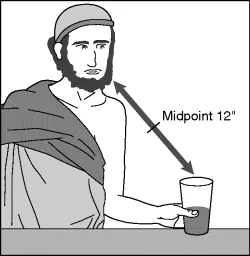
Before you take a sip of this historic brew, think about this. In order to take that sip, the pint must first be hoisted up to your lips. Suppose that this distance is a mere 12 inches. That should be simple enough. But notice that before it gets to your lips, your pint must pass through the halfway point between its resting spot on the bar or table and your mouth.
But once it reaches that halfway point, there is another halfway point between it and your lips. You cannot drink your beer until the pint passes through that point also.
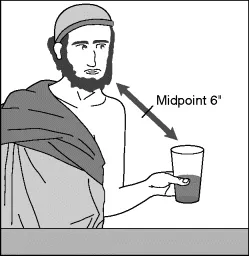
And, once the pint reaches that halfway point, it must pass through another halfway point between that former point and your lips. And, once it arrives there it must pass through another halfway point, and so on.
The problem, you now realize, is that in order to drink this pint, you are going to need to lift it through an infinite number of halfway points (since any distance can always be divided in half). And since it is impossible to pass through an infinite number of points in a finite amount of time, you will never get to taste this beer!
The Ancient Greek philosopher Zeno of Elea came up with this paradox (sometimes called the paradox of bisection) in the fifth century BC. Now, I know what you are thinking. Something has got to be wrong here. We know for a fact that the pint does reach your lips. In fact, I expect you have already proven that Zeno is wrong. (Refutation tastes pretty good, don't you think?) But Zeno would be unimpressed by the fact that you are currently sipping your beer. He thought that since reason shows us that the pint cannot reach your lips in a finite time (much less in a few seconds) our senses must deceive us. In a showdown between reason and the senses, he believed that we ought to choose reason. Zeno's conclusion: motion is impossible – no one ever drinks anything!
As you sit there drinking in the clean hop bitterness and light malty sweetness of your Original Lager, I expect that you believe that reason is on your side. But can you articulate those reasons? If Zeno is mistaken, where did he go wrong?
If you need a little help, here are a couple of ideas that you might do well to consider. First, must the beer really move through an infinite number of points in a finite amount of time? After all, can't we do the same sort of bisection concerning time? The two seconds that you took lifting the glass to your mouth can be divided at its midpoint, as can the next half of the journey, and the next, and so on. So we are left to suppose that while your pint passed through an infinite number of spatial points, it had an infinite number of temporal points in which to do so. No hurries – no worries. This reply may still leave us a bit uncomfortable (and Zeno smiling in his grave), because we are left wondering how the pint moved through infinite points (special or temporal) in on...
Table of contents
- Cover
- Title Page
- Copyright
- Dedication
- Preface
- Personal Acknowledgments
- Acknowledgements
- Chapter 1: Transporter Troubles
- Chapter 2: Zeno's Hand to Mouth Paradox
- Chapter 3: If a Pint Spills in the Forest…
- Chapter 4: The Beer Goggles Paradox
- Chapter 5: Pascal's Wager
- Chapter 6: The Experience Machine
- Chapter 7: Lucretius' Spear
- Chapter 8: The Omnipotence Dilemma
- Chapter 9: What Mary Didn't Know About Lager
- Chapter 10: Malcolm X and the Whites Only Bar
- Chapter 11: Untangling Taste
- Chapter 12: The Foreknowledge Paradox
- Chapter 13: The Buddha's Missing Self
- Chapter 14: The Blind Men and the Black and Tan
- Chapter 15: Liar's Paradox
- Chapter 16: Paley's Cask
- Chapter 17: Chuang Tzu's Butterfly
- Chapter 18: Descartes' Doubt
- Chapter 19: God's Command
- Chapter 20: Mill's Drunkard
- Chapter 21: The Myth of Gyges
- Chapter 22: Laplace's Superscientist
- Chapter 23: Gaunilo's Perfect Ale
- Chapter 24: The Problem of Moral Truth
- Chapter 25: How to Sew on a Soul
- Chapter 26: Plato's Forms
- Chapter 27: Realizing Nirvana
- Chapter 28: The Problem of Evil
- Chapter 29: Time's Conundrum
- Chapter 30: Time Travel Paradoxes
- Chapter 31: Hitler's Hefeweizen
- Chapter 32: The Zen Koan
- Chapter 33: Sex and Sensibility
- Chapter 34: Socrates' Virtue
- Chapter 35: Nature Calls
- Chapter 36: Nietzsche's Eternal Recurrence
- Chapter 37: The Most Interesting Man and the Firing Line
- Chapter 38: Turing's Tasting Machine
- Chapter 39: Singer's Pond
- Chapter 40: The Wisest One of All
- Chapter 41: Enter the Matrix
- Chapter 42: A Case of Bad Faith
- Chapter 43: Cask and Cleaver
- Chapter 44: Flirting with Disaster
- Chapter 45: Fear of Zombies
- Chapter 46: Lao Tzu's Empty Mug
- Chapter 47: Beer and the Meaning of Life
- Chapter 48: The Case for Temperance
- Notes
- Glossary of Beer and Philosophical Terms
Trusted by 375,005 students
Access to over 1.5 million titles for a fair monthly price.
Study more efficiently using our study tools.
Frequently asked questions
Yes, you can cancel anytime from the Subscription tab in your account settings on the Perlego website. Your subscription will stay active until the end of your current billing period. Learn how to cancel your subscription
No, books cannot be downloaded as external files, such as PDFs, for use outside of Perlego. However, you can download books within the Perlego app for offline reading on mobile or tablet. Learn how to download books offline
Perlego offers two plans: Essential and Complete
- Essential is ideal for learners and professionals who enjoy exploring a wide range of subjects. Access the Essential Library with 800,000+ trusted titles and best-sellers across business, personal growth, and the humanities. Includes unlimited reading time and Standard Read Aloud voice.
- Complete: Perfect for advanced learners and researchers needing full, unrestricted access. Unlock 1.5M+ books across hundreds of subjects, including academic and specialized titles. The Complete Plan also includes advanced features like Premium Read Aloud and Research Assistant.
We are an online textbook subscription service, where you can get access to an entire online library for less than the price of a single book per month. With over 1.5 million books across 990+ topics, we’ve got you covered! Learn about our mission
Look out for the read-aloud symbol on your next book to see if you can listen to it. The read-aloud tool reads text aloud for you, highlighting the text as it is being read. You can pause it, speed it up and slow it down. Learn more about Read Aloud
Yes! You can use the Perlego app on both iOS and Android devices to read anytime, anywhere — even offline. Perfect for commutes or when you’re on the go.
Please note we cannot support devices running on iOS 13 and Android 7 or earlier. Learn more about using the app
Please note we cannot support devices running on iOS 13 and Android 7 or earlier. Learn more about using the app
Yes, you can access Philosophy on Tap by Matt Lawrence in PDF and/or ePUB format, as well as other popular books in Philosophy & Philosophy History & Theory. We have over 1.5 million books available in our catalogue for you to explore.