This book brings together the literature of urban sociology and film studies to explore new analytical and theoretical approaches to the relationship between cinema and the city, and to show how these impact on the realities of life in urban societies.
eBook - ePub
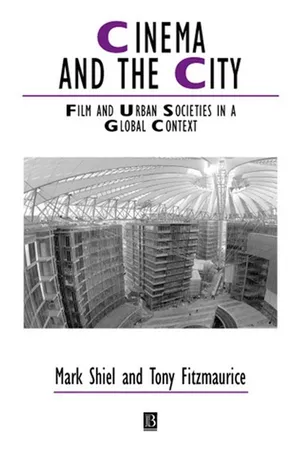
Cinema and the City
Film and Urban Societies in a Global Context
- English
- ePUB (mobile friendly)
- Available on iOS & Android
eBook - ePub
Cinema and the City
Film and Urban Societies in a Global Context
About this book
Information
1
Cinema and the City in History and Theory
A whole history remains to be written of spaces – which would at the same time be the history of powers – from the great strategies of geopolitics to the little tactics of the habitat.
Michel Foucault, “The Eye of Power”1
Cinema and the City
This book is concerned with the relationship between the most important cultural form – cinema – and the most important form of social organization – the city – in the twentieth century (and, for the time being at least, the twenty-first century), as this relationship operates and is experienced in society as a lived social reality.
Since the end of the nineteenth century, the fortunes of cinema and the city have been inextricably linked on a number of levels. Thematically, the cinema has, since its inception, been constantly fascinated with the representation of the distinctive spaces, lifestyles, and human conditions of the city from the Lumière brothers’ Paris of 1895 to John Woo’s Hong Kong of 1995. Formally, the cinema has long had a striking and distinctive ability to capture and express the spatial complexity, diversity, and social dynamism of the city through mise-en-scène, location filming, lighting, cinematography, and editing, while thinkers from Walter Benjamin – confronted by the shocking novelties of modernity, mass society, manufacture, and mechanical reproduction – to Jean Baudrillard – mesmerized by the ominous glamour of postmodernity, individualism, consumption, and electronic reproduction have recognized and observed the curious and telling correlation between the mobility and visual and aural sensations of the city and the mobility and visual and aural sensations of the cinema. Industrially, cinema has long played an important role in the cultural economies of cities all over the world in the production, distribution, and exhibition of motion pictures, and in the cultural geographies of certain cities particularly marked by cinema (from Los Angeles to Paris to Bombay) whose built environment and civic identity are both significantly constituted by film industry and films.2
The nexus cinema–city, then, provides a rich avenue for investigation and discussion of key issues which ought to be of common interest in the study of society (in this case, the city) and in the study of culture (in this case, the cinema) and in the study of their thematic, formal, and industrial relationship historically and today. Indeed, interest in their relationship has been growing significantly of late – particularly with regard to the thematic and formal representation of the city – in the fields of Film Studies, Cultural Studies, and Architecture.3 The central innovative aim of this book is to contribute to the study of the cinema and to the study of society by focusing on the relationship between cinema and the city as lived social realities in a range of urban societies of the present and recent past.
Film Studies and Sociology
One of the fundamental premises of this book is that interdisciplinary contact between Film Studies and Sociology (among other disciplines, including Cultural Studies, Geography, and Urban Studies) can be profoundly useful and fruitful in addressing key issues which the two disciplines share (or ought to share) in common at the beginning of the twenty-first century, and which have either emerged in recent years or which have become especially acute in the contemporary cultural and social context.
These include: the perennial issue of the relationship between culture and society, particularly in what is now commonly referred to as the current global postmodern social, and cultural context; the operation of political, social, and cultural power in the urban centers of the present global system; the historical description (“periodization”) of social and cultural change through such categories as “industrialism,” “post-industrialism,” “modernity” and “postmodernity”; and, as a route to the better understanding of these issues, the concept of spatialization as a means of description and analysis in the study of both culture and society, cinema and the city, today.
As Andrew Tudor and other commentators have pointed out, there has been a paucity of positive contact between the disciplines of Film Studies and Sociology.4 On the whole, their relationship has been a historically unhappy one, most sociological interest in cinema since the early days of the medium having taken either one of two related forms. One area of sociological interest in cinema has, since the 1920s, focused in a limited and undiscriminating way on “the measurable effects of film” on particular groups in society typically, young people – and almost always with the conviction that those effects were bad – as, for example, in the case of the age-old debate over links between cinema and crime, youth delinquency, or violence. Since the 1940s, a second area, particularly informed by the cultural elitism and instrumentalism of the Frankfurt School, has emphasized the status of cinema as just another form of mass communications exercising control in a mass society of unintelligent and unindividuated consumers (a view, of Hollywood cinema at least, which has certainly had many adherents in Film Studies too). Both sociological approaches to cinema have been guilty of mechanical and deterministic thinking which has generated little common ground with the central interests of Film Studies since its inception in the 1960s.
The larger part of Film Studies over the years has concerned itself primarily with the language of cinema and with various approaches to cinema as a powerful signifying system which have focused on the individual, the subject, identity, representation – for the most part, with the reflection of society in films – with a strong faith in theory and an almost complete distrust of empiricism. Film Studies has been primarily interested in the film as text (comprising visual language, verbal systems, dialogue, characterization, narrative, and “story”) and with the exegesis of the text according to one or other hermeneutic (for example, psychoanalysis, Marxism, myth-criticism, semiotics, formalism, or some combination thereof).5 Such issues have dominated largely as a result of the discipline’s origins in (and continuing close relationship with) literary studies, while newer subjects such as Media Studies and Communications have been better at developing sociological approaches (for example, to television) precisely because of their origins, in large part, within Sociology, at a “safe distance” from close concern with the text.6
One of the aims of this book is to recognize this history by proposing something of a challenge to Film Studies and Sociology to work to produce a sociology of the cinema in the sense of a sociology of motion picture production, distribution, exhibition, and consumption, with a specific focus on the role of cinema in the physical, social, cultural, and economic development of cities.7
This interdisciplinary challenge makes two interdependent propositions. First, it proposes that Sociology has much to gain by building upon its traditional interests in capital, economy, labor, demographics, and other issues by incorporating a greater interest in “culture,” “cinema,” and “films” through an investigation of their impact upon urban development, on the one hand, and their informative and influential allegorizing of objective social realities, on the other. Secondly, it proposes that Film Studies has much to gain by building upon its traditional interests in representation, subjectivity, and the text by working harder to develop a synthetic understanding of the objective social conditions of the production, distribution, exhibition, and reception of cinema and the mediated production of urban space and urban identity.
This book and the individual contributions in it, it is hoped, make steps in the direction of such a sociology of the cinema, outlining what such a sociology might look like, and what kind of practical and diverse forms it might take.
Culture and Society
This bringing together of Film Studies and Sociology, then, underpins the aim of this book to examine the relationship between cinema and urban societies and, in doing so, to work against the alienation of the study of culture from the study of society which was traditionally explained through the old opposition of “base” (society, wealth, poverty, work, class, race, income, housing) and “superstructure” (culture, text, image, sign), and which fostered little more than mechanistic understandings of the relationship between the two.
The best antidote to the base-superstructure model, as Fredric Jameson has explained, is that of Althusserian structuralism in which base and superstructure are replaced by “structure” and in which mechanistic notions of causality give way to the concept of “over-determination.”8 This formulation of the relationship between culture and society, which has informed the editorial logic of the book, recognizes the interpenetration of culture, society, and economics as part of “a whole and connected social material process,” to use Raymond Williams’s terminology.9 It allows (even requires) a conception of cultural production as simultaneously different from and yet similar to other forms of (industrial) production in a manner which is particularly appropriate to cinema, more particularly to Hollywood cinema, and most particularly to Hollywood cinema in the contemporary global economy. It opens the way for interdisciplinary investigation and communication as natural and indispensable, tending to undermine intellectual compartmentalization and fostering a view of culture as “a whole way of life.”10 Finally, it undermines the reifying tendency to speak of cinema simply in terms of the text and its reflection of urban and social change “on the ground,” and fosters instead an understanding of cinema (as a set of practices and activities, as well as a set of texts) as something which never ceases to intervene in society, and which participates in the maintenance, mutation, and subversion of systems of power. Althusserian structuralism identifies the cooperation of Film Studies and Sociology not as a mere academic experiment or interdisciplinary trifle, but as a natural and proper pooling of resources in the name of a synthetic and rounded understanding of culture and society as culture and society can only be properly understood – in their relation to each other.
Space and Spatiality
If a significant and stubborn discrepancy between the study of culture and the study of society often remains in evidence today, one crucial and positive area which the two have increasingly held in common in recent years is what has become known as the “spatial turn” in social and cultural theory on the Left (broadly defined) since the 1970s which has involved a growing recognition of the usefulness of space as an organizing category, and of the concept of “spatialization” as a term for the analysis and description of modern, and (even more so) of postmodern, society and culture. This spatial turn has been driven by a wide range of critical thinking from the work of Henri Lefebvre (The Production of Space, 1974), Michel Foucault (Discipline and Punish, 1977), and Ernest Mandel (Late Capitalism, 1975) in the 1960s and 1970s to the work of Marshall Berman (All That Is Solid Melts Into Air, 1982), David Harvey (The Condition of Postmodernity, 1989), Fredric Jameson (Postmodernism, or, the Cultural Logic of Late Capitalism, 1991), Edward Soja (Postmodern Geographies, 1989), and Mike Davis (City of Quartz: Excavating the Future in Los Angeles, 1990) in the 1980s and 1990s.11
On the one hand, in the social sciences, this spatial turn has helped us to understand, as Edward Soja has explained, “how relations of power and discipline are inscribed into the apparently innocent spatiality of social life, how human geographies become filled with politics and ideology.”12 On the other hand, in the study of culture, it has helped us to understand how power and discipline are spatially inscribed into cultural texts and into the spatial organization of cultural production – as, for example, through what Jameson has described as the “geopolitical aesthetic” of contemporary world cinema.13
One of the key presuppositions of this book is that the increasing prominence given to space and spatialization in the recent study of culture and society has been a profoundly important development and that cinema is the ideal cultural form through which to examine spatialization precisely because of cinema’s status as a peculiarly spatial form of culture.
Cinema is a peculiarly spatial form of culture, of course, because (of all cultural forms) cinema operates and is best understood in terms of the organization of space: both space in films – the space of the shot; the space of the narrative setting; the geographical relationship of various settings in sequence in a film; the mapping of a lived environment on film; and films in space – the shaping of lived urban spaces by cinema as a cultural practice; the spatial organization of its industry at the levels of production, distribution, and exhibition; the role of cinema in globalization. Thus, one of the major contentions of this book is that cinema is primarily a spatial system and that, notwithstanding the traditional textual emphasis of much Film Studies, it is more a spatial system than a textual system: that spatiality is what makes it different and, in this context, gives it a special potential to illuminate the lived spaces of the city and urban societies, allowing for a full synthetic understanding of cinematic theme, form, and industry in the context of global capitalism.
Geographical Description and Uneven Development
On this basis, the analysis of the relationship between cinema and urban societies in this book in a comprehensive range of global contexts, and with an emphasis on cinema as a social and material practice, may be seen as an exercise in what Jameson, with reference to the peculiar spatial character of cinema, has termed “cognitive mapping” – that is, the attempt to “think” a system (today, postmodern global capitalism) which evades thought and analysis. The book aims to map culture as a lived social reality which enacts and articulates relations of power, as these are evident in core-periphery relations both within cities and in the current global system between the cities and the cinemas of Los Angeles, of former European colonies, and of former European colonial powers.14
The emphasis throughout the book is on international diversity, and a conceptual organization which attempts to map out different relations of power in the geopolitical system in terms of dominance, subordination, mediation, and resistance, and their articulation in cinema and its political economy. This geographical diversity encompasses many types of city and urban society, whether these are classified according to Saskia Sassen’s typology of “global,” “transnational,” and “subnational” cities or according to Mike Savage and Alan Warde’s classification of “global cities,” “Third World cities,” “older industrial cities,” and “new industrial districts.”15 It also encompasses many types of cinema, including the dominant commercial forms of Hollywood, the European co-production, IMAX, documentary, and lowbudget video in West Africa. As such, the book’s large geographical spread attempting to keep equally in focus at all times the local, regional, and global levels, or micro- and macro-perspectives – serves to highlight the important realities of “uneven development” between various urban societies and various cinemas historically and in the present day, realities which are foregrounded both through the various representations of objective urban social and economic conditions discussed in relation to particular films and cities in the book, and in terms of the uneven development of particular national or metropolitan film industries vis-à-vis the global dominance and technological and financial superiority of Hollywood cinema.16
This description of urban society and of cinema globally in terms of a relationship between cities (and cities alone) corroborates the view held by large numbers of social commentators today that the city – more so than the “nation,” perhaps less so than the “transnational corporation” – is the fundamental unit of the new global system which has emerged since the 1960s, of which the mobility of capital and information is the most celebrated feature.17 Thus the book presents a global portrait of a network of semi-autonomous cities and megacities, many of which (just as Sassen said they would) relate primarily to other cities in the network rather than to the particular national or regional space in which they are physically located.18
The positioning of Los Angeles at the beginning of the book, then, endorses the characterization of that city (and its larger metropolitan region) by many social commentators as the paradigmatic city space, urban society, and cultural environment of the late twentieth and twenty-first centuries – “the place where it all comes together,” as Edward Soja has described it, “a World City, a major nodal point in the ebb and flow of the new global economy” and, almost needless to say, the home of the massively, globally dominant Hollywood cinema and larger US entertainment industry.19 But this notional positioning of Los Angeles as some kind of global core to which the rest of the world can be viewed as periphery must ...
Table of contents
- Cover
- Series
- Title
- Copyright
- Dedication
- List of Illustrations
- Illustrations Acknowledgments
- List of Contributors
- Series Editors’ Preface
- Preface
- 1: Cinema and the City in History and Theory
- 2: Film and Urban Societies in a Global Context
- Part 1: Postmodern Mediations of the City: Los Angeles
- Part 2: Urban Identities, Production, and Exhibition
- Part 3: Cinema and the Postcolonial Metropolis
- Part 4: Urban Reactions on Screen
- Index
Trusted by 375,005 students
Access to over 1.5 million titles for a fair monthly price.
Study more efficiently using our study tools.
Frequently asked questions
Yes, you can cancel anytime from the Subscription tab in your account settings on the Perlego website. Your subscription will stay active until the end of your current billing period. Learn how to cancel your subscription
No, books cannot be downloaded as external files, such as PDFs, for use outside of Perlego. However, you can download books within the Perlego app for offline reading on mobile or tablet. Learn how to download books offline
Perlego offers two plans: Essential and Complete
- Essential is ideal for learners and professionals who enjoy exploring a wide range of subjects. Access the Essential Library with 800,000+ trusted titles and best-sellers across business, personal growth, and the humanities. Includes unlimited reading time and Standard Read Aloud voice.
- Complete: Perfect for advanced learners and researchers needing full, unrestricted access. Unlock 1.5M+ books across hundreds of subjects, including academic and specialized titles. The Complete Plan also includes advanced features like Premium Read Aloud and Research Assistant.
We are an online textbook subscription service, where you can get access to an entire online library for less than the price of a single book per month. With over 1.5 million books across 990+ topics, we’ve got you covered! Learn about our mission
Look out for the read-aloud symbol on your next book to see if you can listen to it. The read-aloud tool reads text aloud for you, highlighting the text as it is being read. You can pause it, speed it up and slow it down. Learn more about Read Aloud
Yes! You can use the Perlego app on both iOS and Android devices to read anytime, anywhere — even offline. Perfect for commutes or when you’re on the go.
Please note we cannot support devices running on iOS 13 and Android 7 or earlier. Learn more about using the app
Please note we cannot support devices running on iOS 13 and Android 7 or earlier. Learn more about using the app
Yes, you can access Cinema and the City by Mark Shiel, Tony Fitzmaurice, Mark Shiel,Tony Fitzmaurice in PDF and/or ePUB format, as well as other popular books in Social Sciences & Urban Sociology. We have over 1.5 million books available in our catalogue for you to explore.