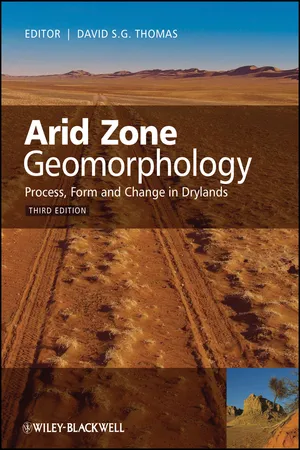
The new edition of Arid Zone Geomorphology aims to encapsulate the advances that have been made in recent years in the investigation and explanation of landforms and geomorphological processes in drylands. Building on the success of the previous two editions, the Third Edition has been completely revised and updated to reflect the latest developments in the field. Whilst this latest edition will remain a comprehensive reference to the subject, the book has been restructured to include regional case studies throughout to enhance student understanding and is clearly defined into five distinct sections; Firstly, the book introduces the reader to Large Scale Controls and Variability in Drylands and then moves on to consider Surface Processes and Characteristics; The Work of Water, The Work of the Wind. The book concludes with a section on Living with Dryland Geomorphology that includes a chapter on geomorphological hazards and the human impact on these environments.
Once again, recognised world experts in the field have been invited to contribute chapters in order to present a comprehensive and up-to-date overview of current knowledge about the processes shaping the landscape of deserts and arid regions. In order to broaden the appeal of the Third Edition, the book has been reduced in extent by 100 pages and the Regional chapters have been omitted in favour of the inclusion of key regional case studies throughout the book. The Editor is also considering the inclusion of a supplementary website that could include further images, problems and case studies.
Runoff generation, overland flow and erosion on hillslopes
John Wainwright and Louise J. Bracken
11.1 Introduction
It may appear paradoxical to consider the role of water flows in arid regions, yet they are one of the most important landscape-forming processes in many drylands. As noted in Chapter 1, there are a number of reasons why aridity occurs. In the tropical and subtropical zones, low annual rainfalls are a function of extended dry periods and a relatively short rainy season. For example, in the US southwest, over half the annual rainfall typically falls between July and September (Osborn and Renard, 1969; Nielson, 1986; Wainwright, 2005; in the southern Mediterranean, precipitation is concentrated over a few winter months, while the northern shores tend to experience peaks in autumn and again in spring (Wainwright and Thornes, 2003), Bracken, Cox and Shannon, 2008). Rainfall in these environments is predominantly convective, producing large pulses of rain in a matter of minutes or hours. High rainfall intensities lead to the crossing of process thresholds and corresponding high energies produce the potential for significant amounts of erosion. The position of these thresholds is affected also by the nature of dry spells. Cold ocean current deserts tend to have significant amounts of their precipitation in the form of fog, which can contribute to the formation of biological crusts (Belnap, 2006). The extent of periods of aridity leads to distinctively patchy vegetation characteristics (Wainwright, 2009a), which often provide extensive bare surface areas that enhance runoff production. These periods and patches also enhance aeolian activity (see Section 4), which can itself feed back to thresholds of runoff production, e.g. by the formation of mechanical crusts (e.g. Valentin, 1993).
Runoff is generated by three basic mechanisms. In the first mechanism, precipitation arriving at the surface exceeds the capacity of the surface to absorb the precipitation (Figure 11.1). The rate at which the surface can absorb the precipitation is called the infiltration rate. The infiltration rate creates the threshold for runoff generation in one of two ways. First, the rainfall intensity can exceed the instantaneous infiltration rate of an unsaturated soil. This mechanism produces infiltration excess or Hortonian overland flow (named after the Robert Horton, who lived from 1875 to 1945 and made many significant advances to our understanding of hydrology and erosion in the first half of the twentieth century). Second, saturation of the soil can produce saturation overland flow (sometimes called Dunne overland flow after the geomorphologist/hydrologist Thomas Dunne) as precipitation arrives on an already saturated surface. In reality, the distinction between these two mechanisms is somewhat artificial, as even saturated soils will enable infiltration at a low rate (the general exception being in soils with high contents of swelling clays) and so they can still be considered to be producing runoff by infiltration excess. These conditions may be relatively common in cases where storms follow one another on successive days (Lange et al., 2003).
Figure 11.1 Conceptual structure of rainfall–runoff processes (after Wainwright, Parsons and Abrahams, 2000).
The second basic mechanism of runoff generation is by exfiltration, or return flow. Exfiltration occurs when saturated soils receive lateral flows from upslope, which causes them to exceed their capacity for soil-moisture storage. Where slope angles get steeper in the downslope direction, or where planform concavities occur, convergence of subsurface flows can occur, producing concentrations of moisture that can lead to exfiltration. An often overlooked case in which such a mechanism could occur in drylands is where soils are thin and sitting on relatively impermeable bedrock, so that the local soil-moisture-storage capacity is low. Dryland soils tend to have intrinsically slow rates of formation (Chapter 7) or are thin because of removal by erosion processes.
In the third mechanism, the formation of subsurface pipes can deliver runoff rapidly from slopes to channels. In certain drylands, pipes are a significant method of runoff production. In all three cases, an understanding of the hydraulic characteristics of the soil, in particular the infiltration rate, is fundamental for understanding rates of runoff production. However, rates of infiltration and incident precipitation can be modified by a range of other factors, notably interception, stemflow and leafdrip, emphasising further the feedbacks from vegetation type and cover. Between storm events, soil moisture can change significantly and rapidly, especially in the hot arid regions, affecting initial infiltration rates for the next event and thus changing thresholds for all three types of runoff-producing mechanism. Vegetation can be a further factor in this feedback. Key runoff-producing areas tend to be found on steep slopes, either abandoned after agriculture or with sparse vegetation, and are composed of runoff-promoting soils such as marls (Bull et al., 2000). These areas do not necessarily relate to the channel network and the mosaic pattern they form is key to producing floods in ephemeral channels. These conceptual models of runoff are in contrast to the variable source area (VSA) developed for humid regions in the 1960s (Betson, 1964; Hewlett and Hibbert, 1967; Dunne and Black, 1970), which proposed that saturated areas produce most of the storm runoff as the water table rises to the soil surface over an expanding area as rainfall continues. Saturation overland flow initially spreads up low-order tributaries, then up unchannelled swales and gentle footslopes of hillsides (Dunne, Moore and Taylor, 1975). The position and expansion of variable areas contributing runoff is related to geology, topography, soils, rainfall characteristics and vegetation (Dunne and Black, 1970); Dunne, Moore and Taylor, 1975).
Figure 11.2 Overland flows showing the discontinuous nature of flow and the presence of flow threads: (a) following a storm event at Jornada LTER site, New Mexico; (b) during a rainfall-simulation event on a desert grassland at Walnut Gulch, Arizona (see Parsons et al., 1997; (c) concentrated rill flows at Jornada LTER site, New Mexico; and (d) flow threads and rills developed on an initially smooth experimental slope at Long Ashton, Bristol, in experiments investigating the movement of archaeological materials on slopes.
Recently, the different conceptual models of runoff production have been the focus of critique, with calls for a new theory of runoff generation (e.g. McDonnell, 2003; Ambroise, 2004; Bracken and Croke, 2007). Hydrological connectivity is one possible concept of runoff generation and flood production that could provide a way forward, but currently there is much confusion in the literature about how the term is used and how it relates to existing research. There has been considerable research on aspects of hydrological ‘connectivity’, although not always referred to as such, including runoff generation at the patch, hillslope and catchment scales, which makes it difficult to draw work together into a single theoretical model of runoff connectivity (e.g. Fitzjohn, Ternan and Williams, 1998; Cammeraat and Imeson, 1999; Ludwig, Wiens and Tongway, 2000). A consistent definition of the term, however, remains difficult to discern from published studies in hydrology and geomorphology.
Once formed, runoff on dryland slopes may be highly discontinuous because of spatial and temporal variability in precipitation and because of spatial variability in surface properties. Reinfiltration of runoff is usually called runon on hillslopes, although once in concentrated flows in rills or gullies, the channel-based term of transmission loss is more generally used. Again, this distinction is more one of terminology rather than reality, and there is essentially a continuum between the two. Similarly, the hydraulics of overland flows was characterised in the early literature as either sheetflow (Horton, 1945) or rill flow. Since Emmett (1970) challenged the realism of unconcentrated flows as occurring as continuous ‘sheets’ and numerous studies since (e.g. Abrahams, Parsons and Luk, 1989; Huang, 1990; Baird, Thornes and Watts, 1992; Dunkerley, 2004; Parsons and Wainwright, 2006) have emphasised the lateral variability of such flows into distinct threads of faster and slower flows (Figure 11.2), it is disappointing that the use of the term still persists. While there may be a continuum in form between flow threads and rills (and ultimately gullies), there may still be a useful threshold in terms of process (Bull and Kirkby, 1997); Kirkby and Bracken, 2009). In particular, as flow concentrates so that it becomes sufficiently competent to produce sediment detachment and thus the formation of rills (and gullies), flow depths and erosion rates typically increase by an order of magnitude, modifying the nature of feedbacks to the infiltration and runoff processes. The principal characteristic of overland flows on hillslopes is the high relative roughness of the surface compared to the flow depth. This roughness significantly affects the pathways and rates of flow transfers and the scientific and methodological basis for understanding these processes is still relatively young. Recent attempts to combine all of the relevant information have been within a connectivity framework.
11.2 Infiltration processes
Infiltration is the critical threshold for understanding runoff generation and thus flooding and related geomorphic processes. This importance is reflected by the amount of research carried out to evaluate and predict infiltration rates under specific conditions. Yet, in many cases, the definition of this threshold is far from simple and many applications result in unhelpful calibrations of models so that any understanding achieved through measurement is undone. The difficulties in making such predictions lie in part in the use of simplified conceptual models, which are problematic in a range of conditions that pertain in drylands. The standard model for infiltration starts off with an exposition of Darcy’s ‘law’:
(11.1)
where q is the rate of flow [L/T], Ks is a constant usually called the saturated hydraulic conductivity [L/T] and dH/dz [L/L] is the pressure gradient. The negative sign relates to the convention of measuring the pressure gradient negative downwards. It is informative to recognise that the law is not a strict one scientifically, but was based on empirical observations (Henri Darcy was an engineer responsible for the water supply in the French city of Dijon, who was interested in characterising the rates of flow through beds of sand used to filter the water). It is based on a number of assumptions, specifically homogeneity of material, saturated flow, steady-state conditions and relatively low rates of viscous flow. Indeed, when these conditions are met, the equation can be derived from the Navier–Stokes equations, which describe fluid motions more completely (Neuman, 1977); Hassanizadeh, 1986). Standard methods exist for determining Ks as a function of particle-size data, based on laboratory testing of homogeneous materials (e.g. Campbell, 1985), but most arid region soils are rather heterogeneous in nature.
Most dryland soils are rarely saturated, but conditions of unsaturated infiltration were addressed in the early twentieth century by Buckingham (1907) and more conceptually by Richards (1931), who coupled Darcy’s equation to a one-dimensional continuity equation. The Richar...
Table of contents
Cover
Title Page
Copyright
Dedication
List of contributors
Preface to the first edition
Preface to the second edition
Preface to the third edition
I: Large-scale controls and variability in drylands
II: Surface processes and characteristics
III: The work of water
IV: The work of the wind
V: Living with dryland geomorphology
Index
Trusted by 375,005 students
Access to over 1.5 million titles for a fair monthly price.
Study more efficiently using our study tools.
Frequently asked questions
Yes, you can cancel anytime from the Subscription tab in your account settings on the Perlego website. Your subscription will stay active until the end of your current billing period. Learn how to cancel your subscription
No, books cannot be downloaded as external files, such as PDFs, for use outside of Perlego. However, you can download books within the Perlego app for offline reading on mobile or tablet. Learn how to download books offline
Perlego offers two plans: Essential and Complete
Essential is ideal for learners and professionals who enjoy exploring a wide range of subjects. Access the Essential Library with 800,000+ trusted titles and best-sellers across business, personal growth, and the humanities. Includes unlimited reading time and Standard Read Aloud voice.
Complete: Perfect for advanced learners and researchers needing full, unrestricted access. Unlock 1.5M+ books across hundreds of subjects, including academic and specialized titles. The Complete Plan also includes advanced features like Premium Read Aloud and Research Assistant.
Both plans are available with monthly, semester, or annual billing cycles.
We are an online textbook subscription service, where you can get access to an entire online library for less than the price of a single book per month. With over 1.5 million books across 990+ topics, we’ve got you covered! Learn about our mission
Look out for the read-aloud symbol on your next book to see if you can listen to it. The read-aloud tool reads text aloud for you, highlighting the text as it is being read. You can pause it, speed it up and slow it down. Learn more about Read Aloud
Yes! You can use the Perlego app on both iOS and Android devices to read anytime, anywhere — even offline. Perfect for commutes or when you’re on the go. Please note we cannot support devices running on iOS 13 and Android 7 or earlier. Learn more about using the app
Yes, you can access Arid Zone Geomorphology by David S. G. Thomas in PDF and/or ePUB format, as well as other popular books in Physical Sciences & Geology & Earth Sciences. We have over 1.5 million books available in our catalogue for you to explore.