- Includes in-depth analyses of well-known case studies in crisis communication, from terrorist attacks to Hurricane Katrina
- Explores the key emerging areas of new technology and global crisis communication
- Provides a starting point for developing crisis communication as a distinctive field research rather than as a sub-discipline of public relations or corporate communication
eBook - ePub
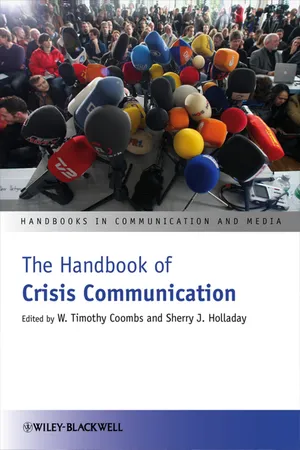
The Handbook of Crisis Communication
- English
- ePUB (mobile friendly)
- Available on iOS & Android
eBook - ePub
The Handbook of Crisis Communication
About this book
Written as a tool for both researchers and communication managers, the Handbook of Crisis Communication is a comprehensive examination of the latest research, methods, and critical issues in crisis communication.
Information
Part I
Crisis and Allied Fields
Any volume that claims to be a “handbook” on a topic commits to an ambitious goal, and this Handbook of Crisis Communication is no exception. Crisis communication theory, research, and practice have expanded rapidly over the past decade. The work is characterized by its attention to a variety of organizational and crisis types as well as methodological diversity – but always with an eye toward application. Clearly, the need to practice crisis communication without the benefit of a solid foundation of theory and research has not prevented practitioners from trying to protect stakeholders and organizations. We hope the chapters in this Handbook provide guidance for those in the trenches as well as those who are trying to support them.
Part I establishes the foundation for the wide range of material covered in this Handbook. Appreciating the roots of crisis communication aids our understanding of how and why the field has developed as it has (and perhaps failed to develop in some areas) and where its future growth lies. It is perhaps ironic, and sobering, that our field benefits from myriad organizational misfortunes ranging from those brought on by the unethical actions of a few organizational members to those produced by natural disasters. Unfortunately, there seems to be no shortage of poor judgment, bad luck, or blatant misconduct. Fortunately, the work of practitioners and researchers can help organizations and stakeholders affected by these crises. The future development of crisis communication seems promising when we reflect on how much we have learned over a relatively brief period.
Chapter 1 (Coombs) is essential reading for anyone who claims involvement in crisis communication research and practice. Chapter 1 prepares us for our journey with this Handbook as it charts the parameters of crisis communication by offering a review of important terms, documenting the history and development of crisis communication models and research, and describing dominant streams of theory and research methodology. Woven throughout this discussion is the concern for how crisis communication research informs the practice.
Chapter 2 (Coombs) describes how crisis communication fits with the allied fields of risk communication, issues management, and reputation management. This chapter explains that although these fields represent unique foci, each can and should inform contemporary work in crisis communication. Work in crisis communication often is tied to these allied fields and can benefit from their body of knowledge. Coombs also suggests that while disaster communication and business continuity differ from crisis communication, those can contribute to our understanding and practice of crisis communication.
Chapter 3 (An and Cheng) provides a fitting capstone for this first section of the Handbook. The authors examine over thirty years of crisis communication research published in the Journal of Public Relations Research and Public Relations Review. They identify theoretical orientations, specific theories, and methodological trends associated with the development of the field. Their inventory of published work in crisis communication confirms its burgeoning growth and points to strengths and weaknesses in the knowledge amassed over this period.
1
Parameters for Crisis Communication
Organizations frequently find themselves in situations we would define as a crisis. Consider but a few examples: Union Carbide’s devastating chemical release in Bhopal; Carrefour suffering from protests at its stores in China because of French attacks on the Olympic torch relay; customers experiencing E. coli at Taco Bell; rumors about designer Tommy Hilfiger’s racist comments; Tyco executives stealing millions from the company; and Oxfam claiming Starbucks did not support coffee growers by opposing the branding of certain African coffees. We must accept that no organization is immune from a crisis anywhere in the world even if that organization is vigilant and actively seeks to prevent crises.
The reality of crises leads to the need for preparation and readiness to respond –crisis management. The critical component in crisis management is communication. Over the past decade, there has been a massive increase in crisis communication research. As the field of crisis communication develops, it is important to develop parameters for that growth. This chapter and the Handbook of Crisis Communication are steps towards articulating the parameters and utility of crisis communication. The focus in this book is the research used to advance our understanding of communication’s role in the crisis management process. To properly set the stage for this collection, it is important to define key terms in crisis management and overview key research on the central theme of crisis communication. By examining these fundamental elements, the parameters of crisis communication begin to emerge.
Key Definitions for Crisis
Because of the diversity of crisis research, it is important to present definitions of key crisis terms early to help set boundaries. The key terms for the Handbook include crisis, crisis management, and crisis communication. The three are inextricably interconnected and must be considered in a progression from crisis to crisis management to crisis communication. By ending with crisis communication, we begin to get a feel for the scope of this burgeoning field of inquiry.
Crisis defined
As you read this book, it will become clear there is no one, universally accepted definition of crisis. You will also note many conceptual similarities in the definitions even when the definitions are not exactly the same. Box 1.1 lists commonly used crisis definitions. The list contains definitions from well-known crisis authors as well as covering a range of disciplines, including public relations, management, and organizational communication.
One point is worth discussing before offering the crisis definition utilized in this chapter. Three definitions note that crises can have positive or negative outcomes. People frequently claim that the Chinese symbol for crisis represents both an opportunity and a threat. Some argue that is a very idiosyncratic translation and is overstated. Regardless, opportunity and threat are more a function of the outcomes of crisis management rather than a defining characteristic of crisis. As chapters 35 and 38 highlight, we can look to crises as opportunities for growth. However, I doubt any manager would argue for the strategic creation of a crisis to advance organizational goals as an effective form of management. Still, there may be extreme cases where only a crisis can save the organization. On the whole, crisis management seeks to prevent crises. Prevention protects people, property, financial resources, and reputation assets. Inherently, crises are threats, but how the crisis is managed determines if the outcomes are threats or opportunities. Effective crisis management can result in stronger organizations but “management by crisis” would take a heavy toll on stakeholders.
Box 1.1 Definitions of Crisis
a major occurrence with a potentially negative outcome affecting an organization, company, or industry, as well as publics, products, services or good name. It interrupts normal business transactions and can sometimes threaten the existence of the organization (Fearn-Banks 1996: 1)
is not necessarily a bad thing. It may be a radical change for good as well as bad” (Friedman 2002: 5)
an event that affects or has the potential to affect the whole of an organization. Thus, if something affects only a small, isolated part of an organization, it may not be a major crisis. In order for a major crisis to occur, it must exact a major toll on human lives, property, financial earnings, the reputation, and the general health and well-being of an organization” (Mitroff & Anagnos 2001: 34–35)
turning points in organizational life” (Regester 1989: 38)
an incident that is unexpected, negative, and overwhelming” (Barton 2001: 2)
a specific, unexpected and non-routine organizationally based event or series of events which creates high levels of uncertainty and threat or perceived threat to an organization’s high priority goals” (Seeger, Sellnow, & Ulmer 1998: 233)
turning point for better or worse” (Fink 1986: 15)
an event that is an unpredictable, major threat that can have a negative effect on the organization, industry, or stakeholders if handled improperly” (Coombs 1999: 2)
This chapter defines crisis as “the perception of an unpredictable event that threatens important expectancies of stakeholders and can seriously impact an organization’s performance and generate negative outcomes” (Coombs 2007b: 2–3). I would like to unpack the critical elements of this definition that serve to characterize a crisis. This crisis definition was informed by discussions at the 2005 NCA Pre-Conference on Integrating Research and Outreach in Crisis and Risk Communication. A variety of experts in the two fields were assembled and one point on the agenda was how to define crisis and risk. A significant point in that discussion was the perceptual nature of crises. How stakeholders view an event has ramifications for whether or not that event becomes a crisis. The definition attempts to honor stakeholder concerns and the role they can play in co-creating the meaning of a crisis. Meaning is socially constructed and crises are no exception. Thus, it was important to utilize a definition that reflects the perceptual nature of crises. Chapter 37 does an excellent job of further arguing for the importance of stakeholders in crisis management.
It is also important to separate crises from incidents (Coombs 2004b). Practitioners often take issue with how loosely the term crisis is bandied about. Crisis should be reserved for serious events that require careful attention from management. This belief stems from the fact that the label “crisis” in an organization results in the allocation of time, attention, and resources (Billings, Milburn, & Schaalman 1980). The majority of the crisis definitions reflect the need to reserve the term crisis for serious events. So the event has to have the potential to seriously impact the organization. But the definition should not be viewed as limiting potential harm only to the organization. Harming stakeholders has to rate as the most significant “negative outcome.” The definition uses “negative outcomes” to include any type of harm to stakeholders, including physical, financial, and psychological. Potential is used because actions taken by crisis managers may prevent a crisis or significantly reduce the damage one can inflict. Crisis management is more than reaction; it can be prevention and preparation too.
Finally, the definition reinforces the role of stakeholders in the crisis through the idea of anomalies. Crises are unusual occurrences that cannot be predicted but are expected. True, managers should anticipate crises can occur and on any given day numerous organizations have crises. The analogy between crisis and earthquakes is fitting. People in Southern California know an earthquake can and will occur but they do not know when exactly one will happen. However, all crises are anomalies because they violate what stakeholders expect. Consider the following stakeholder expectations: trains should not derail, milk should not sicken children, and tacos from restaurants should not contain e. coli. It is this anomalous dimension of crises that draws the attention of the media and other stakeholders. Crises are unusual negative events, so humans are drawn to them just like people on the highway gawk at accidents.
Crisis management defined
Crisis management can be defined as “a set of factors designed to combat crises and to lessen the actual damages inflicted” (Coombs 2007b: 5). Moreover, crisis management “seeks to prevent or lessen the negative outcomes of a crisis and thereby protect the organization, stakeholders, and/or industry from damage” (Coombs 1999: 4). We should think of crisis management as a process with many parts, such as preventative measures, crisis management plans, and post-crisis evaluations. The set of factors that constitute crisis management can be divided into three categories: pre-crisis, crisis, and post-crisis. Pre-crisis involves efforts to prevent crises and to prepare for crisis management. Crisis is the response to an actual event. Post-crisis are efforts to learn from the crisis event (Coombs 2007b). These three categories reflect the phases of crisis management and are useful because they provide a mechanism for considering the breadth of crisis communication.
Crisis communication defined
Crisis communication can be defined broadly as the collection, processing, and dissemination of information required to address a crisis situation. In pre-crisis, crisis communication revolves around collecting information about crisis risks, making decisions about how to manage potential crises, and training people who will be involved in the crisis management process. The training includes crisis team members, crisis spokespersons, and any individuals who will help with the response. Crisis communication includes the collection and processing of information for crisis team decision making along with the creation and dissemination of crisis messages to people outside of the team (the traditional definition of crisis communication). Post-crisis involves dissecting the crisis management effort, communicating necessary changes to individuals, and providing follow-up crisis messages as needed.
Crisis communication has focused on the crisis category/crisis response –what organizations say and do after a crisis. Crisis responses are highly visible to stakeholders and very important to the effectiveness of the crisis management effort. For instance, improper crisis responses make the situation worse. It is by considering the breadth of crisis management that we will stretch the boundaries of what is studied in crisis communication. All of the chapters in Part VIII, Future Research Directions, argue for expanding the focus of crisis communication and can be placed within the parameters of crisis management presented here. Furthermore, a broader definition of crisis communication allows us to better draw on the allied fields for insights on how to improve crisis communication (the focus of chapter 2).
Crisis Management Process
Crisis communication is a field that has witnessed amazing growth in both the professional and academic community over the past decade. The increased number of articles and books on the subject is testament to that development. The growth is positive because of the pressure for effective crisis communication. Crises can create threats to public safety, environmental wellness, and organizational survival. Crisis communication is a critical element in effective crisis management. The main purpose of this chapter is to provide a context for this Handbook by reviewing the history of crisis communication. However, any discussion of crisis communication must begin by reviewing the roots of crisis management, the larger context for crisis communication.
This section traces the origins of crisis management. From there the focus shifts to an overview of the various “types” of crisis communication.
Crisis management: Roots of a field
In 1986 Steven Fink published the seminal work in crisis management: Crisis Management: Planning for the Inevitable. Fink’s (1986) book began to detail the emerging field of crisis management. Today, there exists a vast array of crisis management books, but Fink’s remains a useful classic. Crisis management did not appear from thin air. The roots of crisis management reside in emergency and disaster management.
Emergency and disaster management studied ways to prevent incidents and how to respond to/cope with incidents. We will return to the connection between disasters and crises in the next chapter. Works in crisis management first appeared in the International Journal of Emergencies and Disasters. Moreover, we see strong emphasis on disaster in the publication record of the Journal of Contingencies and Crisis Management. We see the split with disaster with the phrasing “industrial crisis management” and the emergence of Industrial Crisis Quarterly, which later became Organization & Environment. Disaster research developed on a parallel trajectory following Quarantelli (1988) and others, while crisis management could look to Fink (1986) and those more interested in organizational crises. Tracing all the works that informed crisis communication would be a monumental task. We must keep this history of crisis management brief or risk creating a tangent.
To fully explore crisis communication, we need to begin by reviewing the crisis management process. To develop, a field has to have models of its process as they help us to understand what is being done and key concepts. Examining the crisis management process allows us to understand better the critical points where crisis communication enters the equation. Earlier in this chapter the terms crisis and crisis management were defined. The definition of crisis reflects a process view. The process notion of crisis management is reflected in the field’s models. Fink (1986) was among the first to examine crises as occurring in stages. Fink’s model has four stages: (1) prodromal, warning signs of a crisis appear; (2) acute, a crisis occurs; (3) chronic, recovery period that can include lingering concerns from the crisis; and (4) crisis resolution, the organization is back to operations as normal. Fink is proposing a model of how crises develop.
Smith (1990) developed a three step model of the crisis manag...
Table of contents
- Cover
- Series page
- Title Page
- Copyright
- Notes on Contributors
- Preface
- Acknowledgments
- Introduction: Crisis Communication: Defining the Beast and De-marginalizing Key Publics
- Part I: Crisis and Allied Fields
- Part II: Methodological Variety
- Part III: The Practice
- Part IV: Specific Applications
- Part V: Technology and Crisis Communication
- Part VI: Global Crisis Communication
- Part VII: Theory Development
- Part VIII: Future Research Directions
- Afterword
- Name Index
- Subject Index
Trusted by 375,005 students
Access to over 1.5 million titles for a fair monthly price.
Study more efficiently using our study tools.
Frequently asked questions
Yes, you can cancel anytime from the Subscription tab in your account settings on the Perlego website. Your subscription will stay active until the end of your current billing period. Learn how to cancel your subscription
No, books cannot be downloaded as external files, such as PDFs, for use outside of Perlego. However, you can download books within the Perlego app for offline reading on mobile or tablet. Learn how to download books offline
Perlego offers two plans: Essential and Complete
- Essential is ideal for learners and professionals who enjoy exploring a wide range of subjects. Access the Essential Library with 800,000+ trusted titles and best-sellers across business, personal growth, and the humanities. Includes unlimited reading time and Standard Read Aloud voice.
- Complete: Perfect for advanced learners and researchers needing full, unrestricted access. Unlock 1.5M+ books across hundreds of subjects, including academic and specialized titles. The Complete Plan also includes advanced features like Premium Read Aloud and Research Assistant.
We are an online textbook subscription service, where you can get access to an entire online library for less than the price of a single book per month. With over 1.5 million books across 990+ topics, we’ve got you covered! Learn about our mission
Look out for the read-aloud symbol on your next book to see if you can listen to it. The read-aloud tool reads text aloud for you, highlighting the text as it is being read. You can pause it, speed it up and slow it down. Learn more about Read Aloud
Yes! You can use the Perlego app on both iOS and Android devices to read anytime, anywhere — even offline. Perfect for commutes or when you’re on the go.
Please note we cannot support devices running on iOS 13 and Android 7 or earlier. Learn more about using the app
Please note we cannot support devices running on iOS 13 and Android 7 or earlier. Learn more about using the app
Yes, you can access The Handbook of Crisis Communication by W. Timothy Coombs, Sherry J. Holladay, W. Timothy Coombs,Sherry J. Holladay in PDF and/or ePUB format, as well as other popular books in Languages & Linguistics & Communication Studies. We have over 1.5 million books available in our catalogue for you to explore.