How to be a Quantitative Ecologist
eBook - ePub

How to be a Quantitative Ecologist

The 'A to R' of Green Mathematics and Statistics

  1. English
  2. ePUB (mobile friendly)
  3. Available on iOS & Android
eBook - ePub

How to be a Quantitative Ecologist

The 'A to R' of Green Mathematics and Statistics

About this book

How to be a Quantitative Ecologist: The 'A to R' of Green Mathematics and Statistics

Ecological research is becoming increasingly quantitative, yet students often opt out of courses in mathematics and statistics, unwittingly limiting their ability to carry out research in the future. This textbook provides a practical introduction to quantitative ecology for students and practitioners who have realised that they need this opportunity.

The text is addressed to readers who haven't used mathematics since school, who were perhaps more confused than enlightened by their undergraduate lectures in statistics and who have never used a computer for much more than word processing and data entry. From this starting point, it slowly but surely instils an understanding of mathematics, statistics and programming, sufficient for initiating research in ecology. The book's practical value is enhanced by extensive use of biological examples and the computer language R for graphics, programming and data analysis.

Key Features:

  • Provides a complete introduction to mathematics statistics and computing for ecologists.
  • Presents a wealth of ecological examples demonstrating the applied relevance of abstract mathematical concepts, showing how a little technique can go a long way in answering interesting ecological questions.
  • Covers elementary topics, including the rules of algebra, logarithms, geometry, calculus, descriptive statistics, probability, hypothesis testing and linear regression.
  • Explores more advanced topics including fractals, non-linear dynamical systems, likelihood and Bayesian estimation, generalised linear, mixed and additive models, and multivariate statistics.
  • R boxes provide step-by-step recipes for implementing the graphical and numerical techniques outlined in each section.

How to be a Quantitative Ecologist provides a comprehensive introduction to mathematics, statistics and computing and is the ideal textbook for late undergraduate and postgraduate courses in environmental biology.

"With a book like this, there is no excuse for people to be afraid of maths, and to be ignorant of what it can do."
Professor Tim Benton, Faculty of Biological Sciences, University of Leeds, UK

Frequently asked questions

Yes, you can cancel anytime from the Subscription tab in your account settings on the Perlego website. Your subscription will stay active until the end of your current billing period. Learn how to cancel your subscription.
At the moment all of our mobile-responsive ePub books are available to download via the app. Most of our PDFs are also available to download and we're working on making the final remaining ones downloadable now. Learn more here.
Perlego offers two plans: Essential and Complete
  • Essential is ideal for learners and professionals who enjoy exploring a wide range of subjects. Access the Essential Library with 800,000+ trusted titles and best-sellers across business, personal growth, and the humanities. Includes unlimited reading time and Standard Read Aloud voice.
  • Complete: Perfect for advanced learners and researchers needing full, unrestricted access. Unlock 1.4M+ books across hundreds of subjects, including academic and specialized titles. The Complete Plan also includes advanced features like Premium Read Aloud and Research Assistant.
Both plans are available with monthly, semester, or annual billing cycles.
We are an online textbook subscription service, where you can get access to an entire online library for less than the price of a single book per month. With over 1 million books across 1000+ topics, we’ve got you covered! Learn more here.
Look out for the read-aloud symbol on your next book to see if you can listen to it. The read-aloud tool reads text aloud for you, highlighting the text as it is being read. You can pause it, speed it up and slow it down. Learn more here.
Yes! You can use the Perlego app on both iOS or Android devices to read anytime, anywhere — even offline. Perfect for commutes or when you’re on the go.
Please note we cannot support devices running on iOS 13 and Android 7 or earlier. Learn more about using the app.
Yes, you can access How to be a Quantitative Ecologist by Jason Matthiopoulos in PDF and/or ePUB format, as well as other popular books in Mathematics & Probability & Statistics. We have over one million books available in our catalogue for you to explore.

Information

Chapter 1
How to Make Mathematical Statements
(Numbers, Equations and Functions)
c01g001
‘In science there is only physics and stamp collecting’
Ernest Rutherford (1871–1937), the father of nuclear physics.
‘I have hardly ever known a mathematician who was capable of reasoning’
Plato (428–348 BC), the father of all science.
One of the exciting challenges of quantitative ecology is to examine whether a set of observations that have been classified by name can be ordered along a continuum. Therefore, this chapter begins with a discussion of nominal and ordinal scales (Section 1.1). Although there is still a valuable role for nominal classification (see Chapter 12), the deceptively simple act of comparing two, apparently different, individuals, species or communities along one or more quantitative scales, propels us forward from natural history to modern ecology. This transition is mediated by numbers (Sections 1.2 and 1.17). Symbols (Section 1.3) are often used instead of numbers either to cope with ignorance or to make general statements. Mathematical operators (Sections 1.4 and 1.5) are used to connect different (known or unknown) quantities into algebraic expressions. Algebra is the set of rules dictating how these expressions may be manipulated (Sections 1.7–1.9). The two main scientific applications of mathematics are in formalising known facts or assertions as equations or inequalities (Sections 1.10–1.15) and expressing relationships between variables (Sections 1.18–1.25).
1.1. Qualitative and Quantitative Scales
Data are called qualitative if they cannot be compared using some measure of magnitude. For example, nominal observations can only be compared in a rudimentary way, by checking for ‘sameness’. If they are not the same, one nominal observation cannot readily be said to be greater than another. In contrast, quantitative data can be ordered and the degree of dissimilarity between them can be evaluated objectively. This rudimentary taxonomy of data will be elaborated in Chapter 7. For now, it is sufficient to say that the distinction between quality and quantity is not always clear. Often, observations that appear to be nominal can be ordered by means of their attributes, as in Example 1.1.
Example 1.1: Habitat Classifications
Fern frond
c01g002
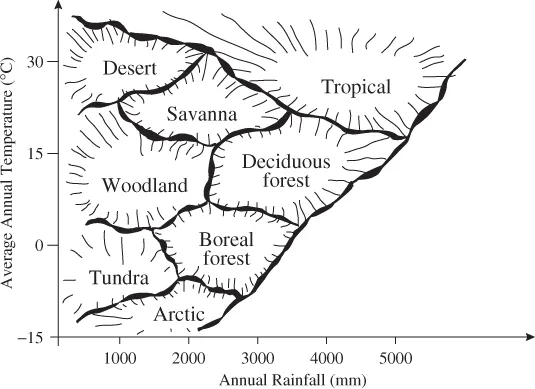
We can easily distinguish between marine and terrestrial habitats. In the marine environment there are polar, upwelling, shelf, open-ocean and coral habitat types. In the terrestrial environment, examples include the boreal, tundra, tropical, temperate, desert and montane habitat types. The definitions of these are generally vague but suffice for most applied purposes. However, studies in spatial ecology (Manly et al. 2002; Aarts et al. 2008) have increasingly found that it is more useful to describe the distribution of plants and animals in terms of individual habitat characteristics such as temperature and precipitation (measured on a quantitative scale) rather than using arbitrary—and occasionally anthropocentric—habitat types (Figure 1.1).
Figure 1.1 Habitat types are arbitrary subdivisions imposed on an environmental continuum.
1.1
genu001
1.1: Declaring Nominal Categories
To create a simple computerised taxonomic scheme involving the categories of Animals, Plants, Fungi, Protoctista, Archaea and Monera, it is first necessary to tell R that these labels are to be treated as text, so that it doesn't expect a numeric value for them. This is done by enclosing the labels in quotation marks:
“An”, “Pl”, “Fn”, “Pr”, “Ar”, “Mo”
The labels can be collected together using the concatenation command c():
c(“An”, “Pl”, “Fn”, “Pr”, “Ar”, “Mo”)
and the taxono...

Table of contents

  1. Cover
  2. Title Page
  3. Copyright
  4. Dedication
  5. Preface
  6. Thank You
  7. Chapter 0: How to Start a Meaningful Relationship with Your Computer
  8. Chapter 1: How to Make Mathematical Statements
  9. Chapter 2: How to Describe Regular Shapes and Patterns
  10. Chapter 3: How to Change Things, One Step at a Time
  11. Chapter 4: How to Change Things, Continuously
  12. Chapter 5: How to Work with Accumulated Change
  13. Chapter 6: How to Keep Stuff Organised in Tables
  14. Chapter 7: How to Visualise and Summarise Data
  15. Chapter 8: How to Put a Value on Uncertainty
  16. Chapter 9: How to Identify Different Kinds of Randomness
  17. Chapter 10: How to See the Forest from the Trees
  18. Chapter 11: How to Separate the Signal from the Noise
  19. Chapter 12: How to Measure Similarity
  20. Appendix: Formulae
  21. Author Index
  22. Subject Index