Step-by-step instructions for executing a website testing and optimization plan
Website optimization is can be an overwhelming endeavor due to the fact that it encompasses so many strategic and technical issues. However, this hands-on, task-based book demystifies this potentially intimidating topic by offering smart, practical, and tested instructions for developing, implementing, managing, and tracking website optimization efforts. After you learn how to establish an optimization framework, you then dive into learning how to develop a plan, test appropriately and accurately, interpret the results, and optimize in order to maximize conversion rates and improve profits.
Zeroes in on fundamentals such as understanding key metrics, choosing analytics tools, researching visitors and their onsite behavior, and crafting a plan for what to test and optimize
Walks you through testing and optimizing specific web pages including the homepage, entry and exit pages, product and pricing pages, as well as the shopping cart and check-out process
Guides you through important optimization areas such as optimizing text and images
Addresses advanced topics including paid search optimization, Facebook fan page optimization, rich media, and more
Includes a companion website that features expanded examples, additional resources, tool reviews, and other related information
Full of interesting case studies and helpful examples drawn from the author's own experience, Website Optimization: An Hour a Day is the complete solution for anyone who wants to get the best possible results from their web page.
Before diving into the many website optimization best practices and test ideas in this book, it’s important to first give you some background and history on this subject and also some key differences between this and other types of optimization relating to websites and search engines.
Introduction to Website Optimization
The online business world continues to change and evolve at a frenetic pace. No longer are online businesses just throwing money at creating and marketing their websites and hoping for success; many are now getting increasingly savvy when analyzing and improving their websites.
Unfortunately too much emphasis is still placed on two things: the aesthetics of the website and how to best drive traffic to it. Very little emphasis is placed on the actual visitors to the website and how well it engages and converts them for key goals like purchase or signup—in a nutshell, how well optimized the website is. To illustrate just how little attention is usually placed on conversion, recent studies by Forrester and eMarketer found that for every $80 spent online to acquire traffic to websites, just $1 is spent to proactively convert this traffic once it has arrived.
Remember, you could have the best-looking website in the world, but if your visitors find it hard to use or it doesn’t fulfill their needs , they often won’t come back (and will likely go to a competitor that’s only a few clicks away on Google). And you could spend hundreds of thousands on paid search and Facebook ads driving visitors to your website, but if your website isn’t optimized to engage and convert them for your key goals and doesn’t influence them to come back, much of this money will be wasted down the drain.
This is why it is so critical to build and run an effective website optimization program for your online business so that it does indeed engage and convert your website visitors much better. More important, as a result of having a website like this, your online business is far more likely to generate greater revenue and profits in the future.
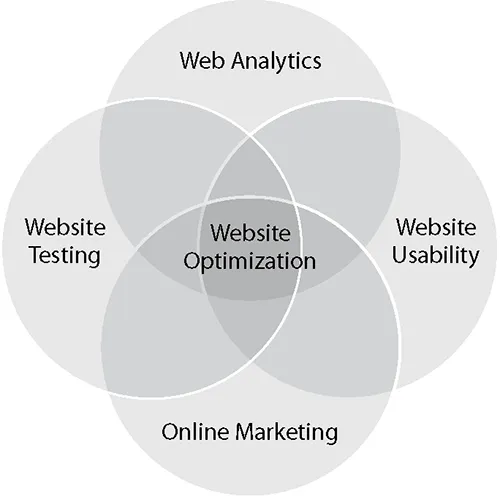
Unfortunately though, this optimization and improvement of websites isn’t as easy as you might expect, and you need much more than just a website testing tool. In addition to this, there are many disparate online disciplines you need to learn and apply before you can become truly great at optimizing websites. Web analytics fundamentals are vital for analyzing success metrics and key reports, and to generate better test idea insights from them. Web usability best practices are essential to make your visitors happier when they interact with your website. A great grasp of online marketing best practices (in particular copy writing) is a must if you are to be able to truly influence your visitors with your headlines, images, and calls-to-action. Finally, website testing skills are essential to create high-impact tests needed to optimize your website. See Figure 1-1 for a visual representation of how these disciplines overlap to form website optimization.
Rather than have people need to rely on reading multiple separate books in all of these disciplines, I decided to make website optimization easier to learn by pulling all these skills together and presenting them in the format of Wiley’s Hour-a-Day popular book series.
Figure 1.1 Interlocking disciplines needed for website optimization
In particular, one of the most important skills you need to help power your website optimization and testing efforts is a sound understanding of how to use web analytics. This is because web analytics data not only helps you measure the success of your optimization efforts, but they can also provide you with some excellent insights to help form your test ideas. Web analysis techniques will be put to great use throughout this book, from learning and measuring the success metrics for your type of website to learning advanced analysis techniques to find high potential conversion pages.
However, even before starting your website optimization and testing efforts, you will likely be met with several challenges in your organization preventing you from doing so with speed and efficiency. Therefore, you will also become versed in fundamentals to help overcome these, improve your internal processes, and ultimately help build an optimization organization that will ensure you get the most out of your optimization efforts.
To help you make changes to optimize your website, you will then learn important website testing strategies and fundamentals, including how to target and personalize your content to better meet the needs of your all-important visitors. These strategies and fundamentals will ensure your A/B and multivariate tests are set up, run, and analyzed optimally for the most impact on your conversion rates and success metrics.
You will also learn to focus on your visitors and their common journeys through your website so that you can better meet their needs, engage them, and convert them. You will learn how to build personas and use cases to help you do this, in addition to gaining the voice of your visitors by using survey, feedback, and task completion rate analysis tools. Remember that your website would be nothing without your visitors!
Over the remainder of the book, you will then learn many advanced best practices, tools, and tips that will help increase your conversion rates and keep your website visitors coming back for more—no matter what type of website you have. You will also learn some “out of the box” optimization best practices that involve more than just your regular website—for example, emerging mobile website best practices and vital email marketing best practices.
Understanding and adopting these optimization best practices and test ideas will also help give you a competitive edge over your rivals. This is because they more than likely aren’t doing a very good job of testing and optimizing their websites, and it will have them wondering exactly how your website is doing so well.
In order to get the most out of this book, I suggest that you spend one day reading each week, and try not to be too tempted to skip through the weeks and read it all in one sitting. I also recommend that you take notes while reading the book and mark down any particularly relevant tips you notice for your website. Don’t forget to use the test idea tracker in Appendix B to list any tests in this book you want to try on your website, and then use the test results tracker in Appendix C to document and help you learn from your results.
The final chapter is also very important to pay attention to, because this is when you will revisit your key success metrics and conversion goals to see just how much you have optimized them and, therefore, your website.
The Rise of Website Optimization: The Aftermath of the Dot-com Bubble Bursting
What started off as just a way of exchanging research between institutes in the early 1990s, the World Wide Web quickly came to mainstream prominence in the mid-1990s. This was due to the increasing ease of online access and the rise of websites like Yahoo.com and Amazon.com, with millions of people coming online to experience new exciting ways to find information and shop. And with this huge demand for these new websites quickly came huge revenues from advertising and product sales for many online businesses.
Traditional businesses and new business ventures began to invest millions in getting their own online business to get their slice of the pie, with these online businesses quickly and affectionately become known as dot-coms.
The growth in revenues for many of these dot-coms increased with amazing velocity, and with that came crazy high market valuations. As a result of this, major investments were made by venture capitalists into these hot dot-coms and new dot-com startups, eager to also earn their slice of the pie. Unfortunately though, in this new gold rush, very few checks and balances were put in place to make sure these dot-coms’ long-term strategies and business plans were sound.
As a result of this, money was usually spent very fast to grow most dot-coms and their market share as quickly as possible, often by expensive lavish marketing campaigns aimed at attracting as many new visitors as possible. The 2000 Super Bowl ads were the pinnacle of this frenzied spending, with 19 dot-coms like Pets.com spending millions on advertising that looked and seemed cool but yielded extremely low return on investment (ROI). Eight of those no longer exist.
All this investment in marketing meant very little money was spent on understanding the visitors to these websites and improving the usability of them so they better engaged and converted their visitors. Consequently, many of the visitors to these dot-com websites either rarely came back or purchased very few times in the future. Certainly not enough to warrant the huge marketing investments made.
Soon after this, the stock market valuations of these dot-coms became untenable, with many dot-coms still leaking money like a sieve, constantly looking for the next round of funding to stay alive. In March 2000, the stock market came crashing down with the emerging realization of this, and the dot-com bubble had burst. Many dot-coms folded soon after this, and it was only then that surviving and new online businesses began to become more prudent with their spending and analysis of online business.
This overdue rise in web analysis in 2000 was helped by the growing demand for new advanced log-file website analysis tools like WebTrends (which was a pioneer in this at the time). However, most of the analysis being done was concerned with measuring website hits (as they often were referred to) and revenue. Very little emphasis was placed on understanding visitor interaction and ways to improve websites, and what was done often relied on obtaining this from expensive usability labs.
Along with this rise in web analysis was a long-overdue emphasis on website visitors and the usability of websites. Usability experts like Jakob Nielsen released books that exposed the huge number of issues that many websites had at the time and detailed how to resolve them. Steve Krug’s groundbreaking book Don’t Make Me Think (New Riders, 2001) helped put usability and user focus further into the spotlight, using a very simple format that was very easy for anyone to understand (including examples of how to email your boss to start cheap usability testing!). I strongly suggest you read this if you haven’t done so already.
However, at this time there weren’t many tools available that could easily test these recommended usability improvements, and there was a lack of understanding of the ROI from doing so. This meant that online businesses were doing very little website testing when building or launching new content, merely hoping their efforts would perform better.
The testing that was done was usually handled informally with no tool, by putting up a new version for a while to see which version seemed to do better. This often resulted in bad consequences for website stability and user experience. And it wasn’t until years later when some online businesses started showing great results and ROI from improved testing rigor and proces...
Table of contents
Cover
Table of Contents
Title
Copyright
Acknowledgments
About the Author
Foreword
Introduction
Chapter 1: Setting the Website Optimization Scene
Chapter 2: Set Up and Improve Usage of Key Web Analytics and Testing Tools
Chapter 3: Lay the Foundations for Optimization Success
Chapter 4: Understand Your Visitors and Their Needs—the Keys to Website Optimization
Chapter 5: Build the Foundation of a Better Converting Website
Chapter 6: Learn the Power of Influence and Persuasion on Visitors and Conversions
Chapter 7: Optimization Best Practices and Test Ideas for Different Page Types and Flows
Chapter 8: Keep Them Coming Back—Optimize for Repeat Visits
Chapter 9: Review and Learn From Your Results, and Keep Testing and Optimizing
Appendix A: Website Optimization and Testing Tools
Appendix B: Test Idea Tracker
Appendix C: Test Results Tracker
Index
End User License Agreement
Trusted by 375,005 students
Access to over 1.5 million titles for a fair monthly price.
Study more efficiently using our study tools.
Frequently asked questions
Yes, you can cancel anytime from the Subscription tab in your account settings on the Perlego website. Your subscription will stay active until the end of your current billing period. Learn how to cancel your subscription
No, books cannot be downloaded as external files, such as PDFs, for use outside of Perlego. However, you can download books within the Perlego app for offline reading on mobile or tablet. Learn how to download books offline
Perlego offers two plans: Essential and Complete
Essential is ideal for learners and professionals who enjoy exploring a wide range of subjects. Access the Essential Library with 800,000+ trusted titles and best-sellers across business, personal growth, and the humanities. Includes unlimited reading time and Standard Read Aloud voice.
Complete: Perfect for advanced learners and researchers needing full, unrestricted access. Unlock 1.5M+ books across hundreds of subjects, including academic and specialized titles. The Complete Plan also includes advanced features like Premium Read Aloud and Research Assistant.
Both plans are available with monthly, semester, or annual billing cycles.
We are an online textbook subscription service, where you can get access to an entire online library for less than the price of a single book per month. With over 1.5 million books across 990+ topics, we’ve got you covered! Learn about our mission
Look out for the read-aloud symbol on your next book to see if you can listen to it. The read-aloud tool reads text aloud for you, highlighting the text as it is being read. You can pause it, speed it up and slow it down. Learn more about Read Aloud
Yes! You can use the Perlego app on both iOS and Android devices to read anytime, anywhere — even offline. Perfect for commutes or when you’re on the go. Please note we cannot support devices running on iOS 13 and Android 7 or earlier. Learn more about using the app
Yes, you can access Website Optimization by Rich Page in PDF and/or ePUB format, as well as other popular books in Computer Science & Computer Science General. We have over 1.5 million books available in our catalogue for you to explore.