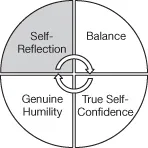
Self-reflection is the key to identifying what you stand for, what your values are, and what matters most. Through self-reflection, you are able to step back, filtering out the noise and distractions. As your view becomes clearer, you can prioritize how and where to invest your time, efforts, and energy. Self-reflection allows you to gain clarity on issues, both personal and professional, because you have taken the time to think more deeply about them. The more self-reflective you are, the easier it is to make choices that are in line with your values, with awareness of the full impact of your decisions.
Self-reflection has been my lifelong practice. As I became more self-aware, I gained clarity about my values and goals. I was able to focus on what mattered most because I took the time to discern my priorities. Engaging in self-reflection on a regular and ongoing basis has made a huge difference in my life as a business leader, an active board member, a university professor, a husband, and a father of five children. What would otherwise appear to be a complicated existence has become much more straightforward and easier to navigate.
Through self-reflection, I have also become a more effective leader in my career, including as a former chairman and CEO of a multibillion-dollar global health care company and currently as an executive partner in a private equity firm with a portfolio of more than thirty companies. Likewise, whether you are a leader of a team, a department, or a Fortune 500 company, or simply an individual who is trying to manage yourself, your priorities, and your time, self-reflection helps you make choices that are better aligned with your values. You are able to discern whether what you're doing is really what needs to be done. You will know what you are deciding and why, and what the outcomes of those decisions are most likely to be. The more aware you are of your choices, whether personal or professional, and their impact, the better the decisions you will make in the future.
Being self-reflective, you take the time to think through your choices and decisions. As situations arise, you are surprised less frequently. Even when you do face an unexpected outcome, self-reflection can help you use it to your advantage for the future.
The Self-Reflection Connection
Self-reflection is central to your leadership. The more you self-reflect, the better you know yourself: your strengths, weaknesses, abilities, and areas to be developed. Being self-aware, you know what you stand for and what is most important to you. With this clarity, you are able to connect and communicate with others more effectively. Grounded in self-knowledge, your leadership becomes more authentic.
All too often, when people aspire to leadership, they want to emulate someone else's style. They want to be like Jack Welch or Ronald Reagan or Abraham Lincoln or another recognizable leader. Although we can all learn a lot from the example of others, your leadership must come from your core. You cannot determine the kind of leader you are without first figuring out who you are. Your leadership needs to be rooted in the real world and reflective of your views, life experiences, and professional path. I believe self-reflection is so important that I make it the focus of my leadership classes at Northwestern University's Kellogg School of Management. My goal is to give the hundreds of students I teach each year a tool that I believe will make a significant difference in the choices they make professionally as well as personally.
Self-reflection enhances leadership by helping you become more aware of the decisions you make, as well as the likely outcomes and implications of them. I refer to this as making your decisions explicitly rather than implicitly. With an explicit decision, you understand that you are not making one decision by itself in a vacuum. An explicit decision takes into account all the factors that are affected by or have an influence on the decision. There are causes, contributing factors, previous decisions, and direct and indirect outcomes to consider. By being explicit, the process becomes transparent. In contrast, implicit decision making takes only a narrow focus without much regard for the big picture—an approach that can lead to surprises, often unpleasant ones.
Making an explicit decision requires you to be self-reflective, ensuring that you stay consistent with who you are, your goals, your values, and your priorities. Therefore, the likelihood of being dealt an unexpected disappointment is far less when you are introspective. Your decision can even be a bit “out of the box” and still have a high probability of producing the expected results, as long as you spend some time in reflection and discernment. Such was the case at Baxter when we decided to promote an unconventional candidate into a very important position.
Baxter's senior vice president of human resources, Mike Tucker, and I sat down to discuss the creation of a talent management process for the entire company, which would be led by one person. Rather than make a quick decision to put someone from HR in that job, we looked at the position holistically. We determined that the ideal candidate would have a good understanding of the total company, with exposure to different divisions, functions, and geographic locations. When we looked at the position with that perspective, someone immediately came to mind: Karen May, who had a background in finance and auditing and was a CPA. She had the company knowledge, the people skills, and a deep understanding of various functions. On the surface, the decision to promote Karen to the job was not obvious; after all, she had no specific HR experience. However, by stepping back and reflecting on the type of person who would be best suited for the job, we could see that Karen was a perfect fit.
She was so successful that two years later Mike told me she was qualified to take over his position as senior vice president of HR for the entire company. Today Karen is an executive vice president for Kraft, a $50 billion global firm. Were we surprised? Truthfully, no. Being self-reflective increased our chances of making a decision that turned out as we had expected. Had we not been introspective and merely followed the usual hiring route, we never would have offered Karen the job, and would have missed out on the contribution she made to talent management at Baxter, and currently at Kraft.
Karen, too, had to engage in self-reflection in order to determine whether she wanted to pursue this opportunity and, if so, for what reason. In a conversation I had with Karen recently, she recalled that when Mike and I approached her about the talent management position, it prompted her to reflect on her inventory of skills. As she explained it, “Was I really a CPA and accountant, because if that was who I was, why would they want me to do this job? But as I reflected on my personal inventory of skills, it raised the question, ‘What would I do to bring value to the table?’”
Her conclusion was that the new job provided another lens through which to gain perspective on her career and how she could contribute her knowledge, talent, and experience in new ways—all priorities of hers. “I saw this as something different…as an opportunity to grow in a much different and more rapid way than if I did something that I was more comfortable with,” Karen added.
Looking back, Karen also found it enlightening to reflect on what did not come to mind at the time. “I did not think about ‘What are people going to say?’ or ‘What about my career?’” she recalled. “It never occurred to me to think that way about a job opportunity, which others would probably have seen as a huge risk. I didn't see it as a risk. I saw it as an opportunity to grow.”
Explicit decisions also help you with your relationships with other people, helping you determine how your choices and actions affect others. Nowhere has this skill been more critical for me than in balancing my personal and professional life. There have been times when my youngest son, Daniel, has asked me to go on a bike ride with him. Normally, nothing would make me happier. But on one particular day, I was about to leave for Kellogg to teach. I had to say no to Daniel, which was disappointing for him, but it was the right decision. The next day, Daniel asked me if I could color a picture with him. Unfortunately, I was about to head out the door to give a speech, so I could not. Two days later, a Saturday, I was going to the gym. I couldn't wait to work out. Daniel stopped me before I left and asked if I would watch one of his Disney DVDs with him. Before I said yes or no, I realized that I was not making one decision in that moment. I was actually making the third of three decisions in a row: the first two resulted in my saying no to him about a bike ride and coloring a picture. I cannot say that my children are very important to me if I continuously put other priorities in front of them. With that understanding, I put my gym bag down and went to watch Mickey Mouse.
Whether you are trying to set priorities about time spent with your children or with your team members, self-reflection helps you pause and look at things holistically. Has a member of your team asked to speak to you on several different occasions, but you were always too busy with something else? If you don't make time to speak with him or her and to live up to your stated value of having an open-door policy with your team, what are the chances that this valued team member will seek opportunity elsewhere? Through self-reflection, you can see that certain decisions are not just one-off incidents but part of a pattern. Therefore, if making time for your team members, spending quality time with your family, or whatever you have identified as a priority is important to you, then saying no to someone or something three times (or more) in a row is a pattern you should avoid. Something must be wrong, and you may have confused your values and priorities—or you may have not set your priorities well to begin with. Self-reflection also plays a critical role in that process.
Setting Priorities
One of the biggest benefits of self-reflection is in identifying what comes first and what comes last. Too often when people or teams engage in setting priorities, they identify multiple things—maybe even ten or twenty—that are “the” top priority. Sorry, but it really doesn't work that way. If you prioritize one hundred things, then there is only one first priority, one second-place priority, and so forth. Moreover, if something is number one on the list, then that means other items must be relegated to places from number two to one hundred. This isn't easy, but unless you prioritize in this fashion, you're only fooling yourself. You will be rushing around trying to accomplish fifty-first-, second-, and third-place “priorities,” instead of committing your time, attention, and resources to what matters most.
This approach to prioritizing may take some getting used to. For example, at Baxter, we would identify the top one hundred projects, listing them from one to one hundred. Initially, when a manager found out that his project was number twenty, his reaction was shock and disappointment. Rather than realizing that the project ranked in the top 20 percent of the company's priorities, which was indeed a good thing, he reacted on the basis of the more common view at most firms, where five or ten things are ranked number one, and a similar number are rated second, third, and so forth. With that skewed scale, of course being number twenty would seem as though he was at the bottom of the barrel! Once the people at Baxter understood that this was really a top one hundred ranking, the perspective began to shift. They knew all one hundred projects would get some attention, with the highest-ranking receiving the most. In time, projects could either move up significantly or be dropped.
As a leader, when you engage in true prioritization, you confront a harsh reality, one that nobody, particularly the overachievers and perfectionists among us, likes to admit: we can't do everything. If you create your own list of one hundred things you'd like to do, you may be able to do only the first seventeen. Knowing that, you must make sure that the top seventeen on your list really ought to be there, and that they are ranked in order of what is most important to you. Once you have established your priorities, then making decisions based on what matters most becomes fairly easy. You do not have to agonize about what is most important because through self-reflection you have already established what comes first, second, third, and so forth.
Similarly, by being a self-reflective leader, you can determine where the organization excels, just as you can assess your own strengths. Unless you, as a leader, are willing to take a step back to reflect, it will be very hard to make these distinctions consistently. I used to tell my teammates at Baxter that I had good news and bad news. The bad news was that of all the things we were involved in, we were probably really good at only two or three of them. The good news, however, was that many companies were not good at any of them. By knowing what we were really good at, we were able to put our focus and our energies on those areas that reflected our strengths and core competencies.
Once you have determined what your organization can do well, then it is time to prioritize accordingly. For example, a company that operates in forty countries can state that its strength is its global nature. But not all the countries in which it operates are equal when it comes to size or the importance of its market. Similarly, a company's strength may be its multiple product lines, but every line is not equal; some rate higher than others in importance. Without an honest assessment, leaders and their companies run the risk of trying to make everything a priority—which, as I've stated previously, is impossible.
When you are in the middle of setting these priorities, however, you can't get your brain around the task unless you step back and ask the key questions: What is most important? What should we be doing? The analysis becomes clearer and easier when you take the time to reflect. Otherwise, your company is at risk of...