In the International Year of Chemistry, prominent scientists highlight the major advances in the fight against the largest problems faced by humanity from the point of view of chemistry, showing how their science is essential to ensuring our long-term survival. Following the UN Millennium Development Goals, the authors examine the ten most critical areas, including energy, climate, food, water and health. All of them are opinion leaders in their fields, or high-ranking decision makers in national and international institutions.
Intended to provide an intellectual basis for the future development of chemistry, this book is aimed at a wide readership including students, professionals, engineers, scientists, environmentalists and anyone interested in a more sustainable future.
eBook - ePub
The Chemical Element
Chemistry's Contribution to Our Global Future
- English
- ePUB (mobile friendly)
- Available on iOS & Android
eBook - ePub
The Chemical Element
Chemistry's Contribution to Our Global Future
1
Chemistry for Development
1.1 Chemistry, Innovation and Impact
The foundations of modern chemistry were laid in the 18th and 19th centuries and further extended in the 20th century. They encompassed the development of a theoretical framework for understanding and explaining the physical and chemical properties of atoms and molecules, together with the invention of increasingly sophisticated techniques for interacting with these entities in order to study and influence their structures and behaviors. These developments have given humanity a degree of mastery over its physical environment that surpasses the sum of achievements over the entire previous period of human history.
Chemistry’s contributions to human advancement need to be seen in terms of its own core role as a physical science, but also as a “platform science” in the context of its relationships within the group of “natural sciences” that includes physics and biology. Chemistry provides the basis for understanding the atomic and molecular aspects of these disciplines and, through its interfaces with a range of pure and applied sciences, underpins the dramatic advances seen in recent decades in such diverse fields as medicine, genetics, biotechnology, materials and energy. Hence, this discussion of the role of chemistry in the process of development is framed in the broader context of the roles of science, technology and innovation more generally.
Innovation, which may operate in both technological and social fields [1], encompasses not only the birth of an idea or a discovery, but its application in practice – taking the outputs of research and invention and using them to put new goods, services or processes into use. While innovation is sometimes represented as a straightforward linear system (Figure 1.1), in reality this is an over-simplified model and innovation needs to be treated as a complex, highly nonlinear ecosystem, full of interdependences and feedback loops.
Figure 1.1 The chain of scientific innovation – from ideas to impact.
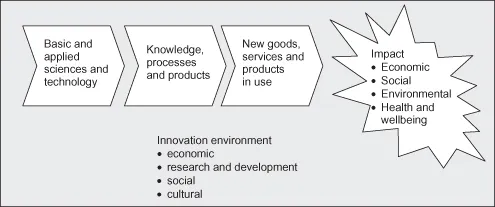
Chemistry may be involved not only in the initial stages of research (e.g., in areas such as agrochemicals and pharmaceuticals: chemical synthesis of new molecules for testing), but also in intermediate stages (e.g., product development, quality control) and in the evaluation of impact (e.g., health status assessment, environmental monitoring), thus contributing in key ways at every stage of the technological innovation chain.
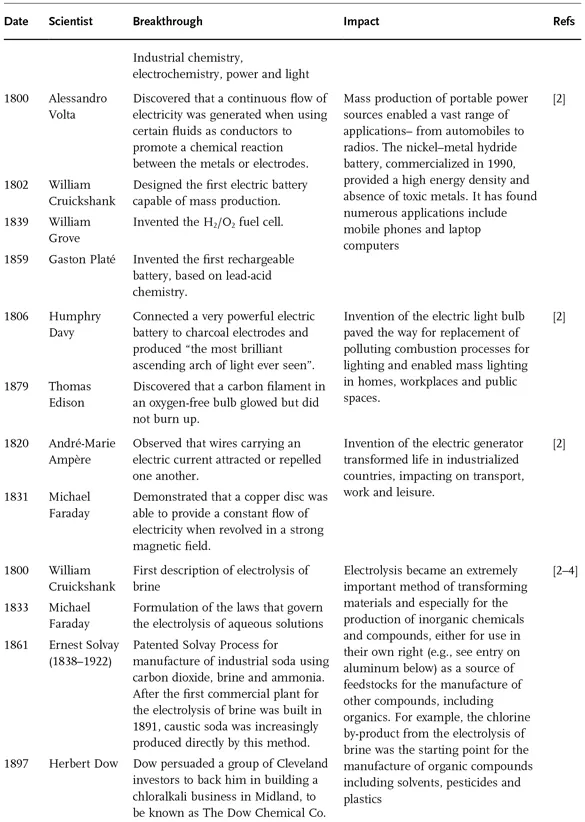
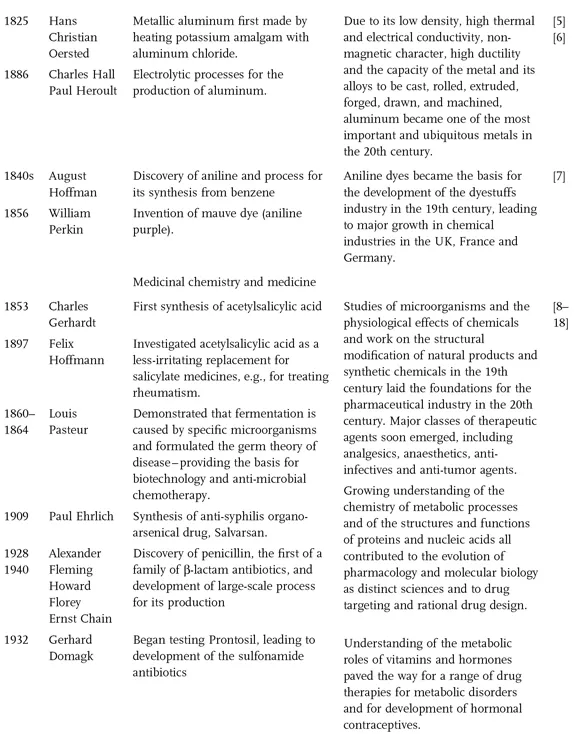
Throughout the modern period of its development, chemistry has contributed enormously both to broad improvements in human wellbeing (including enhancements of health and quality of life) and to wealth creation for individuals and nations. Some landmark examples are summarized in Table 1.1. Early developments in electrochemistry and synergies with physics and engineering led to methods for producing electrical energy, which has impacted on virtually every aspect of human activity. Electrochemistry also provided the basis for the industrial transformation of many materials and, in particular, for the production of metals such as aluminum and important feedstocks such as caustic soda and chlorine. Industrial organic chemistry built on mid-19th century processes for manufacturing dyestuffs, but by the 20th century had expanded to include the synthesis of pharmaceuticals. In parallel with advances in public health (measures for reducing the spread of infectious diseases through improved water, sanitation and vaccination; and for improving health through ensuring optimal nutrition – in all of which areas chemistry has played a major role), pharmaceutical chemistry has contributed enormously to improving life expectancy and the quality of life through the treatment of infectious diseases and metabolic disorders and the control of pain. Chemistry has contributed to many of the advances in agriculture (e.g., fertilizers, plant growth regulators, pesticides) which have been characterized as a “green revolution” and which have helped to feed the world’s population while it grew from about 1 billion to 6 billion during the 20th century. Moreover, chemistry has given the world a wide array of new materials, including polymers, plastics, semiconductors and superconductors, with applications from fabrics and structural materials to information and communications technologies and medical imaging.
Table 1.1 Landmark examples of chemistry breakthroughs contributing to health and wealth.
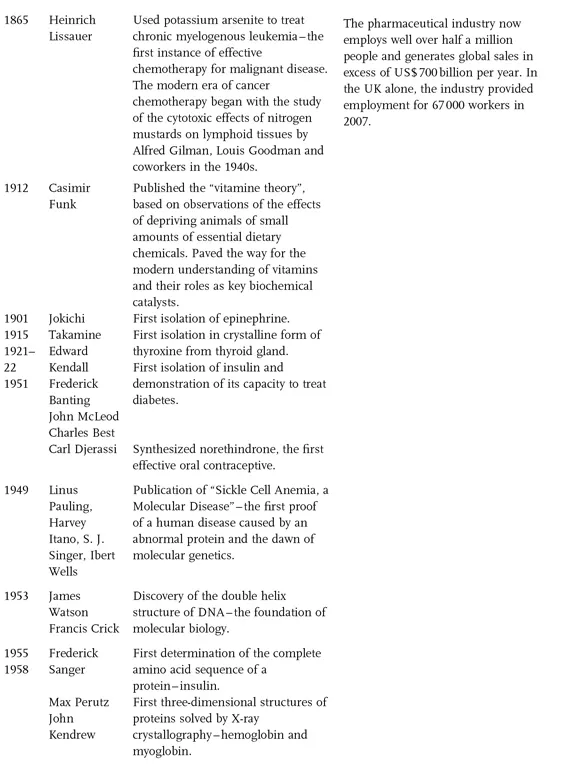
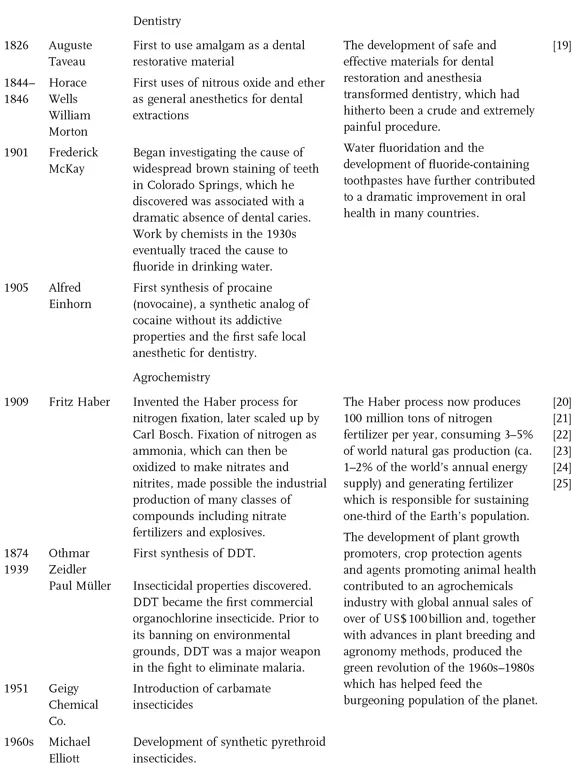
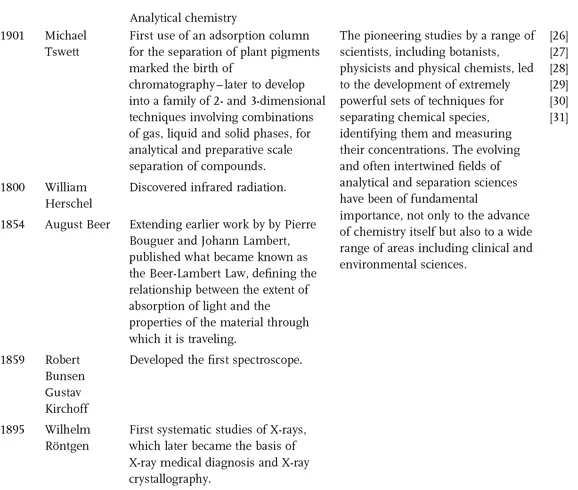
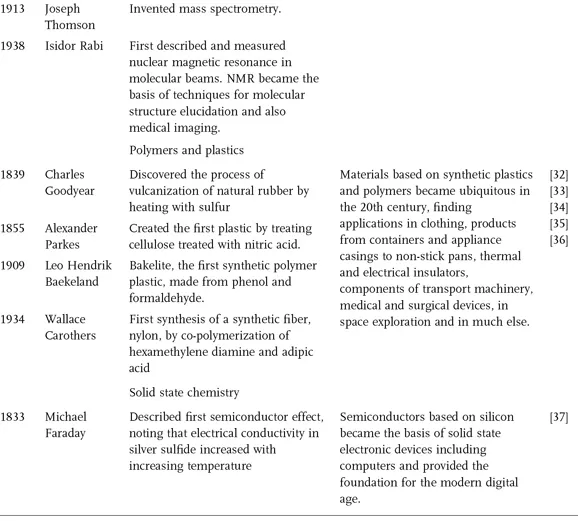
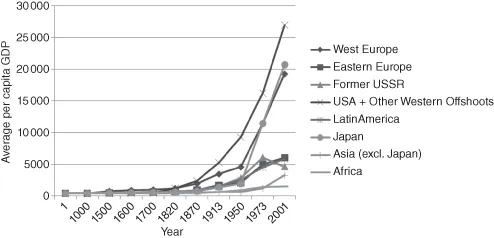
The value added by these products of chemistry and related sciences has contributed to the rapid growth in world GDP [38], especially in the industrially advanced countries during the second half of the 20th century (Figure 1.2). Knowledge-intensive and technology-intensive industries are estimated [39] to have accounted for 30% of global economic output, or some US$15.7 trillion, in 2007.
Figure 1.2 Per capita GDP: Regional and world averages, 1–2001 AD (millions 1990 international Geary-Khamis dollars).
Data from [38], Table 8c.
1.2 Poverty and Disparities in Life Expectancy
The benefits from advances in chemistry and other sciences have not been evenly distributed globally. The least industrially/technologically advanced countries have remained the poorest and people in the low- and middle-income countries (LMICs) have often fared worse than those in high-income countries (HICs), as illustrated by the dramatic relationship between poverty and life expectancy: the poor die young. Life expectancies around the world have increased very markedly over the course of the last century, but as they have done so the disparities between populations have grown larger [40]. However, the relationship between life expectancy and the average per capita income of the country is not a straightforward one and income is not the only factor involved. The economist Easterlin [41] concluded that much of the decline in mortality in the 20th century had its origin in technical progress – and in this context, “technical progress” refers to a combination of technological advances and their diffusion and uptake in different countries and the capacities of the countries themselves to conduct and apply research. Much of the variation in life expectancies seen between countries is explained by differences in the rate of this technical progress – for example, it explains two thirds of the variation in the decline in infant mortality over a 25 year period, whereas change in income explains only 9% [42, 43].
1.3 The Millennium Development Goals
In response to the unacceptable levels of poverty (Box 1.1) and growing disparities in health and wellbeing between people in different countries, the world’s governments met at the Millennium Summit [44] in New York on 6–8 September 2000, issuing the Millennium Declaration which led to agreement on a series of Millennium Development Goals (MDGs) [45] that were set for 2015 (Table 1.2). The targets were acknowledged to be extremely ambitious – but it was recognized that, for the first time in history, mankind had the capacity to substantially reduce or eliminate many sources of human suffering and to offer every person on the planet a basic level of existence that would be free from hunger, disease and discrimination in access to opportunities for development.
Box 1.1 Poverty
What is poverty?
Poverty is hunger. Poverty is lack of shelter. Poverty is being sick and not being able to see a doctor. Poverty is not having access to school and not knowing how to read. Poverty is not having a job, is fear for the future, living one day at a time. Poverty is losing a child to illness brought about by unclean water. Poverty is powerlessness, lack of representation and freedom.
The World Bank [46]
Table 1.2 Millennium development goals.
| Goals | Targets |
| Goal 1 Eradicate extreme poverty and hunger | Halve, between 1990 and 2015, the proportion of people whose income is less than $1 a day Halve, between 1990 and 2015, the proportion of people who suffer from hunger |
| Goal 2 Achieve universal primary education | Ensure that, by 2015, children everywhere, boys and girls alike, will be able to complete a full course of primary schooling |
| Goal 3 Promote gender equality and empower women | Eliminate gender disparity in primary and secondary education preferably by 2005 and in all levels of education no later than 2015 |
| Goal 4 Reduce child mortality | Reduce by two-thirds, between 1990 and 2015, the under-five mortality rate |
| Goal 5 Improve maternal health | Reduce by three-quarters, between 1990 and 2015, the maternal mortality ratio |
| Goal 6 Combat HIV/AIDS, malaria and other diseases | Have halted by 2015 and begun to reverse the spread of HIV/AIDS Have halted by 2015 and begun to reverse the incidence of malaria and other major diseases |
| Goal 7 Ensure environmental sustainability | Integrate the principles of sustainable development into country policies and programmes and reverse the loss of environmental resources Halve, by 2015, the proportion of people without sustainable access to safe drinking water and basic sanitation Have achieved, by 2020, a significant improvement in the lives of at least 100 million slum dwellers |
| Goal 8 Develop a global partnership for development | Develop further an open, rule-based, predictable, non-discriminatory trading and financial system (includes a commitment to good governance, development, and poverty reduction – both nationally and internationally) |
| Address the special needs of the least developed countries (includes tariff-and quota-free access for exports, enhanced program of debt relief for HIPC and cancellation of official bilateral debt, and more generous ODA for countries committed to poverty reduction) Address the special needs of landlocked countries and small island developing states (through the Program of Action for the Sustainable Development of Small Island Developing States and 22nd General Assembly provisions) | |
| Deal comprehensively with the debt problems of developing countries through national and international measures in order to make debt sustainable in the long term | |
| In cooperation with developing countries, develop and implement strategies for decent and productive work for youth | |
| In cooperation with pharmaceutical companies, provide access to affordable, essential drugs in developing countries | |
| In cooperation with the private sector, make available the benefits of new technologies, especially information and communications |
As stated in the report of the Task Force on Science Technology and Innovation of the Millennium Project [47]:
“Since their adoption at the United Nations Millennium Summit in 2000, the Millennium Development Goals have become the international standard of reference for measuring and tracking improvements in the human condition in developing countries. The Goals are backed by a political mandate agreed by the leaders of all UN member states. They offer a comprehensive and multidimensional development framework and set clear quantifiable targets to be achieved by 2015.”
The latest assessment shows that uneven progress has been made towards meeting the targets. Unmet commitments, inadequate resources, lack of focus and accountability and insufficient dedication to sustainable development have created shortfalls in many areas and without a major push forward many of the MDG targets are likely to be missed in most regions [48].
To achieve the goals will require a collective global effort harnessing political will, available resources and innovation in all areas, including the application of science and technology.
1.3.1 Goal 1: Reducing Poverty and Hunger
Economic growth, especially in the world’s most populace country, China, resulted in hundreds of millions of people being lifted out of poverty during the last quarter of the 20th century [46]. Nevertheless, at the end of the century, out of a global population of 6 billion there were more than one billion people living on less than $1 a day, more than three billion living on less than $2 a day and nearly a billion suffering from hunger or severe malnutrition.
While many economically advanced countries produce an excess of food, some of which goes to waste, halving the proportions of those suffering poverty or hunger by 2015 is not merely a matter of redistributing available food. To overcome the net food shortage, allow for the expanding world population (already approaching 7 billion by 2010), ensure food security and indepen...
Table of contents
- Cover
- Related Titles
- Title page
- Copyright page
- The Chemical Element: Chemistry’s Contribution to Our Global Future
- Introduction
- List of Contributors
- 1 Chemistry for Development
- 2 The Role of Chemistry in Addressing Hunger and Food Security
- 3 Poverty
- 4 The Human Element: Chemistry Education’s Contribution to Our Global Future
- 5 The Impacts of Synthetic Chemistry on Human Health
- 6 The Greening of Chemistry
- 7 Water: Foundation for a Sustainable Future
- 8 Facing the Energy Challenges through Chemistry in a Changing World
- 9 Ozone Depletion and Climate Change
- Epilogue
- Index
- Color Plates
Trusted by 375,005 students
Access to over 1.5 million titles for a fair monthly price.
Study more efficiently using our study tools.
Frequently asked questions
Yes, you can cancel anytime from the Subscription tab in your account settings on the Perlego website. Your subscription will stay active until the end of your current billing period. Learn how to cancel your subscription
No, books cannot be downloaded as external files, such as PDFs, for use outside of Perlego. However, you can download books within the Perlego app for offline reading on mobile or tablet. Learn how to download books offline
Perlego offers two plans: Essential and Complete
- Essential is ideal for learners and professionals who enjoy exploring a wide range of subjects. Access the Essential Library with 800,000+ trusted titles and best-sellers across business, personal growth, and the humanities. Includes unlimited reading time and Standard Read Aloud voice.
- Complete: Perfect for advanced learners and researchers needing full, unrestricted access. Unlock 1.5M+ books across hundreds of subjects, including academic and specialized titles. The Complete Plan also includes advanced features like Premium Read Aloud and Research Assistant.
We are an online textbook subscription service, where you can get access to an entire online library for less than the price of a single book per month. With over 1.5 million books across 990+ topics, we’ve got you covered! Learn about our mission
Look out for the read-aloud symbol on your next book to see if you can listen to it. The read-aloud tool reads text aloud for you, highlighting the text as it is being read. You can pause it, speed it up and slow it down. Learn more about Read Aloud
Yes! You can use the Perlego app on both iOS and Android devices to read anytime, anywhere — even offline. Perfect for commutes or when you’re on the go.
Please note we cannot support devices running on iOS 13 and Android 7 or earlier. Learn more about using the app
Please note we cannot support devices running on iOS 13 and Android 7 or earlier. Learn more about using the app
Yes, you can access The Chemical Element by Javier García-Martínez,Elena Serrano-Torregrosa in PDF and/or ePUB format, as well as other popular books in Physical Sciences & Chemistry. We have over 1.5 million books available in our catalogue for you to explore.