- English
- ePUB (mobile friendly)
- Available on iOS & Android
eBook - ePub
About this book
The book is intended to serve as lecture material for courses on relativity at undergraduate level. Although there has been much written on special relativity the present book will emphasize the real applications of relativity. In addition, it will be physically designed with the use of box summaries so as to allow easy access of practical results. The book will be composed of eight chapters. Chapter 1 will give an introduction to special relativity that is the world without gravity. Implications will be presented with emphasis on time dilation and the Doppler shift as practical considerations. In Chapter 2, the four-vector representation of events will be introduced. The bulk of this chapter will deal with flat space dynamics. This will require the generalization of Newton's first and second laws. Some important astronomical applications will be discussed in Chapter 3 and in Chapter 4 some engineering applications of special relativity such as atomic clocks will be presented. Chapter 5 will be dedicated to the thorny question of gravity. The physical motivation of the theory must be examined and the geometrical interpretation presented. Chapter 6 will present astronomical applications of relativistic gravity. These include the usual solar system tests; light bending, time delay, gravitational red-shift, precession of Keplerian orbits. Chapter 7 will be dedicated to relativistic cosmology. Many of the standard cosmological concepts will be introduced, being mathematically simple but conceptually subtle. The concluding chapter will be largely dedicated to the global positioning system as an engineering problem that requires both inertial and gravitational relativity. The large interferometers designed as gravitational wave telescopes will be discussed here.
Information
Part I
The World Without Gravity
1
Non-Relativity for Relativists
Dura lex, sed lex (The law is hard but it is the law)
1.1 Vectors and Reference Frames
In this section we discuss our fundamental concepts as drawn from experience. This ends in frustration since experience is approximate, most things are known relative to other things, and our concepts often seem to be defined in terms of themselves. Thus ‘fundamental’ argument resembles the circular snake devouring its tail (the Ouroboros). However we must make a beginning, and so we confront our first definition and its algebraic implications.
What is an inertial reference frame? I prefer to parse this question into two principal questions. By ‘reference frame’ we mean some well-defined system of assigning a measured time and a measured position to an ‘event’. For the moment an ‘event’ is point-like, as for example the time at which a particle or the centre of mass of an extended body takes a particular spatial position. The reference frame also implies an ‘observer’ who records the measurements. The resulting numbers are the ‘coordinates’ of the event in this reference frame. By ‘inertial’ we mean a reference frame in which Newton’s first law of motion1 applies to sufficiently isolated bodies. This axiom requires not only that the coordinates of a body be determinable from moment to moment, but also that fixed spatial directions be defined. Neither one of these definitions is particularly exact or obvious and yet they are fundamental to our subject. Thus we continue their exploration in the next two sections.
1.1.1 Reference Frames
Although this is not strictly necessary, location is normally specified relative to a set of objects that have no relative motion between them. Some fixed point within this set of objects is chosen as the reference point or ‘origin’ from which all distances are measured. On small enough scales that we can reach continuously, the measurement is made by placing a standard length along a straight line between the points of interest. We call this standard length a ‘ruler’ or a ‘unit’ and we assume that we can determine a ‘straight line’. On larger scales, various more subtle methods are required.
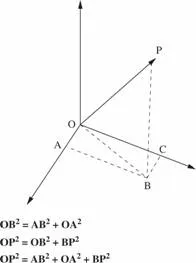
Our most familiar example is the Earth itself. On small scales we have no difficulty in establishing a rigid frame of reference by assuming Euclidean geometry. That is, we assume that the Earth is ‘flat’ so that trigonometry and an accurate ruler suffice to measure distance. When lasers are used we are assuming that even the near space above the surface of the Earth is Euclidean and that light follows the straight lines. On larger scales the Earth is found to be a sphere, so that its surface does not obey Euclidean geometry. Position has to be assigned by latitude and longitude, which requires the use of a combination of accurate clocks and astronomical observations in the measurements. Distance is computed between points using the rules of spherical trigonometry, rather than the Euclidean rule of Pythagoras2 (see e.g. Figure 1.1).
Figure 1.1 The three perpendicular axes emanating from O are reference directions. Each axis is rigid and the projections of OP on these axes furnish the Cartesian weights or components. The theorem of Pythagoras gives the distance OP in terms of these
The Earth is not exactly a rigid sphere, but a global reference frame precise enough to detect this fact became generally available only with the advent of the Global Positioning System (GPS) of satellites. This remarkable development, based on multiple one-way radar ranging, has allowed us to measure the ebb and flow of oceans and continents in a non-rigid, spheroidal global frame. However, it assumes principles that we have yet to examine, and that will be the subject of much of this book.
Thus the procedure to define a ‘rigid’ frame of spatial reference always involves assumptions about the nature of the world around us, and it is these that we must carefully examine subsequently. Moreover such a reference frame is always an idealization. Errors are involved in determining practical spatial coordinates on every scale, so that our knowledge of distance is always approximate. Moreover the degree of idealization increases with spatial extent of the reference frame, as it becomes progressively more difficult to maintain rigidity.
In parallel with spatial position, we have managed recently to establish a global measure of time that allows us to say whether or not events occurred simultaneously. This means that a single number can be assigned to a global point-like event (e.g. the onset of an earthquake in China or sunrise at Stonehenge on Midsummer’s Day). The number is assigned by each of a network of synchronized atomic clocks distributed over the reference frame of the Earth. The sequence of such numbers defines ‘coordinate time’ for the Terrestrial Reference Frame. The difference between such numbers that encompass the beginning and end of an extended event (such as a lifetime) may be called a ‘duration’ for brevity. In practice, only durations of finite length are meaningful since no measurement can be made with infinite precision, but we normally assume that they can be arbitrarily small in principle....
Table of contents
- Cover
- Title
- Copyright
- Dedication
- Preface
- Acknowledgements
- Introduction
- Part I: The World Without Gravity
- Part II: Relativity With the Gravitational Field
- Plate
- Index
Trusted by 375,005 students
Access to over 1.5 million titles for a fair monthly price.
Study more efficiently using our study tools.
Frequently asked questions
Yes, you can cancel anytime from the Subscription tab in your account settings on the Perlego website. Your subscription will stay active until the end of your current billing period. Learn how to cancel your subscription
No, books cannot be downloaded as external files, such as PDFs, for use outside of Perlego. However, you can download books within the Perlego app for offline reading on mobile or tablet. Learn how to download books offline
Perlego offers two plans: Essential and Complete
- Essential is ideal for learners and professionals who enjoy exploring a wide range of subjects. Access the Essential Library with 800,000+ trusted titles and best-sellers across business, personal growth, and the humanities. Includes unlimited reading time and Standard Read Aloud voice.
- Complete: Perfect for advanced learners and researchers needing full, unrestricted access. Unlock 1.5M+ books across hundreds of subjects, including academic and specialized titles. The Complete Plan also includes advanced features like Premium Read Aloud and Research Assistant.
We are an online textbook subscription service, where you can get access to an entire online library for less than the price of a single book per month. With over 1.5 million books across 990+ topics, we’ve got you covered! Learn about our mission
Look out for the read-aloud symbol on your next book to see if you can listen to it. The read-aloud tool reads text aloud for you, highlighting the text as it is being read. You can pause it, speed it up and slow it down. Learn more about Read Aloud
Yes! You can use the Perlego app on both iOS and Android devices to read anytime, anywhere — even offline. Perfect for commutes or when you’re on the go.
Please note we cannot support devices running on iOS 13 and Android 7 or earlier. Learn more about using the app
Please note we cannot support devices running on iOS 13 and Android 7 or earlier. Learn more about using the app
Yes, you can access Practical Relativity by Richard N. Henriksen in PDF and/or ePUB format, as well as other popular books in Physical Sciences & Relativity in Physics. We have over 1.5 million books available in our catalogue for you to explore.