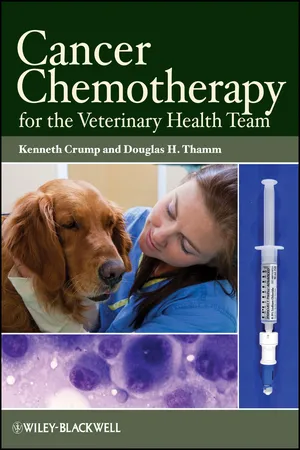
With background information for effectively communicating with clients, including coverage of veterinary cancer surgery and radiation therapy, the book provides specific strategies that address the challenging emotional issues surrounding the diagnosis and treatment of cancer in pets. With particular insight into the technician's role, Cancer Chemotherapy for the Veterinary Health Team is a must-have reference for any practice offering chemotherapy.
eBook - ePub
Cancer Chemotherapy for the Veterinary Health Team
- English
- ePUB (mobile friendly)
- Available on iOS & Android
eBook - ePub
Cancer Chemotherapy for the Veterinary Health Team
About this book
Cancer Chemotherapy for the Veterinary Health Team is a clinically relevant and practical manual designed as a guide for the safe and effective administration of cancer chemotherapy. Coverage includes patient assessment, chemotherapy equipment, drug preparation, safety considerations, handling, administration, waste disposal, and management of chemotherapy side effects. An alphabetical listing of common chemotherapy agents offers information on their uses, indications, and toxicities, as well as administration guidelines for methods, routes, and speeds.
Information
1
Dispelling the Myths of Animal Cancer and Its Treatment
Key Points
- Cancer is a disease we can sometimes cure.
- The four most dangerous words in cancer treatment are “Let’s just watch it.”
- Obtaining a diagnosis prior to surgery is important.
- Often, the part of the tumor that we can see and feel is only the “tip of the iceberg.”
- Pets experience chemotherapy differently from humans.
- Fewer and less severe side effects
- Most dogs and cats do not lose a lot of hair from chemotherapy
- The sooner we start chemotherapy, the better chance the drugs have to do their job.
- Radiation therapy is a form of local therapy.
- Side effects like nausea, fatigue, or bone marrow suppression do not occur.
- Pets are not radioactive after treatment.
Introduction
There is a great stigma attached to a diagnosis of cancer. It is natural for owners of pets with cancer to relate cancer treatment in animals with the experiences they have had with their own treatments, that of their friends, or their family members. Understanding how cancer treatment in animals differs from cancer treatment in humans is critical when informing owners about cancer and discussing treatment options. Pet owners want to make an informed decision when selecting treatment for their dogs or cats with cancer, and the veterinary technician is often called upon to help answer these questions for the owners.
This chapter describes many of the common questions that owners have about animal cancer and its treatment, and some ideas on how to answer those questions. It is presented in a “question-and-answer” format, with explanations and additional information following the answers.
General Information, Pretreatment Diagnostics, and Staging
Client: Is cancer really a problem in animals?
Technician: Unfortunately, yes. It is the leading “natural” cause of death in adult dogs and the second or third leading cause in cats. Up to 50% of dogs and 30% of cats will be affected by some type of tumor in their lifetime.
Client: Why does it seem like there is so much more cancer in pets these days?
Technician: Better health care = longer life. Cancer is an old-age disease, and more pets are living long enough to get old-age-related illnesses.
Explanation
We are getting so good at managing other husbandry-related conditions in our pets (nutrition, infection, parasites, keeping pets indoors and on leashes) that they are now living long enough to develop more old-age conditions, such as heart disease, kidney disease, endocrine disease, and cancer. Furthermore, now that there are more cancer specialists and options for treating cancer in pets, it is being reported more frequently.
Client: Did something in the environment play a role in Sparky’s cancer? Was I feeding the wrong food?
Technician: For most forms of cancer, we don’t know of any specific causes.
Explanation
There have been some relationships suggested between certain types of cancer and the environment. For instance, some suggest a relationship between canine lymphoma and certain farm chemicals or living in urban areas. Canine mesothelioma has been linked to asbestos. Second-hand smoke has been a suggested contributor to feline gastrointestinal lymphoma. But in most cases, such associations do not hold up to further investigation. Thus, based on what we currently know, food additives, lawn chemicals, pesticides, or cosmic rays do not seem to significantly increase a pet’s risk of most cancers.
Client: What is the difference between “cancer” and “tumor”?
Technician: There is no practical difference. Both refer to abnormal masses in the body that occur as a result of cell growth that has become disorganized and no longer responds to the normal signals telling them to stop growing.
Client: What is the difference between “benign” and “malignant”?
Technician: Malignant tumors are those that have the ability to invade surrounding tissues deeply and/or spread to other parts of the body. Benign tumors do not spread and do not invade very deeply. Small surgery is much more likely to permanently fix a benign tumor than it is to fix a malignant tumor.
Client: Why should I treat my dog’s cancer?
Technician: Cancer is a disease that we can sometimes cure. Diseases like heart disease, diabetes, and other endocrine diseases, as well as cancer, can all be thought of as chronic diseases. We treat many animals with chronic diseases that are never cured. Even in cases where cure is unlikely, there are many ways we can extend a pet’s excellent quality of life with treatment.
Client: Why can’t we just watch the mass and see what happens?
Technician: The four most dangerous words in cancer treatment are “Let’s just watch it.” The sooner we know what this is, the sooner we can begin appropriate treatment.
Explanation
Owners may question why a fine needle aspiration or biopsy of a mass needs to be performed, rather than simply monitoring the mass for change. In general, delay in diagnosis only increases the difficulty of treatment because delay allows the tumor to grow. This may mean a larger, more complicated, more risky, or more expensive surgery. Larger tumor size is associated with worse outcomes for several important veterinary cancers. The lump you are dealing with may be benign, but if it is malignant, the time to find that out is now.
Client: Doesn’t performing a fine needle aspiration or biopsy make the tumor “angry” and increase the risk of spread?
Technician: NO. There is no risk of increased spread from a fine needle aspiration or biopsy.
Explanation
Exceptions to this rule are the following:
(1) Some mast cell tumors may become “inflamed” following a fine needle aspiration due to histamine release, although this does not, in any way, increase the spread. This is rarely serious and can be treated or prevented with an antihistamine, such as diphenhydramine.
(2) Needle aspiration/needle core biopsy of splenic and bladder masses is not recommended due to the risk of local tumor dissemination in the abdomen and/or seeding of the biopsy tract. In these situations, tumor cells can seed either the abdominal cavity after bleeding (spleen) or the body wall as tumor cells are dragged through it by the needle (bladder). Cytocentesis for urine collection in patients suspected or known to have bladder cancer should likewise be avoided.
(3) It is important that needle aspirations and biopsies of cutaneous/subcutaneous masses are planned so that the biopsy tract can be removed when the tumor is removed. This will prevent regrowth along the tract.
Client: Why don’t we just take the tumor off? Why do we need to do a fine needle aspiration or biopsy first?
Technician: Knowing what we are dealing with before surgery lets us know how big a surgery we need to perform, and whether there are any tests that should be performed beforehand.
Explanation
Obtaining a diagnosis prior to surgery lets the veterinarian know whether additional tests are indicated prior to surgery and helps to plan the surgical approach. This helps avoid situations like “Why didn’t you take X-rays before surgery?” and “Why should I have to pay for a second surgery if you ‘didn’t get it all’ the first time?” If surgery is used to obtain a diagnosis, it is important that the owner understands that it may only be another diagnostic test. Based on what is learned from a diagnostic surgery, more tests or treatments might be necessary.
Client: We already did surgery. Isn’t that enough? Why can’t we just wait and see if it grows back?
Technician: If a malignant tumor has been incompletely removed (the so-called dirty cut), the likelihood of regrowth may be high. Tumors that grow back can be much harder to treat.
Explanation
Additional treatment, such as more surgery or radiation therapy, is often recommended if a tumor has been incompletely removed. Locally recurrent tumors (tumors that grow back after surgery) are associated with a worse prognosis in certain diseases, such as canine mast cell tumor and oral melanoma, and are suspected of being worse in others. For this reason, if a tumor is incompletely removed, the time to be aggressive is the very first time the tumor occurs.
Client: Why can’t we wait and see if it spreads, instead of treating now?
Technician: The sooner we start chemotherapy, the better chance the drugs have to do their job. Chemothe...
Table of contents
- Cover
- Title page
- Copyright page
- Contributors
- Preface
- Acknowledgments
- 1 Dispelling the Myths of Animal Cancer and Its Treatment
- 2 Cancer Basics
- 3 Preparation for Chemotherapy Administration
- 4 Assessment of the Chemotherapy Patient
- 5 Chemotherapy Handling, Safety, and Disposal
- 6 Workflow for Chemotherapy Administration
- 7 Chemotherapy Agents
- 8 Management of Chemotherapy Side Effects
- 9 Compassionate Client Communication
- Glossary
- Index
Trusted by 375,005 students
Access to over 1.5 million titles for a fair monthly price.
Study more efficiently using our study tools.
Frequently asked questions
Yes, you can cancel anytime from the Subscription tab in your account settings on the Perlego website. Your subscription will stay active until the end of your current billing period. Learn how to cancel your subscription
No, books cannot be downloaded as external files, such as PDFs, for use outside of Perlego. However, you can download books within the Perlego app for offline reading on mobile or tablet. Learn how to download books offline
Perlego offers two plans: Essential and Complete
- Essential is ideal for learners and professionals who enjoy exploring a wide range of subjects. Access the Essential Library with 800,000+ trusted titles and best-sellers across business, personal growth, and the humanities. Includes unlimited reading time and Standard Read Aloud voice.
- Complete: Perfect for advanced learners and researchers needing full, unrestricted access. Unlock 1.5M+ books across hundreds of subjects, including academic and specialized titles. The Complete Plan also includes advanced features like Premium Read Aloud and Research Assistant.
We are an online textbook subscription service, where you can get access to an entire online library for less than the price of a single book per month. With over 1.5 million books across 990+ topics, we’ve got you covered! Learn about our mission
Look out for the read-aloud symbol on your next book to see if you can listen to it. The read-aloud tool reads text aloud for you, highlighting the text as it is being read. You can pause it, speed it up and slow it down. Learn more about Read Aloud
Yes! You can use the Perlego app on both iOS and Android devices to read anytime, anywhere — even offline. Perfect for commutes or when you’re on the go.
Please note we cannot support devices running on iOS 13 and Android 7 or earlier. Learn more about using the app
Please note we cannot support devices running on iOS 13 and Android 7 or earlier. Learn more about using the app
Yes, you can access Cancer Chemotherapy for the Veterinary Health Team by Kenneth Crump, Douglas H. Thamm, Kenneth Crump,Douglas H. Thamm in PDF and/or ePUB format, as well as other popular books in Medicine & Veterinary Medicine. We have over 1.5 million books available in our catalogue for you to explore.