![]()
PHASE I
DEVELOPMENT
![]()
CHAPTER 1
Develop the Idea
Nations may rise and fall, but an idea lives on. Ideas have endurance without death.
—John F. Kennedy
The path to being a product creator starts with wanting more. Wanting more satisfaction out of our work, more control over our time, or more money. It grows with curiosity. Curiosity about what happens outside our cubicle, away from our desk, and elsewhere in society. Curiosity about what is really possible, and what we are really capable of. These emotions ignite with a spark. A light bulb goes off in our heads. Suddenly, we have an idea that might help or entertain people. The idea refines itself and takes the shape of a product: an object that holds the power to simultaneously solve a problem and make money.
The new shoes you want to make for style or comfort, the new snack you want to make for taste and health, the new toy you want to make for decoration and entertainment—are all within reach. Every successful product around you started as a concept, many of them created and brought to market by people just like you.
Whether you want to rescue yourself from unemployment (or from employment), see your ideas come to life, or find a way to help and entertain the people around you, creating and developing your product idea can help make that happen.
Overview
Before we get into the longer discussion of creating and selling your product, let’s start with the definition of product. It is, admittedly, a bit of a catchall. When we use it in this book, a product is an item that is packaged and labeled for sale. It could be on a shelf in a brick and mortar retailer, or it could be for sale online. It is probably labeled with a UPC code. It is a standardized and producible object. It is scalable, salable, and tangible.
In general, the products business is a crowded, competitive space. It can be complex because of the multiple moving touch points between you and your customer and daunting in the scope of events that you will need to manage.
Starting slow, thinking through investments, and trying to spend as little capital as we initially can, we build this complexity piece by piece, only engaging new players once we know what their role will be. For example, although you can make your formula in your kitchen or at your desk, you will eventually benefit from a supplier to create and pack your product. Although you can sell your product on your web site or in your living room, you will eventually need a network of brokers, distributors, and retailers to really scale. Each of these players comes with trade-offs—their own set of intricacies, rules, expectations, and best practices. These reasons (and not always a quality of the product itself) are why the failure rate on new product introductions, especially by new or inexperienced companies is more than 90 percent.
However, with this book in hand, you will be armed with the kind of knowledge most product entrepreneurs don’t have, and you should be well prepared to penetrate a notoriously thorny world. And why not?—established products bring with them a lucrative and long-term revenue stream. In the case of a sale, a very favorable valuation, often four to six times revenue. That means if you are able to work your way up to, for example, $1 million in revenue for the year, you could sell your company for $4 million to $6 million.
An established product is also a direct line to customers, and is a way to communicate a message unlike any other channel. Success can bring the ability to affect society and tackle social problems, as well as personal recognition and empowerment. That next great idea that you’re sitting on is a lottery ticket that lets you pick the numbers as they roll.
The successful products company understands branding, marketing, design, and the messages that matter to their customer. It also understand their partners and suppliers, and build great relationships. Getting through retailers involves street level sales, incentives and promotions, support, and exclusivity. It is nearly impossible for one person to do alone and part-time, but not at all unachievable to leverage your available labor if planned properly.
I did it. And I’m going to show you how.
Keep in mind that even a cleverly engineered supply chain is not enough. The products business is capital intensive. Your manufacturer is going to have minimum production volumes that could be in the truckloads. This book will walk through some negotiation strategies that work, but keep in mind that you will likely have to finance your first order alone. Production should not occupy your whole wallet either, as sales and marketing expenses should be in the plan as well. Although this book will focus on getting your concept to a shelf, every product entrepreneur should have more than a cursory understanding of the costs involved.
Start with Yourself
You are special, but not unique. The experiences and insight that you have developed over the course of your life are yours, but likely similar to a larger group of people. In addition, it is likely that the things you need are commonly needed by your group. Perhaps you already know what kind of product you want to make. Perhaps you even have an idea of what it would look like and what features you would like it to have. Then again, you may have picked up this book exactly to get that kind of inspiration.
Ideas are fluid things—they can change shapes in your head and be very slippery to nail down, even when you think you have a pretty solid concept. For many people I know, this is a big stumbling block—you cannot very well act on a concept and bring it to life without putting it on paper in a way that lets you understand yourself better. A mind map is one tool that enables you to lay out an idea in all its interconnected glory.
How do you create and use a mind map? Stephen Zhu, vice president and co-founder of XMind, recently launched a digital product called XMind in China. It’s mind-mapping software—and to create it, Stephen had to become something of a mind-mapping expert. He says the best way to mind map, if there is such a thing, is to proceed without limitations. Let the creative sparkle work out first, then organize your thoughts, and finally format the map so that it’s easy to refer back to.
I have found that XMind is easy to use. It helps to clarify your thinking by offering a digital place to vent. But the biggest mistake I’ve seen people make is to get caught up in the organization and formatting of the process before all their ideas get out. Don’t let that happen to you.
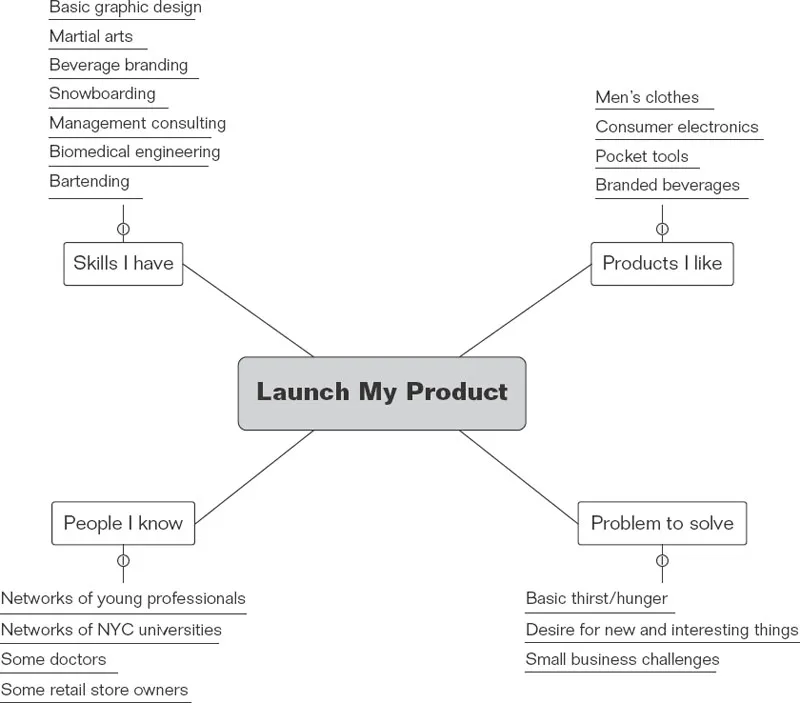
The first exercise in this chapter will get you started on laying out all your random thoughts about your concept. Don’t worry too much about whether it makes sense or where it goes; just get into the concept map and lay everything out. Take a peek at Figure 1.1 to see how I did.
Depending on your area of interest, expertise, or skill, you might choose one industry and category in which to launch your product. For example, in looking at my mind map, I might realize that I have some consulting skills and really want to help small businesses, or that I know many young professionals and have always wanted to create electronics. If you don’t already have a product in mind, selecting this type of segment from your network and the industry you want to play in could be the most influential decisions you make. (We will get into this in Chapter 2, and will start industry selection in the next exercise.)
When you haven’t yet found inspiration in a current product, see if you can identify a customer you have access to. Are you part of a group of people who share a hobby or passion? Most of us are, even if we don’t think of it that way. If you work in an office, everyone there has that in common with you. If you are a member of a gym or play a sport, those are both groups of people who share a very specific pastime. Even seasonal hobbies like snowboarding the winter or jogging in the spring can come with large groups of people who are all interested in similar things. Once you figure out where that group of people is for you, start figuring out what they need. Loiter and talk to people in your gym, join a runners’ club, poll people in your social group about what they might need.
Exercise: Mind Mapping
Before you read any further, grab a pencil and try this exercise. Let’s map out your interests and skills in a quick diagram that could help you get thinking about what you bring to the table.
Put your product in the middle (if you know what it is, great; if not, don’t worry) and list around it all the things about you that could help. Skills you have either from hobbies or past work count, as do the people (both individuals and social groups) that you know. Also, think a bit about why people want this product—what problem do you want to solve for them that will make them want to purchase this from you?
Now, look back at your map. How many of your own skills and experiences seem apropos to your product idea? Depending on your personal and professional background, you may have a lot of content to learn. The product launchers I’ve met fall into one of two categories:
1. Professionals with decades of relevant industry experience who are flexing the full might of a platinum Rolodex to get their product out.
2. People who are chasing a passion without substantial work experience in their field.
I happen to be the latter, but am not necessarily endorsing either.
By the way, if you wanted to try XMind, check out www.xmind.net/.
Use Web Tools to Gauge Demand
As you start getting a feel for a product you might want to create, cross-check your intuition against demand with some of the tools made available to you.
Google Trends channels the zeitgeist of arguably the biggest demand processor in the world. Every moment, someone is typing what they want into Google, and we can read about it using Trends. The key to getting usable insight out of Trends is to test not the name or category of your potential product, but the question keywords that your customers might be thinking about.
When I was trying to come up with my product, I went to Trends to see how some of my different proposed selling points stacked up. I wanted my product to be a starfruit juice (based somewhat on some antioxidant reading I had been doing at the time), but a quick test on Trends confirmed that people were not really searching for starfruit. They didn’t know about it yet. People were frequently and reliably searching for antioxidants and Vitamin C, however. While this does not necessarily mean they want to buy them, it’s definitely an indicator of demand. They had recently been much more likely than in the past to be searching for superfruits. And this was not only true in the United States but in many major markets around the world. Given that my juice was going to be rich in antioxidants and Vitamin C, and was itself a superfruit, I was feeling confident that my product had merit, and in my ability to capture some web traffic.
Exercise: Break it Down
Before we get into the real nuts and bolts of your project, do you already have an inkling of what category or product type you want to work on? Using only your gut feel, look at Table 1.1 and cross off all the categories that you don’t want to create a product in. Circle the ones you might be interested in.
Table 1.1: Product Categories
While search is one decent indicator of popularity, conversation is another. Twitter search is a quick and effective way to see what people are tweeting on a particular topic. To continue my example, I saw that many people were discussing how much they loved starfruit. It turned out that while many had not yet heard of it, there were pockets of people happily exclaiming their love for starfruit. However, for my other terms that I thought were working well on Google, a Twitter search only brought up tweets of people hawking one product or another. It seems that other savvy web marketers saw that people were searching for popular ideas and saturated the conversation with them. This is bound to happen—it takes effort to stay ahead of the wave. Also, a quick search on news and blog articles for your item or for your category will help you see what the mainstream media and experts are saying about your category. Finally, make sure you get on to Amazon and see if something like your product already exists.
Through the methods outlined here, you should get a fair sense of what the market will think of your product. The live conversations you have will let you get personal opinions from those near you. Google will tell you what people are looking for, and a Twitter search will let you in on what they’re discussing. The experts can tell you whether they agree with Google Trends, synthesis of the information. When you put that all together, you should have an idea of your product’s features and selling points, even if you don’t know what it is yet.
Indeed, for a while, I had not yet planned a specific beverage, and wanted to learn more about the category. I realized that my product would be all-natural or organic, it would need to emphasize the Vitamin C, and downplay the sugar content. With that in mind, I could get to the details later.
Exercise: What’s Out There?
Whether or not you have a product in mind yet, get on to your computer and check out what kind of demand exists for your (or any) product.
- Google Trends: google.com/trends
- Twitter Search: search.twitter.com/
- News and Blog Search: news.google.com/ and blogsearch.google.com/
- Amazon Product Search: amazon.com/
- Bonus: USPTO Search: Look for TESS on uspto.gov/
Capture Inspiration
Now that you have a sense of the demand for a product, search yourself for inspiration. Even a product in high demand will t...