eBook - ePub
Predictive Control in Process Engineering
From the Basics to the Applications
- English
- ePUB (mobile friendly)
- Available on iOS & Android
eBook - ePub
Predictive Control in Process Engineering
From the Basics to the Applications
About this book
Describing the principles and applications of single input, single output and multivariable predictive control in a simple and lively manner, this practical book discusses topics such as the handling of on-off control, nonlinearities and numerical problems. It gives guidelines and methods for reducing the computational demand for real-time applications. With its many examples and several case studies (incl. injection molding machine and waste water treatment) and industrial applications (stripping column, distillation column, furnace) this is invaluable reading for students and engineers who would wish to understand and apply predictive control in a wide variety of process engineering application areas.
Information
Chapter 1
Introduction to Predictive Control
Model-based predictive control is a relatively new method in control engineering. The basic idea of the method is to consider and optimize the relevant variables, not only at the current time point but also during their course in the future. This goal is achieved first by a heuristic choice of the manipulated variable sequence and simulation of the future course of the process variables. If the future course of the controlled and the constrained variables is not satisfactory, then new manipulated variable sequences are tried out until the control behavior becomes satisfactory. The expression “predictive control” arises from a forecast of the variables. A process model is necessary to simulate the process; therefore, we have the attribute “model based”. In acquiring knowledge of the predicted process variables, constraints on the manipulated, controlled, and other variables can be simply taken into account. Predictive control makes possible robust control, mostly at the expense of slower performance. These algorithms are particularly suitable for petrochemical plants, which are slow enough to allow the simulation of the future course of the process values to consider both the controlled variables and the fulfillment of the constraints.
In the sequel the basics of predictive control are dealt with, namely,
- preview of predictive control,
- manipulated, reference, and controlled signals,
- cost function of predictive control,
- receding horizon strategy,
- free and forced responses of the predicted controlled variable,
- minimization of the cost function.
Several simulation examples illustrate the predictive control principle and its advantage over proportional plus integral (plus derivative) (PI(D)) control for
- linear single-input, single-output (SISO) systems,
- linear multi-input, multi-output (MIMO) systems, and
- nonlinear processes.
Finally, the possibility of handling constraints is demonstrated. Practical examples are not dealt with in this introductory chapter. They are discussed in Chapters 12 and 13.
1.1 Preview of Predictive Control
There is a fundamental difference between predictive control and conventional on–off or PID control:
- A conventional controller observes only the current (and remembers the past) process variables.
- A predictive controller observes the current and also the future process variables (and remembers the past variables).
Predictive thinking is more natural in everyday thinking, for example, during car driving one observes the future shape of the road, brakes if one is approaching a curve, pushes the gas pedal if one is nearing a hill, and decreases the speed if another, slower car appears in the field of vision. Figure 1.1 compares the two driver philosophies.
Figure 1.1 Car driving strategies.
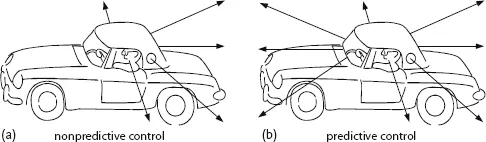
- Conventional control in driving would mean a driving style where the car driver looks only through the side windows. In a curve the driver can correct the trace following the position only after having observed an error.
- Any real driver on the route is a predictive controller, because he/she drives depending on the curvature and what he/she sees in advance in front of the car.
The longer the preview distance, the better the position control, but the calculations are more time consuming. The horizon length has to be increased with the car speed. Beyond a certain preview distance the control would not be better. A minimum sampling time is necessary, otherwise the car cannot follow the driver’s commands in due time.
The aim of control is to follow the reference signal and reject (which means eliminate) the effect of the disturbances. Therefore, the quality of the control depends on how these signals can be known in advance and also on the quality of the process model.
Sometimes there is no information about the future course of the reference signal or disturbance. Then the signal is assumed to remain constant, which is also a prediction, though it is not optimal.
1.1...
Table of contents
- Cover
- Half Title page
- Title page
- Copyright page
- Preface
- Notation and Abbreviations
- Chapter 1: Introduction to Predictive Control
- Chapter 2: Linear SISO Model Descriptions
- Chapter 3: Predictive Equations of Linear SISO Models
- Chapter 4: Predictive On–Off Control
- Chapter 5: Generalized Predictive Control of Linear SISO Processes
- Chapter 6: Predictive PID Control Algorithms
- Chapter 7: Predictive Control of Multivariable Processes
- Chapter 8: Estimation of the Predictive Equations
- Chapter 9: Multimodel and Multicontroller Approaches
- Chapter 10: GPC of Nonlinear SISO Processes
- Chapter 11: Predictive Functional Control
- Chapter 12: Case Studies
- Chapter 13: Industrial Applications
- Chapter 14: Practical Aspects and Future Trends
- Index
Trusted by 375,005 students
Access to over 1.5 million titles for a fair monthly price.
Study more efficiently using our study tools.
Frequently asked questions
Yes, you can cancel anytime from the Subscription tab in your account settings on the Perlego website. Your subscription will stay active until the end of your current billing period. Learn how to cancel your subscription
No, books cannot be downloaded as external files, such as PDFs, for use outside of Perlego. However, you can download books within the Perlego app for offline reading on mobile or tablet. Learn how to download books offline
Perlego offers two plans: Essential and Complete
- Essential is ideal for learners and professionals who enjoy exploring a wide range of subjects. Access the Essential Library with 800,000+ trusted titles and best-sellers across business, personal growth, and the humanities. Includes unlimited reading time and Standard Read Aloud voice.
- Complete: Perfect for advanced learners and researchers needing full, unrestricted access. Unlock 1.5M+ books across hundreds of subjects, including academic and specialized titles. The Complete Plan also includes advanced features like Premium Read Aloud and Research Assistant.
We are an online textbook subscription service, where you can get access to an entire online library for less than the price of a single book per month. With over 1.5 million books across 990+ topics, we’ve got you covered! Learn about our mission
Look out for the read-aloud symbol on your next book to see if you can listen to it. The read-aloud tool reads text aloud for you, highlighting the text as it is being read. You can pause it, speed it up and slow it down. Learn more about Read Aloud
Yes! You can use the Perlego app on both iOS and Android devices to read anytime, anywhere — even offline. Perfect for commutes or when you’re on the go.
Please note we cannot support devices running on iOS 13 and Android 7 or earlier. Learn more about using the app
Please note we cannot support devices running on iOS 13 and Android 7 or earlier. Learn more about using the app
Yes, you can access Predictive Control in Process Engineering by Robert Haber,Ruth Bars,Ulrich Schmitz in PDF and/or ePUB format, as well as other popular books in Physical Sciences & Industrial & Technical Chemistry. We have over 1.5 million books available in our catalogue for you to explore.