- In this ground-breaking work on the body and embodiment, the latest scholarship from anthropology and related social science fields is presented, providing new insights on body politics and the experience of the body
- Original chapters cover historical and contemporary approaches and highlight new research frameworks
- Reflects the increasing importance of embodiment and its ethnographic contexts within anthropology
- Highlights the increasing emphasis on examining the production of scientific, technological, and medical expertise in studying bodies and embodiment
- English
- ePUB (mobile friendly)
- Available on iOS & Android
eBook - ePub
A Companion to the Anthropology of the Body and Embodiment
About this book
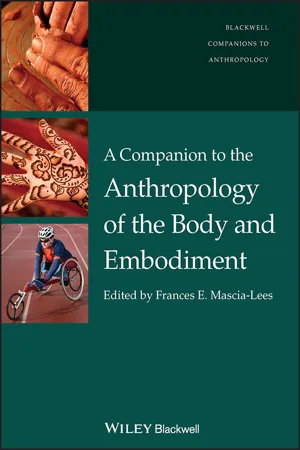
A Companion to the Anthropology of the Body and Embodiment offers original essays that examine historical and contemporary approaches to conceptualizations of the body.
Information
CHAPTER 1
AESTHETICS
Aesthetic Embodiment and Commodity Capitalism
“Aesthetics was born as a discourse of the body”
(Terry Eagleton 1991: 13)
AESTHETICIZATION OF EVERYDAY LIFE
The “aesthetic” is a slippery term, with a complicated history in Western philosophy. In the eighteenth century, Alexander Baumgarten (1714–1762) appropriated it from the Greek aisthētikós, meaning “perceptive by feeling,” for the name of his new science of sense experience. However, not long after, and due to the complex socioeconomic and political context in which the discourse of the aesthetic was deployed, Kant (1724–1804) transformed it to mean almost its opposite: a disinterested, distanced, contemplative, and objectifying act of consciousness (see Buck-Morss 1992 and Eagleton 1991). Thus, although “aesthetics was born as a discourse of the body” (Eagleton 1991: 13), referring to corporeal, material nature (Buck-Morss 1992: 6), it transmuted quickly, coming to be a term applied to the rational act of good judgment (i.e. taste) about art and the beauties of nature, and ultimately to a theory of art and beauty. In this conceptualization, art is understood as an autonomous realm of human endeavor separate from social, political, and economic constraints. It is the Kantian notion of the aesthetic as autonomous, removed from normal needs and desires, that has been under critique in the academy for three decades.1 Critics argue that this construction renders aesthetic experience transcendent, universal, acultural, and ahistorical, when it is actually a handmaiden of privilege masking political interests. Bourdieu (1984) famously critiqued Kant’s conceptualization, exposing his notion of aesthetic appreciation as a form of cultural capital that constructs class identity and maintains class privilege through distinctions in “taste.”2
The aesthetic has also been of central concern to critical theory. In his analysis of aesthetic theory in Marxism and Literature, Raymond Williams suggests why: he identifies it, along with “the psychological,” as among “the two great modern ideological systems” of the West (Williams 1978: 129). He, like Bourdieu, critiques the idea of the aesthetic as an autonomous realm, independent of the economic, social, and political. For Williams, this problematically renders the aesthetic asocial, and, in the process, allows the “social” to be constructed in opposition as a fixed form, rather than experiential process (1978: 133).3 Williams, also warns about another characteristic of the aesthetic under conditions of commodity capitalism: its ability to blunt class-consciousness and revolutionary action through “the dulling, the lulling, the chiming, the overbearing” of its methods and content-matter (1978: 155–156). With this, Williams joined other cultural Marxists in contesting Kant’s disembodying of the aesthetic, re-embodying it and returning to its original meaning of sense perception.
It is the danger of the numbing effects of consumer capitalism on the human senses that interests me in this chapter. The impact of the proliferation of commodities on the modern subject was, of course, one of Walter Benjamin’s (1968) central insights. Benjamin was concerned with the phantasmagoric nature of commodity forms, which deceives the senses through an appearance of reality produced by technological manipulation. He warned of the shallow “aestheticization of everyday life” resulting from this mediation of reality, which disconnects the spectacles of modernity from the political and social trends buttressing them. Drawing on Freud, he argued that to protect the individual from the perceptual shocks of the modern world – produced not only by new technologies of representation and reproduction, but also a profusion of objects in the arcades, industrial production in the factory, and crowds in the street – consciousness must act as a shield, staving off the trauma of excessive stimuli by stopping their penetration deep enough into memory to leave a permanent trace (Benjamin 1968: 242; Buck-Morss 1992). Susan Buck-Morss suggests that this protective mechanism initiated a “crisis in perception” in which the role of the perceptual system was reversed; rather than opening the modern subject to the world and enabling experience, she argues, its goal became anesthetic: to numb the organism and deaden the senses (1992: 16–18). The consequences for the modern subject were dire: “[this] dialectical reversal, whereby aesthetics changes from a cognitive mode of being ‘in touch’ with reality to a way of blocking out reality, destroys the human organism’s power to respond politically even when self-preservation is at stake” (Buck-Morss 1992: 18).
Buck-Morss argues that the deadening of this political response is required by capitalism to produce passive consumers. It was accomplished primarily through an overstimulation produced by manipulating environmental stimuli to control the body’s sensual system (1992: 22).
Theodore Adorno’s and Max Horkheimer’s (1979) now classic condemnation of the “culture industry” presents just such an argument: repeated exposure to commodified, mass-mediated entertainment activates and stimulates the senses in order to dull them, undermining the possibility of revolutionary action. However, for them, critical resistance could still emanate from the autonomous realm of “high art.” In this contention, Horkheimer and Adorno differ from Walter Benjamin, who famously argued in “The Work of Art in the Age of Mechanical Reproduction” (Benjamin 1968) that new technologies of cultural production, such as the camera, might have democratizing and libratory potential and that non-auratic art might even undo the alienation of the corporeal sensorium and lead to new forms of collective politics.
By the 1980s, the concern with the stupefying effects of commodity culture became fundamental to a Marxist cultural theory focused on understanding late capitalism. The theorization of the aesthetic was at the heart of this project. Theorists such as Jean Baudrillard (1983), Mike Featherstone (1991), and Fredric Jameson (1984) were centrally concerned with the working out of the changing relationship of the cultural to the economic, and particularly, the aesthetic to commodification. Everything, from the possibility of political change and moral certitude, the nature of consciousness and of the unconscious, the significance and value of art and of everyday experience, the character of subjectivity and identity, and the meaning of the body and libidinal desire, was at stake in these discussions (Mascia-Lees and Sharpe 2000).
Echoing Benjamin, but absent his ambivalence toward the aesthetic as at once problematic and a possible realm of liberation, these critics conceived the cultural conditions of late capitalism as an age in which the complete integration of cultural production into commodity production rendered everyday life thoroughly aestheticized (Featherstone 1991; Jameson 1984). They argued that processes that had begun to emerge in modernity under industrial capitalism were completed in postmodernity under late capitalism: the boundary between art and everyday life and the real and the image was fully collapsed, as was the distinction between high art and mass/popular culture and between taste cultures (Featherstone 1991: 65). If Adorno and Horkheimer continued to validate “high art” as an autonomous realm and site of resistance, and Benjamin found political possibility in modernity’s new media technologies, these theorists occluded any possibility of a critical position, rendering late capitalist subjects completely impotent. The rapid flow of images that came to saturate everyday life produced, they claimed, sensory overload, a waning of affect, and a loss of a sense of depth and history (Jameson 1984), a culture of superficiality (Featherstone 1991: 66), and a world of the simulacrum in which commodities bear no relationship to their materiality but are merely floating signifiers in an arbitrary sign system of taste and lifestyle (Baudrillard 1983).
A major drawback in much of this work is the assumption, rather than demonstration, of a particular experience of commodification and its effects on the human body in the actual everyday life of consumers. Too often, public forms of cultural production – literary, architectural, or otherwise – are read as expressions of the sensory condition of the contemporary subject, whether affectless, anaesthetized, overloaded or, for that matter, endlessly desirous. The exemplar of this approach is Fredric Jameson’s well-known reading of Los Angeles’s Bonaventure Hotel as a disorienting aesthetic space that “transcends the capacities of the individual human body to locate itself, to organize its immediate surroundings perceptually, and cognitively to map its position in a mappable external world” (Jameson 1984: 83). This dazed and confused consumer is, in turn, understood by Jameson as a symbol of an “even sharper dilemma” for the subjects of late capitalism: their incapacity “to map the great global multinational and decentered communicational network” in which they are caught (Jameson 1984: 84).
In the last two decades, anthropology has witnessed burgeoning interest in the senses, investigating how meanings are invested in, and conveyed through, the senses in different cultural contexts (Classen 1997: 405). David Howes (2005) has been at the forefront of exploring the sensory logic of late capitalism. In his “material history of the senses” under capitalism, Howes argues that everyday life today has become “hyperaestheticized” through commodity aesthetics, the inclusion of an aesthetic dimension into products through the enhancement of surface appearance (Howes 2005, see Haug 1986). Contemporary consumers are no longer “confined to the projection of dream worlds of consumer gratification,” Howes suggests; now all the senses are “massaged” as manufacturers, designers, and advertisers differentiate their products in vying to pique consumer desire and increase market share (2005: 248 and 281–303). Howes argues that this project of instrumentalizing the senses comes at a price to capitalism itself (2005: 248):
Multiplying the sensory stimuli emitted by the merchandise and designing for affectivity (i.e. pleasure with products) was bound to undermine the very instrumentality, the very rationality of the system whose ends it was supposed to serve. The hyperaestheticization of the body of the commodity has deconstructed its utility. With utility now in recession, a space has opened up where people can “make sense” of things in all sorts of non-commercial, “non-rational,” ways such as using Lifebuoy soap to give a sheen to one’s skin, or deploying Kool-Aid as a hair dye (2005: 298).
Although he suggests this “deinstrumentalization” might open up possibilities for consumers to reclaim the sensual, Howes pulls back from this conclusion, suggesting that it is unlikely that “the sensory profusion” of contemporary consumer culture has “let the consumer out of the glove” (2005: 298). But are there other sites to which we might turn to uncover how members of consumer society today, “value, relate and combine the senses in everyday life” (Howes, this volume, chapter 15)?
In this chapter, I seek to further Howes’s aim of writing a material history of the senses in commodity culture by focusing on the everyday lives of actual subjects: a group of U.S. consumers who self-consciously consume products associated with the widespread late 19th- and early 20th-century Arts and Crafts Movement, an artistic, philosophical, and socialist movement that arose in opposition to industrial capitalism and had as its expressed goal “making the everyday beautiful.” My ethnographic investigation shows that outside the realm of commodity aesthetics, mass-mediated entertainment, and the rapid flow of signs and images that permeate consumer culture, there are realms of contemporary life in which the human sensorium is enlivened, rather than deadened. In order to find them, however, we need not only shift location but also our standard conceptualizations about the relationship of the aesthetic to the senses under commodity capitalism. I suggest such a refiguring by treating the aesthetic as Merleau-Ponty does: a way of embodied knowing, a way through which “humans respond to forms, shapes, and color,” and to light, lighting, shadows, and reflections “in ways that take on a life of their own and open themselves up to metaphoric meaning” (Merleau-Ponty 1964: 123). New insights emerge if we approach the aesthetic as a form of embodiment, a way of being-in-the-world.
AESTHETIC EMBODIMENT
To focus attention on this Merleau-Pontian conceptualization of the aesthetic and to differentiate it from other modes of embodiment, I use the concept “aesthetic embodiment.” Although all aesthetic experiences are embodied, not all embodied experiences are aesthetic; thus invoking “embodiment” alone does not signal the particular nature of the experiences I seek to understand. Employing “aesthetic embodiment” also helps to clarify the meaning and use of the word “aesthetic.” In this chapter, for example, I am concerned with the Arts and Crafts aesthetic both as a style and as the form of embodiment it constitutes. I explore aesthetic embodiment as a somatically-grounded, culturally mediated, affective encounter with the beautiful (see Berleant 2004). I focus on the beautiful because it has significant ethnographic salience for the Arts and Crafts population with which I work. I am interested in asking whether Arts and Crafts aestheticizes life in the ways cultural Marxists would predict. To address this issue, it is first necessary to explore why, among consumers for whom the Arts and Crafts aesthetic operates as a meaningful category, certain commodities come to be seen as beautiful and how this form of beauty constitutes a significant dimension of their lived experience. What role does beauty – its creation, presence, and assessment – play in the fabric of their experiences of everyday life?
As a larger research agenda, focusing on different dimensions of “aesthetic embodiment” should reveal significant insights about how the aesthetic constitutes a lived world. E. Valentine Daniel’s 1994 comparison of beauty and pain as aesthetic experiences in “The Individual in Terror” is particularly instructive. Focusing specifically on the relationship of beauty and pain to language, he argues that both are “concerned with the sensory ... with throbbing precepts that push against the conceptual membrane that encloses the world of active semiosis of articulate speech” (Daniel 1994: 233). Pain and beauty are also similar in that both put “language on trial;” but they do so in different ways: “beauty finds language wanting because of beauty’s profound inexhaustibility; pain finds language wanting in pain’s excruciating particularity” (Daniel 1994: 233). Beauty’s “mode of signification is found in iconic signs – in metaphors and in objects that partake of beauty’s qualities.” Thus beauty’s objectification is “generous,” “opening out to the world, inviting further signs, objects, and interpretants;” pain, by contrast “closes in on itself;” it finds “affirmation not in its extension but intensification” (Daniel 1994: 233).
If aesthetic embodiment constitutes particular ways of being in world, then “style,” according to Merleau-Ponty, is a way of inhabiting it, a coherent orientation toward the world and a way of expressively appropriating it (see Singer 1993). Here, “style” is not meant in its more colloquial sense as a veneer over things that can be extracted and identified on its own, but instead, “a way to characterize the persistence and characteristic manner of appearance that we recognize in other things without having to constitute them explicitly” (Singer 1993: 234). This manifestation is greater than surface appearance alone. Rather than being something distinctive to be discerned, style is the characteristic of a thing that elicits a perceptual and implied motor response in which both perceived and perceiver are joined in the style of intercourse from which their identity emerges (Singer 1993: 234). Style is, in this sense, experiential and inextricably connected to an object’s particular materiality, as Vivian Sobchack’s description vividly captures:
Style is ... the thread running through all the properties of the thing and in a person’s interaction with that thing ... The glasslike feel, brittleness, tinkling sound [of a drinking glass] and such have an accent, an atmosphere, that also encompasses the over-glass-sliding movement-of-the-finger or the bent-shooting-out-finger-striking-tinkling-evoking-flick movement of the hand (quoted in Barker 2009: 3).
Arts and Crafts today can, of course, be understood as a style in the vernacular sense: many consumers identify it by a set of external characteristics and appreciate it for that appearance. However, it is not with these consumers that I am centrally concerned in this chapter, but those for whom Arts and Crafts style provides a coherent orientation to the world. These are consumers for whom affect and intellect come together in an aesthetic sensibility that produces a particular “somatic mode of attention” (Csordas 1993).
The original Arts and Crafts Movement, as I discuss in more detail below, was grounded in Marxist principles, which tied the political to the aesthetic by locating beauty in non-alienated labor; celebrating equality, community, and immersion in the details of daily life; and linking respect for others with an aesthetic sensibility. For many producers and consumers of Arts and Crafts today, “beauty” is an expression of an aesthetic philosophy embedded in these political and ethical commitments. The aesthetic embodiment of Arts and Crafts, for them, is a full experience in which beauty resides neither in the object nor the eye of the beholder, but is constituted through experiences connecting mind, body, individuals, and community. Just as the Japanese tea ceremony, described by Dorinne Kondo, can be understood as a confluence of religious and philosophical beliefs with an aesthetic that locates beauty in the mundane (Kondo 2005: 192–211), so too can Arts and Crafts be seen as a complex ethical-philosophical-style nexus, with bea...
Table of contents
- Cover
- Series page
- Title page
- Copyright
- Dedication
- Notes on Contributors
- Synopses
- Introduction
- CHAPTER 1 AESTHETICS
- CHAPTER 2 AFFECT
- CHAPTER 3 AUTOETHNOGRAPHY
- CHAPTER 4 BIOETHICS
- CHAPTER 5 BIOPOWER
- CHAPTER 6 BODILINESS
- CHAPTER 7 COLONIALISM
- CHAPTER 8 CULTURAL PHENOMENOLOGY
- CHAPTER 9 DEAD BODIES
- CHAPTER 10 DISSECTION
- CHAPTER 11 (TRANS)GENDER
- CHAPTER 12 GENOMICS
- CHAPTER 13 HAPTICS
- CHAPTER 14 HYBRIDITY
- CHAPTER 15 IMPAIRMENT
- CHAPTER 16 KINSHIP
- CHAPTER 17 MASCULINITIES
- CHAPTER 18 MEDIATED BODIES
- CHAPTER 19 MODIFICATION
- CHAPTER 20 NEOLIBERALISM
- CHAPTER 21 PAIN
- CHAPTER 22 PERSONHOOD
- CHAPTER 23 POST-SOCIALISM
- CHAPTER 24 RACIALIZATION
- CHAPTER 25 THE SENSES
- CHAPTER 26 SENSORIAL MEMORY
- CHAPTER 27 TASTING FOOD
- CHAPTER 28 TRANSNATIONALISM
- CHAPTER 29 VIRTUALITY
- Index
Trusted by 375,005 students
Access to over 1.5 million titles for a fair monthly price.
Study more efficiently using our study tools.
Frequently asked questions
Yes, you can cancel anytime from the Subscription tab in your account settings on the Perlego website. Your subscription will stay active until the end of your current billing period. Learn how to cancel your subscription
No, books cannot be downloaded as external files, such as PDFs, for use outside of Perlego. However, you can download books within the Perlego app for offline reading on mobile or tablet. Learn how to download books offline
Perlego offers two plans: Essential and Complete
- Essential is ideal for learners and professionals who enjoy exploring a wide range of subjects. Access the Essential Library with 800,000+ trusted titles and best-sellers across business, personal growth, and the humanities. Includes unlimited reading time and Standard Read Aloud voice.
- Complete: Perfect for advanced learners and researchers needing full, unrestricted access. Unlock 1.5M+ books across hundreds of subjects, including academic and specialized titles. The Complete Plan also includes advanced features like Premium Read Aloud and Research Assistant.
We are an online textbook subscription service, where you can get access to an entire online library for less than the price of a single book per month. With over 1.5 million books across 990+ topics, we’ve got you covered! Learn about our mission
Look out for the read-aloud symbol on your next book to see if you can listen to it. The read-aloud tool reads text aloud for you, highlighting the text as it is being read. You can pause it, speed it up and slow it down. Learn more about Read Aloud
Yes! You can use the Perlego app on both iOS and Android devices to read anytime, anywhere — even offline. Perfect for commutes or when you’re on the go.
Please note we cannot support devices running on iOS 13 and Android 7 or earlier. Learn more about using the app
Please note we cannot support devices running on iOS 13 and Android 7 or earlier. Learn more about using the app
Yes, you can access A Companion to the Anthropology of the Body and Embodiment by Frances E. Mascia-Lees in PDF and/or ePUB format, as well as other popular books in Social Sciences & Physical Anthropology. We have over 1.5 million books available in our catalogue for you to explore.