- Covers a wide range of topics within adult development and aging, from theoretical perspectives to specific content areas
- Includes newly commissioned essays from the top researchers in the field
- Takes a biopsychosocial perspective, covering the biological, psychological and social changes that occur in adulthood
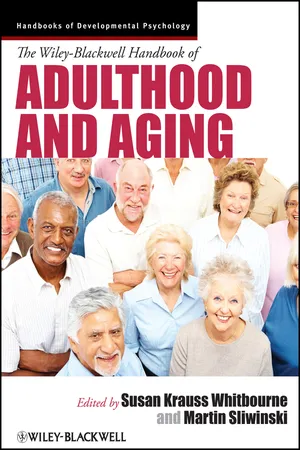
eBook - ePub
The Wiley-Blackwell Handbook of Adulthood and Aging
- English
- ePUB (mobile friendly)
- Available on iOS & Android
eBook - ePub
The Wiley-Blackwell Handbook of Adulthood and Aging
About this book
This exceptional collection draws on the most recent demographic data and combines classic research with cutting-edge approaches to provide an invaluable overview of the developmental psychology of the adult years.
Information
Part I
Foundations
Chapter 1
Theoretical Perspectives
A Biopsychosocial Approach to Positive Aging
A Historical Introduction
The topic of successful human aging has engaged many great minds, including the Roman orator Cicero (43 bce/1923), who observed, “It is not by muscle, speed, or physical dexterity that great things are achieved but by reflection, force of character, and judgment; in these qualities, old age is usually not only not poorer, but is even richer” (Chandler, 1948). Similarly, Plato associated old age with calm and freedom (Griffin, 1949). Nearly two millennia would pass before positive aging would emerge as a topic of scientific inquiry. Such work began in the 1940s with a group of scholars at the University of Chicago who were interested in personal and social adjustment in old age (Burgess, 1960; Cavan, Burgess, Havighurst, & Goldhamer, 1949; Pollak, 1948). The Kansas City Studies of Adult Life (Williams & Wirths, 1965) continued the Chicago tradition and offered a conception of successful aging based on four dimensions: the amount of activity in which the individual was engaged, the ability to disengage, satisfaction with life, and maturity or integration of personality. Two additional components were later added: a balanced exchange of energy between the individuals and the social system, and a stable social system. Few of these ideas were accompanied by tools for empirical assessment.
In the decades that followed, life satisfaction became the most frequently investigated dimension of successful aging (for reviews see Cutler, 1979; Larson, 1978). The construct included components of zest versus apathy, resolution and fortitude, relationships between desired goals and achieved goals, self-concept, and mood tone (Neugarten, Havighurst, & Tobin, 1961). Others elaborated the meaning of successful aging to include happiness, adjustment, affect balance, morale, subjective well-being, and optimal interplay between the individual and the environment (Fozard & Popkin, 1978; Herzog, Rodgers, & Woodworth, 1982; Lawton, 1977; Stock, Okun, & Benin, 1986). Some of these initiatives grew out of a specific focus on old age, while others were imported from different domains and applied to the later years.
Limitations of these early approaches were noted, such as the lack of guiding theory (Ryff, 1982, 1989a) which resulted in related problems (i.e., elusive definitions of constructs, assessment instruments lacking evidence of validity) (Sauer & Warland, 1982). Despite the emphasis on positive aging, much research was conducted with tools designed to assess ill-being (e.g., anxiety, depression, worry, anomie, loneliness, somatic symptoms; for reviews, see Lawton, 1977, 1984). Even on the positive side, much successful aging research utilized dependent variables that could characterize optimal functioning at any age, which, in turn, meant that the unique challenges and opportunities of growing old were neglected. Clark and Anderson (1967) drew attention to the challenges of aging by describing “adaptive tasks,” which included having an awareness of aging and a sense of instrumental limitations, redefining one's physical and social life space, substituting alternative sources of need satisfaction, reassessing the criteria for evaluation of self, and reintegrating values and life goals. On the opportunity side of aging, Ryff (1989a) drew on multiple theories of psychosocial development (Bühler, 1935; Bühler & Massarik, 1968; Erikson, 1959; Jung, 1933; Neugarten, 1968, 1973) to advance an approach to well-being that incorporated such constructs as personal growth, purpose in life, and self-acceptance, all of which could potentially improve with age.
Other advances in successful aging research focused on psychological processes of selection, optimization, and compensation (Baltes & Baltes, 1990). Illustrated largely in the context of cognitive function, selection referred to the restriction of one's life world to fewer domains of functioning, given age-related loss in adaptive potential. Optimization referred to engaging in behaviors that enrich and augment general reserves (e.g., cognitive reserve) and maximize chosen life directions and associated behaviors. Compensation resulted from restrictions in range of plasticity and adaptive potential, combined with the use of new strategies (e.g., external memory aids, when internal memory mechanics are insufficient).
Adopting a broader, less discipline-bound formulation, Rowe and Kahn (1998) defined successful aging to include three elements: absence of physical illness or disability, high levels of cognitive function and physical functioning, and active engagement with life. Little empirical research accompanied their formulation, although recent research with older Canadians showed that only one of the three criteria was empirically viable (Weir, Meisner, & Baker, 2010). That is, the majority of older Canadians maintained connections with their community (active life engagement), but with increasing age, many experienced disease-related disability and impaired physical functioning.
This brief introductory overview underscores diverse formulations of successful aging evident in gerontological research over the past 70 years, with some having more lasting impact than others. That the ideal of positive aging evolves through time is meaningful and appropriate, to the extent that new versions build on what has gone before by refining core conceptualizations and strengthening empirical underpinnings. With such evolution in mind, we posit that two overarching criteria are critical to theoretical and empirical formulations of successful aging. First, normally occurring changes in the aging mind and body must be incorporated – that is, the formulation must be explicitly developmental, while also giving notable attention to individual differences in the timing of such change. Although lifespan developmental criteria have been previously prominent in psychological formulations of successful aging (e.g., Baltes & Baltes, 1990; Ryff, 1982), they have been curiously absent in formulations of physical aging. The Rowe and Kahn (1998) criteria of successful aging, in fact, neglect the reality that over the course of aging most older persons will develop multiple medical conditions. Comorbidity is thus part of normal aging and, as such, should be considered in formulating optimal later life functioning – something recognized half a century ago by Clark and Anderson (1967). Others have begun to endorse a conception of successful aging in which disease and functional limitations coexist, along with compensatory psychological or social mechanisms (Young, Frick, & Phelan, 2009).
A second key criterion is that the inherent interplay between biological, psychosocial, and social aspects of aging (Ryff & Singer, 2009) must be recognized – that is, formulations of successful aging must be fundamentally biopsychosocial. Our call for greater emphasis on a biopsychosocial approach is intended to address the neglect of biological processes in most prior formulations of positive aging, whether about psychological functioning or physical health. In this regard, we seek to connect the field of gerontology to a long and growing tradition in health research, which emanates from dissatisfaction with traditional medical models (Engel, 1977). Our intent is to build on advances in this literature, including those emerging from psychoneuroimmunology (Lutgendorf & Costanzo, 2003) and psychoneuroendocrinology (Campeau, Day, Helmreich, Kollack-Walker, & Watson, 1998; de Kloet, 2003). Combined with recognition of the wide heterogeneity among aged persons, we see the route to understanding why some age well and others do not as occurring via integrative models built on diverse combination of risk and protective factors (biological, psychological, social).
What follows is organized in four main sections. We first provide an overview of biopsychosocial approaches to health that we believe have useful import for the field of aging. Second, we address what it means to live well in later life, despite the emergence of medical comorbidities. Third, we consider what it means to live well in the face of social inequality. With both of these topics, we give primacy to psychological and social strengths, which are important not only for quality of life and positive subjective experience, but also because they are increasingly linked to biological regulation, brain activity, and unfolding trajectories of morbidity and mortality. Given the cascade of mechanisms and processes situated around these phenomenological experiences, which define the human condition, we conclude with consideration of interventions designed to promote psychosocial well-being.
Biopsychosocial Approaches to Health
Decades ago, psychiatrist George Engel proposed the adoption of a biopsychosocial model as an alternative to the dominant biomedical model (Engel, 1977). Engel recognized the extraordinary power of the biomedical model to identify “biochemical defects” within the body and to guide the development of treatments for these defects, but he called for physicians to pay more attention to the psychological and social aspects of illness and the patient. He believed that while many of the causes of and treatments for psychiatric conditions likely involve specific biological processes within the brain, important other aspects of treating psychiatric conditions – environmental factors associated with mental illness, cultural and psychological factors influencing a person's decision to seek treatment, physician–patient communication, a patient's willingness and ability to follow treatment recommendations – require that physicians become familiar with the social and psychological contexts of their patients' lives. Engel called for the integration of the biopsychosocial perspective into the training of medical students, and he himself brought biopsychosocial training to the medical curriculum at the University of Rochester where he taught.
Engel's goal of fundamentally changing the practice of medicine has not been extensively adopted; the biomedical model continues to dominate medical education and practice. Thus his exhortation to the medical community remains as pertinent now as it was 30 years ago (Alonso, 2004; Borrell-Carrio, Suchman, & Epstein, 2004). The biopsychosocial model has been incorporated into medical practice in a limited number of ways (Bitton et al., 2008; Finestone, Alfeeli, & Fisher, 2008; Griffith, 2009; Koppe, 2010; McCabe et al., 2010; McCollum & Pincus, 2009; Widerstrom-Noga, Finnerup, & Siddall, 2009), but its largest impact has been in providing the framework for a generation of basic science researchers and as a conceptual foundation for research disciplines favoring an integrative perspective on biological processes relevant to health, such as psychosomatic medicine (Fava & Sonino, 2010; Novack et al., 2007), psychoneuroimmunology (Lutgendorf & Costanzo, 2003), and psychoneuroendocrinology (Campeau et al., 1998; de Kloet, 2003). Psychoneuroimmunology (PNI) is the study of how the immune system is affected by social and psychological experiences and the biological pathways, including brain regulation, by which these influences impinge on immune function. Psychoneuroendocrinology (PNE) is the study of neural and hormonal responses to social and psychological experiences. Psychosomatic medicine integrates the basic sciences of PNI and PNE with a focus on clinical outcomes and potential interventions to improve health. Many of the same biological systems and social and psychological processes feature in research in all of these fields, so for the sake of parsimony we will not dwell on conceptual or empirical distinctions among them. Rather, using PNI as an organizing framework, we aim to present a broad overview of research that exemplifies a biopsychosocial perspective and, as such, may inform integrative approaches to successful aging.
Long before PNI became a formal area of research, the physiologist Hans Selye characterized a set of physiological changes that routinely occurred in animals after exposure to stressors ranging from cold and surgical injury to sublethal doses of a variety of drugs. These changes included a rapid decrease in the size of tissues related to the immune system, such as lymph nodes and the thymus gland (Selye, 1936). Subsequent efforts showed that adrenal hormones mediated the effects of Selye's stressors on immune cells and tissues (Dougherty, 1952), and to this day adrenal hormones remain central elements of research focused on the biological effects of social and psychological experiences. Other seminal lines of research that led to the development of PNI as a discipline included links between personality characteristics and autoimmune disease (e.g., Solomon & Moos, 1964); between impaired immune function and extremes of negative mood, such as bereavement (Bartrop,...
Table of contents
- Cover
- Series Page
- Title Page
- Copyright
- Notes on Contributors
- Preface
- Part I: Foundations
- Part II: Physical Changes and Health
- Part III: Cognition
- Part IV: Personality
- Part V: Abnormal Aging
- Part VI: Social Processes
- Part VII: Well-Being and Creativity
- Author Index
- Subject Index
Trusted by 375,005 students
Access to over 1.5 million titles for a fair monthly price.
Study more efficiently using our study tools.
Frequently asked questions
Yes, you can cancel anytime from the Subscription tab in your account settings on the Perlego website. Your subscription will stay active until the end of your current billing period. Learn how to cancel your subscription
No, books cannot be downloaded as external files, such as PDFs, for use outside of Perlego. However, you can download books within the Perlego app for offline reading on mobile or tablet. Learn how to download books offline
We are an online textbook subscription service, where you can get access to an entire online library for less than the price of a single book per month. With over 1.5 million books across 990+ topics, we’ve got you covered! Learn about our mission
Look out for the read-aloud symbol on your next book to see if you can listen to it. The read-aloud tool reads text aloud for you, highlighting the text as it is being read. You can pause it, speed it up and slow it down. Learn more about Read Aloud
Yes! You can use the Perlego app on both iOS and Android devices to read anytime, anywhere — even offline. Perfect for commutes or when you’re on the go.
Please note we cannot support devices running on iOS 13 and Android 7 or earlier. Learn more about using the app
Please note we cannot support devices running on iOS 13 and Android 7 or earlier. Learn more about using the app
Yes, you can access The Wiley-Blackwell Handbook of Adulthood and Aging by Susan K. Whitbourne, Martin J, Sliwinski, Susan Krauss Whitbourne,Martin J, Sliwinski,Susan K. Whitbourne, Susan Krauss Whitbourne, Martin J, Sliwinski in PDF and/or ePUB format, as well as other popular books in Psychology & Developmental Psychology. We have over 1.5 million books available in our catalogue for you to explore.