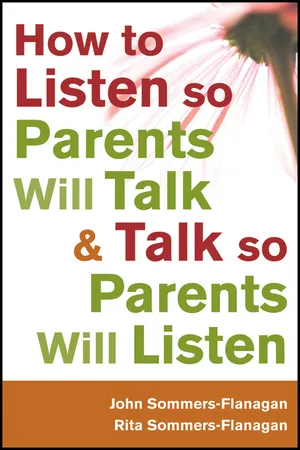
How to Listen so Parents Will Talk and Talk so Parents Will Listen
eBook - ePub

How to Listen so Parents Will Talk and Talk so Parents Will Listen

  1. English
  2. ePUB (mobile friendly)
  3. Available on iOS & Android
eBook - ePub

How to Listen so Parents Will Talk and Talk so Parents Will Listen

About this book

"In keeping with person-centered theory and therapy, John and Rita Sommers-Flanagan have produced a book that will be immensely helpful for professionals who work with parents. Throughout the pages, there are many examples of practitioners honoring and respecting parents and listening deeply to how best be of help. I am delighted that this book continues to echo and expand on my father's work."
Natalie Rogers, PhD, REAT, author, The Creative Connection and The Creative Connections for Groups

"Because parenting can be such a dizzying task, professionals working with parents need to have intelligible, compassionate, and ethical principles to guide their work. John and Rita Sommers-Flanagan have mastered this complex terrain, and we are fortunate, in this articulate and accessible book, to gain from their exceptional experience and wisdom."
Andrew Peterson, EdD, author, The Next Ten Minutes: 51 Absurdly Simple Ways to Seize the Moment

Step-by-step guidance for building healthy dialogues with parents that open communication and promote positive outcomes

Embracing the uniqueness of every parent, family situation, and practitioner, How to Listen so Parents Will Talk and Talk so Parents Will Listen helps professionals address the parent-child problems that families often find puzzling or challenging and for which they seek support and guidance.

How to Listen so Parents Will Talk and Talk so Parents Will Listen features many specific interventions and methods for helping parents implement developmentally appropriate and scientifically supported strategies for building healthy parent-child relationships and working through the most common conflicts encountered in families. It includes:

  • Tips for creating a positive therapist-client experience with parents

  • Guidelines for working with a variety of parents

  • Parenting tip sheets and homework assignments

  • Case studies focusing on many different parenting problems, including the strong-willed child, divorce, homework battles, spanking, and more

How to Listen so Parents Will Talk and Talk so Parents Will Listen will help you develop positive relationships with parents so that constructive two-way dialogue can be established. Even the most difficult and resistant parents can be successfully engaged through the helpful strategies, advice, and tools found in this practical guide.

Frequently asked questions

Yes, you can cancel anytime from the Subscription tab in your account settings on the Perlego website. Your subscription will stay active until the end of your current billing period. Learn how to cancel your subscription.
No, books cannot be downloaded as external files, such as PDFs, for use outside of Perlego. However, you can download books within the Perlego app for offline reading on mobile or tablet. Learn more here.
Perlego offers two plans: Essential and Complete
  • Essential is ideal for learners and professionals who enjoy exploring a wide range of subjects. Access the Essential Library with 800,000+ trusted titles and best-sellers across business, personal growth, and the humanities. Includes unlimited reading time and Standard Read Aloud voice.
  • Complete: Perfect for advanced learners and researchers needing full, unrestricted access. Unlock 1.4M+ books across hundreds of subjects, including academic and specialized titles. The Complete Plan also includes advanced features like Premium Read Aloud and Research Assistant.
Both plans are available with monthly, semester, or annual billing cycles.
We are an online textbook subscription service, where you can get access to an entire online library for less than the price of a single book per month. With over 1 million books across 1000+ topics, we’ve got you covered! Learn more here.
Look out for the read-aloud symbol on your next book to see if you can listen to it. The read-aloud tool reads text aloud for you, highlighting the text as it is being read. You can pause it, speed it up and slow it down. Learn more here.
Yes! You can use the Perlego app on both iOS or Android devices to read anytime, anywhere — even offline. Perfect for commutes or when you’re on the go.
Please note we cannot support devices running on iOS 13 and Android 7 or earlier. Learn more about using the app.
Yes, you can access How to Listen so Parents Will Talk and Talk so Parents Will Listen by John Sommers-Flanagan,Rita Sommers-Flanagan in PDF and/or ePUB format, as well as other popular books in Psychologie & Psychothérapie. We have over one million books available in our catalogue for you to explore.

Information

Publisher
Wiley
Year
2011
Print ISBN
9781118012963
eBook ISBN
9781118068014
Edition
1

PART ONE
Understanding and Being With Parents

These first three chapters focus on how practitioners can understand the challenges parents face and be with them in a way that facilitates therapeutic relationship development. Being with parents in an accepting, respectful, and positive manner, preparing specifically to work with them, and understanding what parents want are all crucial components to helping parents speak openly about their fears and hopes. And if parents don't speak openly, there's very little you can do to assist them in becoming better parents. As Carl Rogers might say, the initial goal for practitioners is to make psychological contact while holding an attitude of acceptance, empathy, and honest collaboration; this is the essence of the therapeutic relationship.

CHAPTER ONE
A Way of Being With Parents

Whether parents consider themselves to be “tiger” parents, collaborative parents, or find themselves feeling like doormat parents, parenting in the 21st century is stressful and demanding. According to recent epidemiological studies, 12 to 20 percent of children and adolescents in the United States meet the diagnostic criteria for mental disorders (Costello, Egger, & Angold, 2005; Costello, Mustillo, Erkanli, Keeler, & Angold, 2003; Merikangas et al., 2010). Although these extreme emotional and behavioral disorders are obviously of concern to parents, there are also many relatively mild parent–child problems that parents find puzzling and disturbing and for which they seek support and guidance. This helps explain why there are thousands of Internet websites, hundreds of popular press books, and dozens of magazines and newspaper columns—all with the primary aim of helping parents manage their parenting challenges. As Kohn (2005) stated in the opening of his book, Unconditional Parenting, parenting is no easy task:
Even before I had children, I knew that being a parent was going to be challenging as well as rewarding. But I didn't really know.
I didn't know how exhausted it was possible to become, or how clueless it was possible to feel, or how, each time I reached the end of my rope, I would somehow have to find more rope. (p. 1; italics in original)
This book is based on sound theoretical and empirical knowledge and is designed to help you give parents the help they want and need. This chapter describes how parents are unique. It also focuses on why adopting a particular way of being with parents will facilitate your ability, as a helping professional, to obtain positive therapeutic and educational outcomes.

Why Parents Are a Distinct and Unique Population

Parents face many unique challenges. It's often impossible to know the magnitude of the parenting problem before the parents step into the consulting room.

Case: Emma the Great and Powerful

Imagine you're meeting with a mother and a father to talk about parenting. From the session's beginning, both parents speak bluntly about their situation. The father says,
I don't know how much more we can take. Emma, our only child who just turned seven, has complete control of our household. I dread coming home from work. I've been staying longer at the office to postpone the inevitable series of angry confrontations that I know will start within 10 minutes of my arrival home. I know that's crazy. I know we need help. I mean, I know I need help. I feel like our family is about to disintegrate.
The mother is even more emotionally distraught. Between tears, she describes a recent walk to school with Emma.
I knew it would be a struggle. She didn't want to wear gloves, but there's snow on the ground and it's below freezing and so she needed them. We argued for 10 minutes. She finally put them on. Then, partway through our walk to school she dropped them and kept walking. I asked her to pick them up. She refused. I told her, “If you don't pick up those gloves you won't get to watch TV after school.” I knew that would get her. She bent down and slowly picked up her gloves and we walked the rest of the way to school. Because we were late, I was dropping her off in front of the teacher and her class and when I leaned down to kiss her on the cheek and wish her a good day, she reared back and slapped me across the face. I was so shocked and embarrassed and hurt that I just cried all the way home.
If you were meeting with these parents, you would easily recognize their pain, their distress, and their need for help. Most likely, your main question would be something like: How can I most efficiently support these parents and provide them with guidance and tools for dealing with Emma's challenging behaviors?

What Parents Want From Professionals

Emma's parents, and parents in general, are distinct from other clinical populations in several ways.
  • When parents schedule an appointment, they're not seeking professional assistance for their own adult problems; they're usually seeking professional input or assistance for how to deal with their child or children.
  • Parents tend to want immediate and direct guidance and advice. If you had spent an hour with Emma's parents and had not provided them with practical suggestions for how to deal with Emma's behavior, they most likely wouldn't return or recommend your services to other parents. On the other hand, as we will discuss below, they also want and need to feel respected, safe, and understood before any attempts at advice will be successful.
  • Partly because of keen interest in their children's well-being and partly because of previous exposure to many different parenting ideas, parents can be exceedingly critical of educational or therapeutic interventions. Emma's parents have most likely already talked to their friends and family and possibly consulted online resources or read books about how to deal with strong-willed children. This is one reason why parents want, and sometimes demand, experienced and competent professional helpers.
  • Parents are often simultaneously defensive and vulnerable. Although they want help, if they don't feel respected and accepted by helping professionals, they can quickly become defensive and sometimes hostile. For example, if a helping professional immediately informed Emma's mom that Emma needs natural consequences and therefore should be allowed to go to school without gloves, that professional might be viewed as clueless and uncaring—and may get a harsh lecture on the dangers of frostbite during Montana winters.
Based on the preceding factors it's clear that parents constitute a unique clinical population and deserve individually tailored educational and therapeutic approaches.

The Many Venues and Settings Available to Parents in Distress

In the preceding situation, Emma's parents had many potentially effective choices for how to deal with their family situation. They could have sought help from Emma's pediatrician; they could have taken Emma to a counselor or psychotherapist or attended family therapy together; they could have obtained a parenting consultation through a local community agency; they could have contacted Emma's school psychologist or school counselor; or they could have enrolled in a parenting education course or signed up for a more intensive and longer-term parent-training curriculum.
From the menu of options available, Emma's parents selected a two-session parenting consultation that was offered as a part of a research project in their community. Broadly speaking, the purpose of the research was to investigate what parents found most useful during their consultation experience (J. Sommers-Flanagan, 2007). Within the framework of this two-session protocol, Emma's parents completed a registration form and several standardized parenting questionnaires prior to their initial session. One month after their initial session, they returned for a second session. Following their second session they completed post-intervention questionnaires and a satisfaction measure. Twelve weeks later they were contacted via telephone to assess their perceptions of their two-session consultation experience.
Despite their dire initial presentation and an extremely brief intervention, Emma's parents experienced a remarkably positive outcome. During the second session, Emma's father spoke passionately about the changes they experienced following their first session:
Everything is much, much better. It's not that Emma changed; we changed. What I remember most is that we decided to try the boring consequences and passionate rewards technique that you suggested and it was a life saver. We started talking about it in the car on the way home from our consultation. We discovered it wasn't so much about our daughter, but it was about us and how we'd been responding to her. We'd been so angry and reactive and ready to jump on her whenever she misbehaved that the idea of being completely boring helped us let go and focus on her behavior rather than our reactions. And once we got more in control and became boring, Emma's behavior improved too. Everything is much better.
Emma's parents also reported significant positive changes on their post-session questionnaires and endorsed the highest satisfaction ratings possible. Twelve weeks later, in a telephone interview with an independent evaluator, they continued to articulate the benefits of their short parenting consultation experience.

Using Theory and Evidence

Although Emma's parents chose a short parenting consultation intervention, they could have selected any of the other educational or therapeutic options mentioned previously—and possibly obtained similarly positive outcomes. Previous research and individual parent testimonials support the fact that many different treatment approaches and models can produce positive child behavior outcomes and parental satisfaction (Kaminski, Valle, Filene, & Boyle, 2008; Lambert & Barley, 2002; Lambert & Bergin, 1994; Wampold, 2005, 2010). Similar to clinical work with other populations, positive outcomes with paren...

Table of contents

  1. Cover
  2. Table of Contents
  3. Title
  4. Copyright
  5. Dedication
  6. Case Examples
  7. Preface
  8. PART ONE: Understanding and Being With Parents
  9. PART TWO: Strategies For Working With Parents
  10. PART THREE: Practical Techniques for Parenting Challenges
  11. APPENDIX A: An Annotated Bibliography of Parenting Books
  12. APPENDIX B: Tip Sheets for Parents
  13. APPENDIX C: Parent Satisfaction and Counselor Reflection Inventory
  14. APPENDIX D: Master List of Attitudes, Strategies, and Interventions
  15. APPENDIX E: Chapter Checklists
  16. APPENDIX F: Parent Homework Assignments
  17. References
  18. Author Index
  19. Subject Index
  20. End User License Agreement