![]()
Part 1
Communication
![]()
Chapter 1
Listen Like Leitha
At the University of Notre Dame, I had the pleasure of meeting Ms. Leitha Lewis, housekeeper of O'Neill Hall dormitory. She took the time to introduce herself and referred to us as her babies. When we first met, I thought this was just her way of introduction and didn't think anything of it, until I saw her days later.
She would greet each student with a smile—and not just any smile, a real smile. You know how some smiles look uncomfortable? Ms. Leitha's smile radiated sincerity and understanding, two very important traits of listening. She always listened to students, not with just an ear, but with both eyes, reflecting back their feelings. She also demonstrated other skills that made her a great listener.
After graduation and reflecting on what I had learned at Notre Dame, I discovered that the most powerful lesson came from her. Ms. Leitha taught me how to become an excellent listener, someone who could be “in the moment” when listening.
In this chapter, Ms. Leitha's name is an acronym for how to become a better listener:
L: Liking
E: Eyes, empathy, encouragement (oh my!)
I: “In the moment,” “I am not the focus”
T: Time and take notes
H: Head and heart
A: Another time
Liking
Have you ever noticed when listening to someone that the more you like the person, the better listener you become? We listen better when we actually like the person; in fact, liking the person even makes it easier to remember that person's name and the conversation.
Do you remember the name of that cute guy or girl when you were growing up, the one who brought a smile to your face? For me, that girl was Brittany Dotson (hope she doesn't read this book!). Why do you remember a certain name? It's simple; because you like that person.
When you listen with liking, you give the person respect that says, “I want to understand you,” and you make a deeper connection in your mind. Say your boss, whom you admire and respect, comes by your office to chat. Since you like him, it makes listening to him more natural.
What prevents us from listening with liking? Us! We sometimes have our own preconceived ideas and perceptions about someone. Sometimes while listening to someone, thoughts flood your mind—“Can this person do anything for me?” “I probably won't like this person,” or “Who likes them anyway?”—influencing how you listen.
Nothing in this world is good or bad, but thinking makes it so.
—William Shakespeare
Listening with liking is much like cleaning a windshield. Your view of that person is open and not obstructed by something else. Listening with liking looks like a smile:
- Lean toward the person.
- Make eye contact with him or her.
- Reflect the other person's feelings without agreeing.
- Do your best to make the person feel comfortable.
Listen to someone you wouldn't normally talk to and discover what you can learn from him or her. Focus on similarities rather than differences.
Leadership Tip
When we like someone, we want to hear what that person has to say…and we seem to always find the time to listen.
Listening with Dislike
But what happens if you don't like the person? Have you ever experienced any of these scenarios?
1. You didn't care for your neighbor at first; then one day you actually became friends.
2. You met someone and were indifferent, but then over time you became that person's friend.
3. You couldn't stand your boss, until she opened up to you and you discovered she is a caring person.
Let's say you get a call one evening. When the person on the other end says he is from the IRS, your stomach starts to turn, sweat starts running down your brow, and your blood pressure goes up. Maybe you're nervous because you just heard a horror story involving a colleague at work about her encounter with the IRS and how it ended.
Before the person can ask a question, your mood turns to dislike, your tone becomes gruff, and your mind gets defensive and your answers short.
Stop a minute. Can you guess the outcome of the conversation? What tone will you convey to the caller? How quickly will listening with dislike resolve your tax issue? In your present state, you may find yourself in some type of confrontation.
If you remember one thing that I tell you, I hope it's that your behavior is a choice. When you feel yourself behaving a way you don't want to, pause and change it.
Eyes, Empathy, Encouragement (Oh My!)
The eyes are vital to listening, because you see facial expressions and body posture when you communicate. Also, when you make eye contact with someone, you demonstrate your focus on that person.
Not only did Ms. Leitha listen with liking, she also listened with her eyes. It's as if she used them as a mirror to reflect the other person's feelings. If you came in and were upset about a grade, her eyes reflected it. If you were excited with good news, so was she.
Has this ever happened to you? Someone enters your office, and your head is buried in the computer. You're checking e-mails or typing. You glance up very quickly and then glance back at your keyboard, and as you look back at the keyboard you say, “Go ahead, I'm listening,” as you pound away furiously on the keys.
Does the message you send to that person really indicate that you're listening? No, because you're not making eye contact.
Do you ever wonder if people are listening to you, if they are truly excited to see you? Would you like to find out? One way is called the “eyebrow test.” The next time you greet someone, watch the eyebrows. If they go up, that person is happy to see you.
Put the eyebrow test to use. When you're greeted by relatives at the next holiday gathering, watch their eyebrows when they answer the door. If you're greeted by a warm “It's so good to see you” and their eyebrows go up, it's a good sign, because it means they are generally interested in you.
The most important thing in communication is to hear what isn't being said.
—Peter Drucker
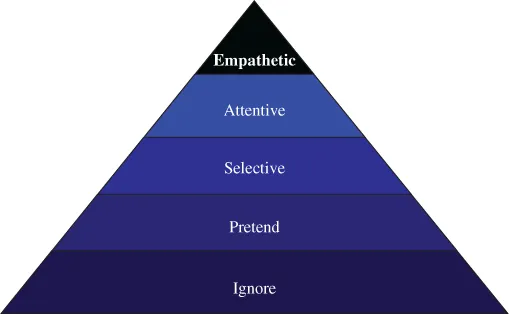
Referencing a Dale Carnegie instructor, the five levels of listening are:
1. Empathetic
2. Attentive
3. Selective
4. Pretend
5. Ignore
The first and highest level of listening is empathetic. Empathy is demonstrating that you are aware of others' thoughts and feelings and trying to understand them. To listen with empathy usually involves you asking a lot of questions to really understand someone or something.
The next level is attentive. At this point, you are paying attention and maybe able to memorize and repeat back what was said. An example is a student who gets a good grade on a test. But just because she gets a high grade doesn't mean she understands the material.
The third level is selective listening: hearing what you want to hear. For example, a wife tells her husband, “Go to the store, fix the door, organize your office, and you can watch the game.” What the husband hears is, “I can watch the game.”
The fourth level is pretend. This level of listening is common at networking functions and parties. Someone pretends to listen to someone he or she doesn't know, only to be searching for someone else to talk to.
The fifth level is ignore. We all have probably been guilty, at some time or another, of completely ignoring someone who is talking. A friend of mine named Chris learned how to ignore his mom while he was growing up. One day she needed a ride to work. Chris, listening on the lowest level, completely forgot, resulting in his mom having to walk three miles to work.
You have probably heard the expression, “to walk a mile in someone else's shoes.” In other words, you get a feeling for what it's like in another person's situation, a concept related directly to listening. When listening to someone, look at that person's shoes to help you remember this point.
When we fail to picture ourselves in other people's shoes, often we “advice dump.” We just dump our advice on them about what they need or should do, or question them without trying to fully understand their position. Remember, “their shoes” will help you empathize with them.
Do you remember your middle school days? Did you ever get into trouble? I once did something that landed me in the principal's office. I remember it still because the entire time I was talking to Sister Irene, it felt like she was casting judgment on me and not listening to my side of the story.
Have you ever felt that someone was judging you while you were talking? It's not a comfortable situation. People can tell if you are listening to them or judging them in a matter of minutes. Leave judgment to the courts, and do your best to understand the person you are engaged in conversation with by giving your full attention.
Here is an example of how understanding history can help us all become better listeners:
“The Kennedys stayed here. Matter of fact, a lot of famous people have stayed at this hotel,” Paul, the bellhop at the Radisson in Lackawanna, Pennsylvania, said as he took my luggage to my room.
I was fascinated at how much Paul knew about the hotel. There was an obvious history about the place, and learning it gave me more of an appreciation of the building. As Paul continued, I thought of how this example relates to us all.
I've always been a fan of history, respectful of people who have gone before and pave...