![]()
1
Great Teams Think of Themselves as Winning Underdogs
It's David versus Goliath, and I hope we remember to bring our slingshots.
—HERB BROOKS, prior to the U.S.—Soviet game at the 1980 Winter Olympics
People remember that during the Olympics, the mask I wore had shamrocks on it—one on the right and one on the left, to the outside of the eye openings. The shamrocks were for luck, and also a nod of pride to my Irish heritage. During the 2010 Vancouver Winter Olympics, the U.S.A. starting goalie, Ryan Miller, played with a mask on which were painted Olympic and patriotic images—and also a shamrock, which I was honored to learn he had placed there as a tribute to me.
I am a mix of Irish and Scottish ancestry, with a bit more of my lineage weighted to the Irish side. My people came from the British Isles. Fundamental to my family history is something that is fundamental to the history of tens of millions in America: Leaving a place—a familiar place, even if at the time it was a place short on opportunity—and traveling to a place about which a lot had been read and talked about, a place that held great promise, yet no guarantees, and about which there was still a lot that was unknown.
You came to the United States because you were persecuted, hungry, and hoping for something better. Many came here because they had to escape something, or get away from someone or something, even the law.
You came with dreams—big dreams. You had big hopes. You believed you could defy the odds, do the seemingly impossible, even the miraculous.
And if you were one of those who got off the boat and were on your way to making a name for yourself, you stepped onto American soil with something to prove; you had a chip on your shoulder. You were a “winning underdog.”
clr ? Peggy Noonan, author and newspaper columnist, former speechwriter for President Ronald Reagan, and a chronicler of the American experience, recognizes that people infused with the spirit and identifying themselves as a winning underdog made America great. In one of her Wall Street Journal columns she wrote, “Our people came here not only for a new chance, but to disappear, hide out, tend their wounds, and summon the energy, in time, to impress the dopes back home. America has many anthems, but one of them is ‘I'll show ‘‘em!’”
“I'll show ‘‘em!” is about being a winning underdog.
Great teams think of themselves as winning underdogs.
Kindle Your Competitive Fire
I am one of eight kids who grew up in a lower-middle-class family in North Easton, which is actually a village within the incorporated town of Easton. North Easton is located about 30 miles south of Boston. I had four older sisters; I was the third oldest of the brothers. My mom, Peg, and my father, Don—the man for whom I famously searched the stands at Lake Placid—were devoted, loving, and very warm people.
My father was a talented athlete (he is a member of the Oliver Ames High School Athletic Hall of Fame, the high school from which he graduated in 1936, and from which I graduated in 1975). He was a Big League prospect in baseball, and had a full athletic scholarship to attend Assumption College, but the very summer he was to head off to college, he seriously injured his hand while working in a factory. He did not go to college.
My father made most of the money coming into our household as the food service director at a local community college; he also worked part-time jobs, and volunteered on the town board of health for close to 30 years, as well as being a youth sports coach. He was busy. Yet not as busy as my mother who, as a homemaker with eight kids and our family's chief operations officer, worked around the clock.
Our home was small; it had one bathroom. When I speak to groups, a story that always gets a loud laugh—and if you are part of a big family, you laugh with understanding—is when I tell of how growing up in the Craig family, on those rare occasions when we had a steak dinner, if you had to get up from the table for anything—to answer the phone or go to the bathroom, whatever—then you took that steak dinner with you; because if you didn't take it with you, you could be certain that when you returned to the table, the steak would be gone, if not everything else on your plate as well.
We didn't have a lot, but we had enough. We were also a team. It was understood by us, and in town, that if you touched one Craig then you touched them all.
I was a kid and I was already indoctrinated in the “all for one” and “one for all” quality that enabled a group of guys, unheralded and underestimated, to one day make history in the Adirondacks. And soon I would have something to prove. I had attitude that kindled the fire—and I would become a winning underdog.
I was in fifth grade. It was 1968. Back then, Easton had three youth sports leagues: Little League, a church basketball league, and an ice hockey league. That was it, which in many ways I think is a good thing. (I am concerned that today we start kids in sports too early, and that they are overscheduled, but I won't go on about that here.)
I was already playing baseball; I was a catcher. I didn't play hoops, but our postman, Phil Thompson, told my parents that he thought hockey would be good for me. Smart guy, that Mr. Thompson.
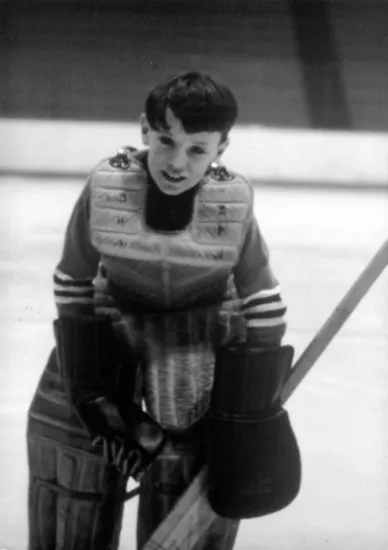
I started out with borrowed skates; they were a little big so I put cardboard in the toes. I played goalie, because I liked the equipment; it looked similar to a baseball catcher's equipment. Plus, it seemed that the goalie didn't need to know the rules. No rules for the goalie—just stop the puck.
I was good—I could skate and had solid reflexes. I was also small—smaller than almost all the other kids in the league. Being small, though, didn't prevent me from dreaming big. I wanted to play in the Olympic Games. One time, in seventh grade, the teacher saw me not paying attention to her lecture; instead I was busy writing on paper. I was near the back of the class, and the teacher walked toward me and called out, “Jimmy, what are you doing?” I looked up and said, “I am practicing my autograph. I am going to be in the Olympics some day and people are going to want my autograph.”
I was all of 12 years old, and already I had attitude and was kindling my competitive fire.
When I was still in junior high, almost every Sunday morning throughout the year, I used to travel into Boston with the older guys who were already playing hockey for Oliver Ames High School, the school I would soon attend. We traveled the 25 miles to Boston Arena (now Matthews Arena) so that we could play against the best high school and amateur talent around.
A car would pull into my family's driveway at about five A.M. Among the players I drove in to the city with were Ricky Bodio, Ray Daly, Peter Deibel, and Billy Condon. They were juniors and seniors at Oliver Ames, and since they were talented and tough athletes, I looked up to them figuratively; and, since at the time I was 5′1″ and 120 lbs., I also looked up to them literally.
I would lug out my equipment, join the guys, and, all packed together, we were on our way. We got on the ice around 6 A.M. and put in a good five hours; sometimes we would play until noon. It was a sacrifice and tiring—but I also loved it. I would stay in net sometimes for four hours straight and take the best that the older players could dish out. I knew they were determined to break this little squirt in net, but I was just as determined not to fold. I wanted to prove to the older guys that I could hack the pressure and, if I was already in high school, that I could back them up. Just as importantly, I wanted to prove to myself that I could take it.
The practice paid off. I started for the varsity when I was a freshman. Yet I remained small. As a sophomore, come hockey time, I was all of 5′5″ and 120 lbs. Yet even a few years prior to becoming a Boston University Terrier, I was already a terrier in practice in games; that is, I played with emotion, confidence, and attitude that were outsized for my frame. After practice ended, I stayed on the ice and had our assistant coach, Gerry Linehan, fire shot after shot at me.
I grew. My senior year, when I stood in net for the Oliver Ames Tigers, I was 5′10″, 170 lbs. We lost only one game during the regular season, and we made it a couple games into the state tournament before losing to the eventual state champion. I made a couple of local newspaper all-scholastic teams, but I didn't make the big city newspaper teams at the Boston Globe and Boston Herald. Not one Division I college was interested in offering me a scholarship. I knew I could play at that level, but it seemed, with the exception of my mom and dad, no one else did.
As well, I had next to no concept of what was involved in applying for college. I had worked hard in the classroom in high school and done all right but not great in the grades department. I didn't do well on my SATs. I am not even sure if I took any Achievement Tests.
I wanted to go to college, but it seemed I wasn't prepared.
I mean, the application essays were daunting. And there were application fees. Just swinging the money to apply to college was going to be difficult.
But I got the break in the person of Mike Addesa, the hockey coach at the College of the Holy Cross, an independent NCAA Division I program. Mike had been a high school hockey referee who worked many games in which I played. He was impressed by what he saw, and he told me he thought I could play major college hockey. He helped with the process of applying to Holy Cross, and he told me that, provided I was accepted—which he said was just about guaranteed—I would receive a full athletic scholarship.
Things looked good. That was until I didn't get accepted at Holy Cross.
What now? I consulted and talked with my family and friends, and we felt that an excellent option would be to attend Norwich Academy, a military college in Vermont that had a Division III hockey program.
I applied and was accepted to Norwich. I arrived for the fall semester. I stayed at Norwich Academy for about two weeks. This wasn't a good fit. What confirmed that this wasn't the place for me was when an upperclassman came into my room, and in the mode of indoctrinating me took a framed photo of my mother, who was battling cancer, and threw it on the ground. I went at him—and I guess I wasn't supposed to. I said enough of this and headed back to Easton.
What now?
I needed to stay in school–and to continue studying and to continue playing hockey.
I enrolled at Massasoit Community College, in Brockton, the gritty city that borders Easton and is better known as being at one time the world's biggest manufacturer of shoes and the hometown of undefeated heavyweight world boxing champion Rocky Marciano, and the adopted hometown of world middleweight boxing champion Marvin Hagler.
Massasoit had a hockey team, even if not many people knew about it. And, as I started classes at Massasoit, good fortune struck in the person of Neil Higgins, who had played goalie at Boston College in the early 1970s. Neil recognized that I could play Division I, and he told me to consider Massasoit Community College to be my tryout for the big time. I could go through the motions at Massasoit, he said, and mope and play with a piss-poor attitude, or I could approach the opportunity as a proving point.
Well, I was a winning underdog. I used this to my advantage. Being overlooked and underappreciated kindled the flames. The Massasoit Warriors made it to the national community college championship game. I made 60 saves in that game, and we won 1-0. Word had been getting around about my play at Massasoit, and my performance in the championship game certified the talk that I could compete at the Division I level. Within a couple weeks, Boston University coach Jack Parker was at my family's home offering me a full scholarship.
Who would have thought that Massasoit Community College would be my opportunity to play big time college hockey?
You never know when that opportunity will present itself. When it does, you need to be ready and to commit and to go for it.
But as for that scholarship to BU—there was a complication.
“I already offered the scholarship to someone else,” Coach Parker told me and my mom and dad.
What?
“But this kid has not made a decision,” he continued. “And if he chooses to go someplace else, then the scholarship is yours.”
“Well, who did you offer the scholarship to?” I asked.
“Mark Holden.”
Holden was another Boston area goalie.
“Well, I've seen Holden play,” I said. “And he is very good, but he is not as good as me.”
Mark Holden ended up going to Brown University, but that decision was made only partly because of the opportunity of an Ivy League education. Another reason was that he thought he had a better chance of playing at Brown than he did at BU.
I got that scholarship.
When I showed up at BU, I wasn't readily embraced by the players on the team. Who could blame them? They were all recruited from strong hockey programs. I was recruited from Massasoit Community College, hardly a hockey hotbed.
I hadn't proven myself.
I was confident, though, that my chance was coming—and soon.
And I would be ready.
Herb Brooks—A Winning Underdog for the Ages
There would have been no “Miracle on Ice” if Herb Brooks had not been cut from the 1960 U.S. Olympic hockey team. But he got cut, and in about the most painful way possible.
Only a couple weeks remained until the opening ceremonies of the Squaw Valley games, and Herb Brooks, a three-year starter for the Minnesota Golden Gophers, was on the team. He was even in the official team photo. Then U.S. coach Jack Riley received word from former Harvard University standout Bill Cleary that he was interested in playing for the U.S...