The hedge fund industry has been reeling in the wake of recent Ponzi schemes and insider trading scandals as well as the loss of billions of dollars in assets under management due to fund closures. Getting Started in Hedge Funds, Third Edition focuses on the current state of the industry; how hedge funds did or did not survive the subprime and subsequent credit crisis; and, what the future holds for investors. Getting Started in Hedge Funds, Third Edition also provides readers with a brief overview of the industry's history, and describes the inner-workings of these complex investment vehicles, including how to start a hedge fund, and what new regulations means for managers and investors.
• Profiles 10 highly successful hedge fund managers
• Addresses the Madoff scandal, as well as other lesser known Ponzi schemes, and analyzes the ripple effect felt throughout the industry as a result of these and other scandals
Despite the performance of some of these funds in the last few years, hedge funds are here to stay. In this Third Edition, Getting Started in Hedge Funds, Strachman provides an updated "how-to" guide for investors interested in hedge funds in this era of "new normal."
eBook - ePub
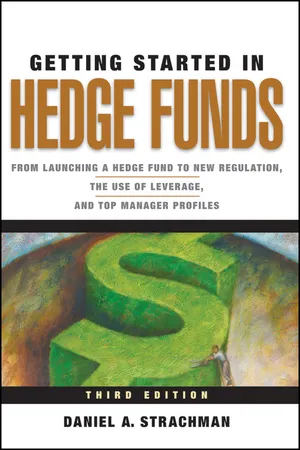
Getting Started in Hedge Funds
From Launching a Hedge Fund to New Regulation, the Use of Leverage, and Top Manager Profiles
- English
- ePUB (mobile friendly)
- Available on iOS & Android
eBook - ePub
Getting Started in Hedge Funds
From Launching a Hedge Fund to New Regulation, the Use of Leverage, and Top Manager Profiles
About this book
The book on hedge fund basics, completely updated to reflect today's post-crisis industry
Chapter 1
Hedge Fund Basics
It seems to me that the only time the press mentions hedge funds is when one blows up or some sort of crisis hits one of the world's many markets or there is a fraud and investors are robbed or taken to the cleaners. This has been a constant by the media since the summer of 1998.
Step back if you will to the summer of 1998, when Charlton Heston took over the presidency of the National Rifle Association, Compaq Computer bought Digital Equipment Corporation for nine billion dollars, the largest deal in the industry at the time, and the United States embassies in Tanzania and Kenya were bombed, killing 224 people and injuring over 4,500. It was also during this time that a currency crisis in Asia spread to Russia, then crept into Europe, and finally hit the shores of the United States in mid-July and early August.
Many who follow the markets assumed that things were bad and were going to stay that way for a very long time. And of course the first people who were looked at when the volatility hit and markets dropped were members of the hedge fund community. Although no one knew for sure what was going on and who and how much was lost, one thing was clear: Many of the most famous hedge funds of the time were in serious trouble.
After weeks of speculation and rumors, the market finally heard the truth: The world's “greatest investor” and his colleagues had made a mistake of significant proportions.
At a little before 4 P.M. Eastern Standard Time (EST) on Wednesday, August 26, 1992, Stanley Druckenmiller made the announcement on CNBC in a matter-of-fact way: The Soros organization, in particular its flagship hedge fund, the Quantum Fund, had lost more than $2 billion in recent weeks in the wake of the currency crisis in Russia. The fund had invested heavily in the Russian markets and the trades had gone against them. When the ruble collapsed, the liquidity dried up, and there was nothing left to do but hold on to a bunch of worthless slips of paper. During the interview, Druckenmiller did mention that although the fund had sustained significant losses in its Russian investments, overall its total return was still positive for the year, with gains upwards of 19 percent. However, in the months that followed, the Soros organization announced significant changes to the operation, including closing one fund that lost over 30 percent.
When asked by the CNBC reporter where the losses came from, Druckenmiller was not specific. It appeared that it was not one trade but a series of trades that had gone against them. The next day, the New York Times reported that the fund had also posted losses in dollar bond trades.
When Druckenmiller made the announcement, the Russian equity markets had been down over 80 percent and the government had frozen currency trading as well as stopped paying interest on its debts. The Asian flu had spread, and Russia and many of the other former Soviet republics looked to be in trouble. The difference was that in Russia and the surrounding countries, things looked quite a bit worse than in east Asia.
Although there had been rumors of hedge fund misfortunes and mistakes in these regions, no one knew the true size and scope of the losses. Druckenmiller's announcement was the tip of a very big iceberg and the beginning of a trend in the hedge fund industry, one that was a first: to be open and honest about losses. Hedge fund managers en masse seemed to be stepping up to the plate and admitting publicly that they had made mistakes and had sustained significant losses.
The day after the Soros organization spoke up, a number of other hedge fund managers issued similar statements. Druckenmiller's interview turned out to be the first of several such admissions of losses by famed fund managers. And the losses were staggering.
One fund lost over 85 percent of its assets, going from over $300 million under management to around $25 million. Another said it had lost over $200 million. Others lost between 10 and 20 percent of their assets. They all had come out publicly to lick their wounds, a sort of Wall Street mea culpa.
When the carnage first hit, it seemed that everyone except Julian Robertson, the mastermind behind Tiger Management, the largest hedge fund complex in the world at the time, was the only “name” fund manager not to post losses. Yet even that proved not to be true.
In a statement on September 16, 1998, Robertson said that his funds had lost $2.1 billion or 10 percent of the $20-odd billion he had under management. The losses seemed to come in the early part of September and stemmed from a long-profitable bet on the yen's continuing to fall against the dollar. Because the yen instead appreciated, a number of Robertson's trades declined in value.1 The funds also saw losses on trades executed in Hong Kong when government authorities intervened in the stock and futures markets to ward off foreign speculators.
Still, like Soros, Tiger was up significantly for the first eight months of 1998. These numbers echoed the funds' performance in recent years with returns in 1996 of over 38 percent and in 1997 of 56 percent. In a letter to investors explaining the losses, Robertson cautioned that the volatility of various markets would make it difficult to continue to post positive returns month after month.
“Sometimes we are going to have a very bad month,” he wrote. “We are going to lose money in Russia and in our U.S. longs, and the diversification elsewhere is not going to make up for that, at least not right away. You should be prepared for this.”
One of Robertson's investors, who requested anonymity, said that she could not believe all the bad press Robertson received for admitting to the losses. She also questioned whether the reporters really knew what they were talking about when they wrote stories on hedge funds.
“He had some losses, but he is also having a very good year,” she said. “The press treats him unfairly because they don't understand what he does or how he does it. They also don't understand how he could be up so much when the mutual funds they themselves are investing in are not performing as well.”
However, things were worse at Tiger than the public believed. On November 2, 1998, The Wall Street Journal ran a story titled “Robertson's Funds Become Paper Tigers as Blue October Leads to Red Ink for '98.” According to the story, the funds had lost over 17 percent, or about $3.4 billion through October, which wiped out all of the funds' gains for the year. The funds' total losses through the end of October were approximately $5.5 billion, leaving Tiger with assets of around $17 billion, and it was expected to post losses of 3 percent for the month of November. By the middle of December the funds were down approximately 4 percent for the year.2 On top of the losses, the funds also faced a number of withdrawals from investors both in the United States and abroad. Although a number of industry watchers and observers seemed to believe that Tiger had significant amounts of withdrawals, the firm's public relations firm denied that this was the case. The spokesperson did say that the funds did have “some withdrawals but nothing significant.”
Robertson's letter to investors seemed to be the only words of wisdom that investors, traders, and brokers could hold on to as the carnage in the hedge fund industry unfolded. Every day for the next four or five weeks, the financial pages were filled with stories similar to the tales of Robertson's and Soros' woes.
After all the dust settled and the losses were realized, the hedge fund industry entered its dark period, a direct result of the losses that many big funds posted and the fact that it was the dawn of the technology stock where no investor could do wrong. This period lasted until the tech bubble burst and investors realized that they needed professionals handling their money and that they could not make money on their own. However, in spite of the years that followed the collapse of Russia, it was clear that Soros and Robertson, both true money masters, and others like them were going to give way to a new breed of managers. The stimulus for this change in the industry was the result of the following incident. The next 10 years saw a series of ups and downs for the hedge fund industry—mostly ups. The industry and those who relied on hedge funds continued to thrive well into the 21st century. However, as the first decade of the new millennium drew to a close, the hedge fund industry and much of the financial systems were turned upside down.
In some ways one could say the events of the summer of 1998 prepared the powers that be and investors around the globe for the events that occurred during the credit crisis of 2008 and the revelation of the Madoff fraud. In order to understand why, one needs to first look at an event that shocked the world 10 years earlier.
The Near Collapse of Long-Term Capital Management
For most of the summer of 1998, the news about the financial markets was not good. Although many expected to see a recovery in the third and fourth quarter, things took a turn for the worse on September 21, 1998, when the story broke that a large hedge fund was about to collapse and take markets around the globe with it.
For weeks leading up to that Monday, there had been speculation that Long-Term Capital Management LP (LTCM), a hedge fund with more than $3 billion in assets and run by one of Wall Street's smartest traders, was on the brink of collapse. Earlier in the summer, the firm had announced that it had lost over 44 percent of its assets. Rumors about it not being able to meet margin calls were running rampant through Wall Street.
The first real signs that something was dreadfully wrong came when the press broke a story that the New York Stock Exchange had launched an inquiry to determine if the fund was meeting its margin calls from brokers. There had been speculation that some of the brokers were giving Long-Term Capital special treatment and not making it meet its margin obligations, and the NYSE was trying to find out if it was true.

margin call
demand that an investor deposit enough money or securities to bring a margin account up to the minimum maintenance requirements.
Initially, things at the fund seemed to be under control. It was believed that its managers had put a stop to the hemorrhaging and its operation was returning to normal. These rumors were part truth and part myth. Nobody on Wall Street—not the traders, not the brokers, and least of all the firms that had lent to Long-Term Capital—wanted to believe that it was in dire straits. This was not some whiz kid trader who had just gotten out of business school and was flying by the seat of his pants. This was John Meriwether, the person who had invented and mastered the use of rocket science to make significant returns while limiting risk.
The fund was more than Meriwether; it was managed by some of the smartest minds around Wall Street's trading desks. At the time, Long-Term Capital's partners list read like a who's who of Wall Street's elite. People like Robert Merton and Myron Scholes, both Nobel economics laureates, as well as David Mullins, a former vice chairman of the Federal Reserve Board, were the people making trading decisions and managing its assets. And there were a number of former Salomon Brothers trading whizzes as well as a handful of Ph.D.s whom Meriwether had groomed personally.
How could this fund blow up? The question seemed ludicrous, especially because the market conditions that existed had often proved to be the ones in which this kind of fund thrived. Wall Street believed that it was impossible for Meriwether to be going the way of Victor Niederhoffer or David Askin—two other high-profile hedge fund managers who lost everything when funds they operated blew up in the mid-1990s.
Everyone, including himself, believed that Meriwether was the king of quants, as traders who use quantitative analysis and mathematics are called, a true master of the universe. People believed that the press had gotten things wrong and that of course the fund would be able to weather the storm.
quantitative analysis
security analysis that uses objective statistical information to determine when to buy and sell securities.
“He has done it before,” they said. “Of course he will do it again.” Yet by the end of September 1998, there was one word to describe the previous statement: wrong.
The markets had gotten the best of Meriwether and his partners. He and his team of Ph.D.s and Nobel laureates had made mistakes that could not be reversed. They had bet the farm and then some and were on the brink of losing it all. The problem was a combination of leverage, risk, and, of course, greed—three ingredients that when mixed together produce one thing: unsustainable losses.
The first news stories came out in late August and early September, after Meriwether announced in a letter to investors that the fund had lost a significant amount of assets. In his letter, which was subsequently published on Bloomberg, Meriwether blamed a number of circumstances for the losses. Still, he said, he and his colleagues and partners believed that the markets would turn in their favor; as long as they continued on the same path, investors would see light at the end of a very dark tunnel.
The letter stated, “Losses of this magnitude are a shock to us as they surely are to you,” and that although the firm prided itself on its ability to post returns that are not correlated to the global bond, stock, or currency markets, too much happened too quickly for it to make things right. As with most of Meriwether's communications with investors, the letter did not delve into the types of trades or markets in which the fund was investing. The letter also did not discuss the amounts of leverage Long-Term Capital was u...
Table of contents
- Cover
- Series: Books in the Getting Started in Series
- Title Page
- Copyright
- Dedication
- Acknowledgments
- Introduction
- Chapter 1: Hedge Fund Basics
- Chapter 2: How Hedge Funds Operate
- Chapter 3: The Managers
- Chapter 4: Hedge Fund Investing
- Conclusion
- Appendix A: Hedge Fund Strategies
- Appendix B: Example of Material Included in an Onshore Document
- Appendix C: Example of Material Included in a Cayman-Based Fund for Tax-Exempt US-Investors
- Glossary
- Notes
- About the Author
- Index
Trusted by 375,005 students
Access to over 1.5 million titles for a fair monthly price.
Study more efficiently using our study tools.
Frequently asked questions
Yes, you can cancel anytime from the Subscription tab in your account settings on the Perlego website. Your subscription will stay active until the end of your current billing period. Learn how to cancel your subscription
No, books cannot be downloaded as external files, such as PDFs, for use outside of Perlego. However, you can download books within the Perlego app for offline reading on mobile or tablet. Learn how to download books offline
Perlego offers two plans: Essential and Complete
- Essential is ideal for learners and professionals who enjoy exploring a wide range of subjects. Access the Essential Library with 800,000+ trusted titles and best-sellers across business, personal growth, and the humanities. Includes unlimited reading time and Standard Read Aloud voice.
- Complete: Perfect for advanced learners and researchers needing full, unrestricted access. Unlock 1.5M+ books across hundreds of subjects, including academic and specialized titles. The Complete Plan also includes advanced features like Premium Read Aloud and Research Assistant.
We are an online textbook subscription service, where you can get access to an entire online library for less than the price of a single book per month. With over 1.5 million books across 990+ topics, we’ve got you covered! Learn about our mission
Look out for the read-aloud symbol on your next book to see if you can listen to it. The read-aloud tool reads text aloud for you, highlighting the text as it is being read. You can pause it, speed it up and slow it down. Learn more about Read Aloud
Yes! You can use the Perlego app on both iOS and Android devices to read anytime, anywhere — even offline. Perfect for commutes or when you’re on the go.
Please note we cannot support devices running on iOS 13 and Android 7 or earlier. Learn more about using the app
Please note we cannot support devices running on iOS 13 and Android 7 or earlier. Learn more about using the app
Yes, you can access Getting Started in Hedge Funds by Daniel A. Strachman in PDF and/or ePUB format, as well as other popular books in Business & Finance. We have over 1.5 million books available in our catalogue for you to explore.