![]()
PART 1
The Company as of Today
![]()
Chapter 1
The Industrial Company: its Purpose, History, Context, and its Tomorrow? 1
The industrial company, as we know it, dates back almost 100 years. However, the understanding of technical issues, the customer-supplier relationship, and the place of the individual within the company have changed dramatically. At the beginning of this century, the consideration of sustainable development, depletion of fossil materials, and climate change require new approaches where innovation plays a decisive role.
Existing enterprises in liberal countries, or even countries that claim to represent socialist systems such as China, have very common characteristics due to their structure, mode of organization, and operation; these enterprises are based on capitalism that can be defined as a system “based on individual investments to produce marketable goods” [APP 10].
This is the type of company that we will be discussing.
The 18th Century witnessed the birth of the entrepreneur who risked his capital in the hope of achieving profit.
One cannot separate the company from its historical, social, economic, and environmental contexts. It is necessary to go back several centuries to understand the company today; its beginning was slow when compared to the rapid changes that have affected us relentlessly since the beginning of this century.
A flashback to the past will help us to throw light on the future.
1.1. Purpose, structure, typology
The purpose of the industrial company is to satisfy customers by selling them products coming from manufacturing tools, sometimes with services required for their use: after-sale customer service, technical support, possible reclamation after the use of by-products generated by the process if they are chemical products.
In the manufacturing (automotive, electrical equipment, audio visual, etc.) industry, the recycling of all or a part of equipment takes the form of a genuine fully fledged industry, due to the depletion of certain raw materials such as copper, rare earth elements and due to their cost, which keeps on increasing.
It is the existence of manufacturing means that distinguishes the industrial company from service corporations, such as banks, insurance companies, food service companies, and so on. The borderline between these two concepts is not clear cut. The kitchens of a food service company make up an industrial tool, thereby requiring maintenance and energy; this tool can be the source of environmental damage (smells, smoke, waste) which must be controlled using chemical processes.
The industrial company makes increasing use of subcontracting for executing non-strategic tasks, that is tasks which are not a part of the enterprise’s business. If security, cleaning, catering, and so on, can be rightly classified under this category, it is questionable whether the outsourcing of maintenance, instrumentation, inspection, utility production and sometimes, the complete manufacturing of the finished product is safe. There could be loss of control of know-how and project management.
The products marketed by the company originate from its research and development services and engineering and design departments or have been acquired from third-parties via patent or license purchases. The know-how and knowledge accumulated over the years are thus one of the essential characteristics in this type of organization.
At the initial stage of the company, there are generally one or more individuals who are willing to start out — the entrepreneur(s) — with reasons as diverse as the desire to buy their independence, sometimes by alienating themselves, to earn money and notoriety, to develop themselves, and so on.
The company is a human venture.
Industrial enterprises are vastly diverse. Can we compare General Motors, a skilled tradesman working alone or with a partner, an IT multinational, a pharmaceutical company or a building firm with 20 employees? What these enterprises have in common is the act of implementing financial, human, and intellectual means. The intellectual means recovered by the implemented technologies differentiate them from the original input.
1.1.1. The four pillars of the company
Any company is supported by four pillars: economic, financial, human, and legal.
1.1.1.1. The economic pillar: the product/market relationship
The concept of product/market relationship is currently the very basis of the economic concept.
The product is what the company offers on determined markets (automotive, electrical goods, audiovisual, construction, etc.) where it will face competition.
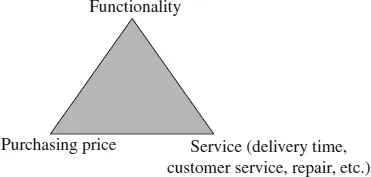
What the customer wants (Figure 1.1) is a product that meets his requirements, this is its functionality.
The primary function of an automobile is, but not limited to, transportation. The customer also wants to spend as little as possible while being served quickly and assured of support from the supplier (after-sale customer service, repair, etc.).
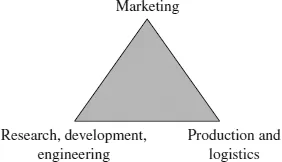
Success at the company level (Figure 1.2) is based on another tripod:
– marketing that aims to analyze the markets in order to identify the customer’s requirements;
– research and development (R&D) in charge of designing the product and the engineering (engineering and design department), which must define the industrial tool and have it built;
– production and logistics, whose mission is the creation of the product and making it available to the customer, in other words, the distribution.
A wobbly tripod is a source of failures and disappointments. A product may be excellent, perfectly respond to demand, but if the plant that manufactures it is unreliable (breakdowns, repeated strikes, etc.), then the customer is tempted to look for another source of supply.
1.1.1.2. The financial pillar
Right from its creation, the company has required stable resources. This cash requirement is covered by the capital, which is provided by the entrepreneur and his associates, if any, and by loans taken mostly from the banks. This is the liability of the company.
The entrepreneur takes a risk that he shares with his shareholders.
He, therefore, has a duty to achieve a given result (profit) to pay for the capital loaned.
The company is the permanent seat of exchanges:
– expenses, caused by the production and distribution; and
– revenues generated by sales. The company must have money at all times: this is the treasury. The initial economic difficulties faced by an company are always at the treasury level. The inability to pay implies the suspension of payment.
1.1.1.3. The human pillar
Employees are considered the first asset of the company. They are the individuals who run the company and make it evolve; they dedicate the largest part of their everyday life to it, often carrying with them a sense of pride.
The company provides a social status: it is a source of development, satisfaction but sometimes also of imbalance, frustration, alienation, and even illness. Work forms an integral part of life; to assert this, all we have to do is listen to what the unemployed have to say. All enterprises state that their greatest capital is human capital, but how many of them practise what they preach? Stress, various occupational illnesses, suicides, and acts of violence are dreadful indicators of deep problems.
1.1.1.4. The legal pillar
The legal form of the company defines the hierarchy within the company and the relationships with third-parties.
The company has the obligation to accept the laws of the countries where it operates, be it only for the quality of the products that it sells there, which must respect some rules and adhere to certain codes. In capitalist economy countries, there are several types of companies: partnerships, joint stock companies, cooperative enterprises, and so on.
Most companies are corporations, whereas the individual is a physical person. Owing to this corporation status, the company has the right to have capital, to sign contracts, buy, sell, use, and so on.
1.1.2. Typology of enterprises
Enterprises can be classified according to several criteria. Besides the legal form that we have just described, enterprises are most often characterized by their size and the nature of their job stream.
1.1.2.1. The size of the company
This is the most important and most accessible criterion. It gives the company its power, its local, national, and international impact, and its ability to influence its field of activity.
The size of the company can be measured by the amount of capital, turnover, and by the n...