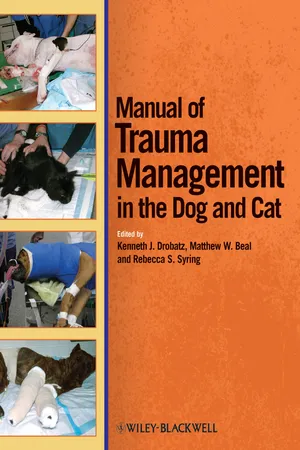
Beginning with a concise summary of the global assessment of traumatized patients, the heart of the book is devoted to guidance on managing specific types of trauma following definitive diagnosis. Manual of Trauma Management in the Dog and Cat is a valuable quick-reference guide to treating canine and feline trauma patients for general practitioners and emergency specialists alike.
eBook - ePub
Manual of Trauma Management in the Dog and Cat
- English
- ePUB (mobile friendly)
- Available on iOS & Android
eBook - ePub
Manual of Trauma Management in the Dog and Cat
About this book
Manual of Trauma Management in the Dog and Cat provides quick access to clinically relevant information on stabilizing, diagnosing, and managing the trauma patient. The book uses an outline format to provide fast access to essential information, focusing on practical advice and techniques for treating traumatic injuries. Manual of Trauma Management in the Dog and Cat is an ideal handbook for quickly and confidently managing this common presenting complaint.
Information
Chapter 1
GLOBAL APPROACH TO THE TRAUMA PATIENT
1. GLOBAL APPROACH TO THE TRAUMA PATIENT
a. Trauma is defined as a “wound or injury” and may occur secondary to motor vehicle accidents, fall from heights, animal interactions, human-animal interactions, etc. Severity may range from mild to fatal. Trauma may affect only one organ system or multiple organ systems, either directly or indirectly. Therefore, a global and thorough approach is required to improve survival and decrease morbidity in trauma patients.
b. Initial assessment of the trauma patient occurs quickly but can theoretically be broken down into two major phases; primary survey and secondary survey:
i. Primary survey is the assessment of the respiratory and cardiovascular systems, followed by assessment of the central nervous system and urinary tract system.
ii. Secondary survey is assessment of all other systems once the animal's most immediately life-threatening problems, identified during the primary survey, are dealt with.
c. The primary goal in attending to a critically injured trauma patient is to optimize oxygen delivery to the tissues. In fact, during the initial approach and resuscitation of these patients, all procedures are oriented toward this goal. Oxygen delivery is dependent upon cardiac output, hemoglobin concentration, and oxygen saturation of hemoglobin. It is important to optimize these variables at all times.
2. BRIEF PATHOPHYSIOLOGY
a. Traumatic shock results in a maldistribution of blood flow because of increased circulating catecholamines, hypovolemia, and increased vasoactive hormones.
b. Persistent microcirculatory perfusion failure may lead to sludging of blood and increased cellular and platelet aggregation.
c. Endothelial injury due to trauma may result in release of inflammatory mediators and stimulation of coagulation.
d. Damaged cellular membranes, due to poor perfusion or direct trauma, result in release of phospholipids. The enzymes phospholipase, cyclooxygenase, and lipoxygenase produce thromboxane and leukotrienes:
i. Thromboxane causes vasoconstriction, further compromising tissue perfusion and stimulating platelet aggregation.
ii. Leukotrienes and activation of the complement cascade propagates the inflammatory response with mobilization and activation of neutrophils.
iii. Neutrophil release of lysosomal enzymes and toxic oxygen metabolites cause further cellular damage, leading to edema with subsequent increase of oxygen diffusion distance to the cells from the capillaries.
iv. Optimizing tissue oxygen delivery will minimize the perpetuation of these inflammation-producing cascades.
3. ASSESSING AND MAINTAINING OXYGEN SATURATION OF HEMOGLOBIN—THE RESPIRATORY SYSTEM
a. At presentation,...
Table of contents
- Cover
- Title Page
- Copyright
- Dedication
- Preface
- Acknowledgments
- Contributor List
- Chapter 1: GLOBAL APPROACH TO THE TRAUMA PATIENT
- Chapter 2: TRIAGE AND PRIMARY SURVEY
- Chapter 3: SHOCK IN THE TRAUMA PATIENT
- Chapter 4: MONITORING THE TRAUMA PATIENT
- Chapter 5: ANESTHESIA AND ANALGESIA FOR THE TRAUMA PATIENT
- Chapter 6: TRAUMA-ASSOCIATED THORACIC INJURY
- Chapter 7: TRAUMATIC BRAIN INJURY
- Chapter 8: TRAUMA-ASSOCIATED PERIPHERAL NERVE INJURY
- Chapter 9: TRAUMATIC SPINAL INJURY
- Chapter 10: URINARY TRACT TRAUMA
- Chapter 11: TRAUMA-ASSOCIATED ABDOMINAL PARENCHYMAL ORGAN INJURY
- Chapter 12: TRAUMA-ASSOCIATED BILIARY TRACT INJURY
- Chapter 13: TRAUMA-ASSOCIATED BODY WALL AND TORSO INJURY
- Chapter 14: TRAUMA-ASSOCIATED GASTROINTESTINAL INJURY
- Chapter 15: TRAUMA-ASSOCIATED OCULAR INJURY
- Chapter 16: TRAUMA-ASSOCIATED MUSCULOSKELETAL INJURY TO THE HEAD
- Chapter 17: TRAUMA-ASSOCIATED SOFT TISSUE INJURY TO THE HEAD AND NECK
- Chapter 18: TRAUMA-ASSOCIATED MUSCULOSKELETAL INJURY TO THE APPENDICULAR SKELETON
- Chapter 19: TRAUMA-ASSOCIATED MUSCULOSKELETAL INJURY TO THE PELVIS, SACRUM, AND TAIL
- Chapter 20: BITE WOUND TRAUMA
- Chapter 21: TRAUMA-ASSOCIATED AURAL INJURY
- Index
Trusted by 375,005 students
Access to over 1.5 million titles for a fair monthly price.
Study more efficiently using our study tools.
Frequently asked questions
Yes, you can cancel anytime from the Subscription tab in your account settings on the Perlego website. Your subscription will stay active until the end of your current billing period. Learn how to cancel your subscription
No, books cannot be downloaded as external files, such as PDFs, for use outside of Perlego. However, you can download books within the Perlego app for offline reading on mobile or tablet. Learn how to download books offline
Perlego offers two plans: Essential and Complete
- Essential is ideal for learners and professionals who enjoy exploring a wide range of subjects. Access the Essential Library with 800,000+ trusted titles and best-sellers across business, personal growth, and the humanities. Includes unlimited reading time and Standard Read Aloud voice.
- Complete: Perfect for advanced learners and researchers needing full, unrestricted access. Unlock 1.5M+ books across hundreds of subjects, including academic and specialized titles. The Complete Plan also includes advanced features like Premium Read Aloud and Research Assistant.
We are an online textbook subscription service, where you can get access to an entire online library for less than the price of a single book per month. With over 1.5 million books across 990+ topics, we’ve got you covered! Learn about our mission
Look out for the read-aloud symbol on your next book to see if you can listen to it. The read-aloud tool reads text aloud for you, highlighting the text as it is being read. You can pause it, speed it up and slow it down. Learn more about Read Aloud
Yes! You can use the Perlego app on both iOS and Android devices to read anytime, anywhere — even offline. Perfect for commutes or when you’re on the go.
Please note we cannot support devices running on iOS 13 and Android 7 or earlier. Learn more about using the app
Please note we cannot support devices running on iOS 13 and Android 7 or earlier. Learn more about using the app
Yes, you can access Manual of Trauma Management in the Dog and Cat by Kenneth J. Drobatz, Matthew W. Beal, Rebecca S. Syring, Kenneth J. Drobatz,Matthew W. Beal,Rebecca S. Syring in PDF and/or ePUB format, as well as other popular books in Medicine & Veterinary Medicine. We have over 1.5 million books available in our catalogue for you to explore.