Of all the complications which arise from diabetes, cardiovascular complications are by far the most prevalent and the most deadly.
Authored by some of the world's leading names in this area, this outstanding book provides all those managing diabetic patients with clinical, practical and succinct guidance to the diagnosis and management of cardiovascular complications in diabetes.
With a joint endocrinology and cardiology focus, and with the very latest in clinical guidelines from the ADA, EASD, AHA, ASC and ESC, selected highlights include:
The role of new biomarkers of cardiovascular disease in diabetes
The latest on diagnosis of cardiovascular problems via vascular imaging
Hypertension and cardiovascular disease in the diabetic patient
Dyslipidaemia and its management in type 2 diabetes
Management of thrombosis, acute coronary syndrome and peripheral arterial disease in diabetes
Key points, case studies and self-assessment questions allow for rapid-reference, quick understanding of all topics, thus ensuring that this is perfect reading for endocrinologists, diabetes specialists and cardiologists of all levels managing patients with diabetes and associated cardiovascular problems.
Andrew Lansdown1, Elizabeth Ellins2 and Julian Halcox2
1Cardiff University School of Medicine, Cardiff, UK
2Swansea University College of Medicine, Swansea, UK
Key Points
The endothelium is a key participant in the homeostasis of the vessel wall.
Nitric oxide (NO) plays a key role in regulating healthy vascular function.
Reduced local NO bioavailability is a characteristic hallmark of vascular endothelial dysfunction.
Endothelial dysfunction is chiefly driven by oxidative stress and inflammation.
A number of techniques for assessing endothelial function are available; flow-mediated dilatation (FMD) is the current noninvasive ‘gold-standard’ methodology.
A number of circulating markers are also helpful in assessment of endothelial dysfunction.
Hyperglycemia, insulin resistance, and dyslipidemia are all important contributors to endothelial dysfunction.
Endothelial dysfunction in diabetes is associated with adverse micro- and macrovascular complications.
Drug therapies, including statins, insulin sensitizers, and ACE inhibitors, have been shown to improve endothelial dysfunction in diabetes.
Introduction
The vascular endothelium, the monolayer of thin cells lining the arteries and veins, serves as the key regulator of arterial homeostasis. It plays a vital role in regulating vascular tone, cellular adhesion, platelet activity, vessel wall inflammation, angiogenesis, and vascular smooth muscle cell proliferation. In order to regulate these functions, a number of important vasoactive molecules, including nitric oxide (NO), endothelium-derived hyperpolarizing factor (EDHF), prostacyclin (PGI2), and endothelin (ET-1), are produced and released by the endothelial cells [1, 2].
Normal Endothelial Cell Function
The arterial endothelium is composed of a layer of spindle-shaped endothelial cells that are bound together by tight junctions and communicate directly with each other and the underlying smooth muscle cells via gap junctions. This forms a protective barrier between the blood and the rest of the vessel wall that is relatively impermeable to low-density lipoprotein (the core component of atherosclerotic lesions), able to sense molecular cues and interact with cellular components of the circulating blood.
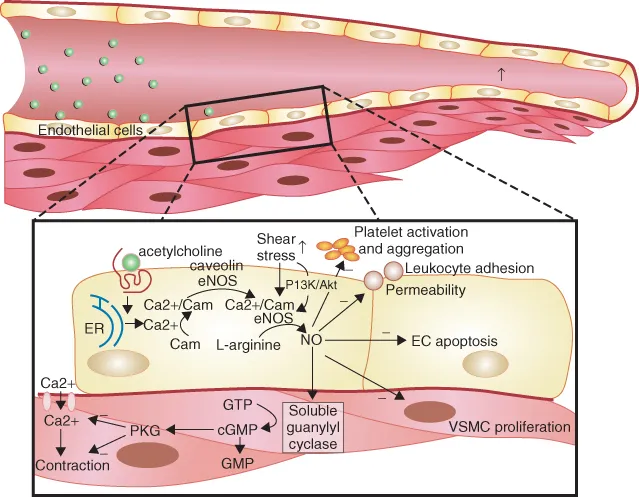
Furchgott and Zawadzki first demonstrated in 1980 that endothelial cells are essential in order for underlying smooth muscle relaxation to occur in response to acetylcholine administration in the rabbit aorta [3] and NO was subsequently identified as this endothelium-derived relaxing factor [4]. A healthy endothelium is able to secrete NO, a diatomic molecule generated from L-arginine, by the action of the enzyme endothelial NO synthase (eNOS) in the presence of cofactors such as tetrahydrobiopterin [5]. NO exerts its action by diffusing into vascular smooth muscle cells where it activates G-protein-bound guanylate cyclase, resulting in c-GMP generation, smooth muscle relaxation, and vasodilatation [1] (Figure 1.1). eNOS, in normal physiology, is activated by shear stress from blood flow through the vessels and also by molecules such as adenosine, bradykinin, serotonin (in response to platelet aggregation), and vascular endothelial growth factor (induced by hypoxia; Figure 1.1) [6–8].
Figure 1.1 Illustration of the stimulation of endothelial NO synthase by acetylcholine and shear stress leading to increased nitric oxide (NO) production in endothelial cells by receptor and nonreceptor and calcium-dependent and noncalcium-dependent pathways. (Source: Herrmann J et al. 2010 [8]. Reproduced with permission of Oxford University Press.)
In addition, NO has antiplatelet effects and can down-regulate inflammatory pathways and also decrease the generation of ET-1, a potent vasoconstrictor polypeptide, which also possesses pro-inflammatory, pro-oxidant, and pro-proliferative activity [9].
Other endothelial-derived vasodilators exist and act independently of NO to maintain vasodilator tone. PGI2, produced from the cyclooxygenase system, and EDHF are such molecules, with the latter able to compensate for the loss of NO-mediated vasodilator tone when NO bioavailability is reduced [10, 11]. Normal health and physiological functioning of the vascular endothelium are maintained by a balanced release of endothelial-derived relaxing factors, such as NO and prostacyclin (PGI2), and vasoconstricting factors like ET-1 and angiotensin II. The dysequilibrium of their production, release, and action is the chief characteristic of endothelial dysfunction [12].
Beyond its function in regulating vessel tone, the vascular endothelium also serves to play an important role in both mediating and responding to inflammatory pathways. In addition to its constrictor effects, angiotensin II generated by the endothelium has effects on vascular smooth muscle cell contraction, growth, proliferation, and differentiation. A range of selectins and adhesion molecules are produced, resulting in the binding and transendothelial migration of inflammatory cells [13, 14]. Furthermore, the endothelium is directly involved in the balance between coagulation and fibrinolysis, which is mediated by its synthesis of both tissue-type plasminogen activator (t-PA) and its inhibitor, plasminogen activator inhibitor-1 (PAI-1) [12, 15].
Measuring Endothelial Function
Following the in vitro work of Furchgott and Zawadzki, Ludmer et al. demonstrated for the first time in humans that locally administered acetylcholine caused vasoconstriction of atherosclerotic coronary arteries and vasodilatation in normal coronary vessels in subjects undergoing cardiac catheterization [16]. Subsequently, a noninvasive method was developed for assessing endothelial function in the conduit arteries of the peripheral circulation. This method used a period of forearm ischemia followed by reactive hyperemia to increase blood flow through the brachial artery, increasing local shear stress, mediating NO release and brachial artery dilatation [17]. Peripheral endothelial vasodilator function correlates with coronary endothelial function and cardiovascular risk factors, including smoking, dyslipidemia, and diabetes, and can predict incident cardiovascular events in older adults [18–21].
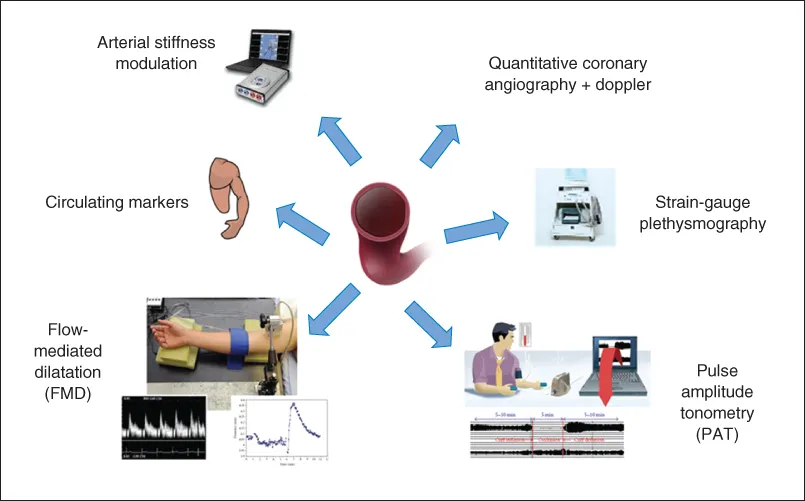
Various techniques have been developed that use pharmacologic agents to act on the endothelium or that measure the vasodilator response to increased shear stress. No one test has been shown to be ideal and indeed a combination may be required to evaluate fully the various aspects of vascular endothelial biology (Figure 1.2).
Figure 1.2 Methods for assessing human endothelial function.
Invasive methods for assessing endothelial function include venous occlusion plethysmography and quantitative coronary angiography with Doppler flow wire to assess coronary diameter and blood flow.
The original tests of endothelial function used the latter techniques to assess coronary circulatory physiology. Pharmacologic agents, such as acetylcholine, are used to induce an endothelium-dependent vasomotor response, measuring changes in the epicardial and microvascular circulation. At the doses traditionally used, a vasodilator response is usually observed in normal coronary vessels, but in the presence of endot...
Table of contents
Cover
Title Page
Copyright
List of Contributors
Introduction
Chapter 1: The Vascular Endothelium in Diabetes
Chapter 2: New Biomarkers of Cardiovascular Disease in Diabetes
Chapter 3: Kidney Disease in Diabetes
Chapter 4: Vascular Imaging
Chapter 5: Glycemia and CVD and Its Management
Chapter 6: Hypertension and Cardiovascular Disease and Its Management
Chapter 7: Dyslipidemia and Its Management in Type 2 Diabetes
Chapter 8: Thrombosis in Diabetes and Its Clinical Management
Chapter 9: Diet and Lifestyle in CVD Prevention and Treatment
Chapter 10: Management of Acute Coronary Syndrome
Chapter 11: Management of Peripheral Arterial Disease
Index
End User License Agreement
Trusted by 375,005 students
Access to over 1.5 million titles for a fair monthly price.
Study more efficiently using our study tools.
Frequently asked questions
Yes, you can cancel anytime from the Subscription tab in your account settings on the Perlego website. Your subscription will stay active until the end of your current billing period. Learn how to cancel your subscription
No, books cannot be downloaded as external files, such as PDFs, for use outside of Perlego. However, you can download books within the Perlego app for offline reading on mobile or tablet. Learn how to download books offline
Perlego offers two plans: Essential and Complete
Essential is ideal for learners and professionals who enjoy exploring a wide range of subjects. Access the Essential Library with 800,000+ trusted titles and best-sellers across business, personal growth, and the humanities. Includes unlimited reading time and Standard Read Aloud voice.
Complete: Perfect for advanced learners and researchers needing full, unrestricted access. Unlock 1.5M+ books across hundreds of subjects, including academic and specialized titles. The Complete Plan also includes advanced features like Premium Read Aloud and Research Assistant.
Both plans are available with monthly, semester, or annual billing cycles.
We are an online textbook subscription service, where you can get access to an entire online library for less than the price of a single book per month. With over 1.5 million books across 990+ topics, we’ve got you covered! Learn about our mission
Look out for the read-aloud symbol on your next book to see if you can listen to it. The read-aloud tool reads text aloud for you, highlighting the text as it is being read. You can pause it, speed it up and slow it down. Learn more about Read Aloud
Yes! You can use the Perlego app on both iOS and Android devices to read anytime, anywhere — even offline. Perfect for commutes or when you’re on the go. Please note we cannot support devices running on iOS 13 and Android 7 or earlier. Learn more about using the app
Yes, you can access Managing Cardiovascular Complications in Diabetes by D. John Betteridge, Stephen Nicholls, D. John Betteridge,Stephen Nicholls in PDF and/or ePUB format, as well as other popular books in Medicine & Endocrinology & Metabolism. We have over 1.5 million books available in our catalogue for you to explore.