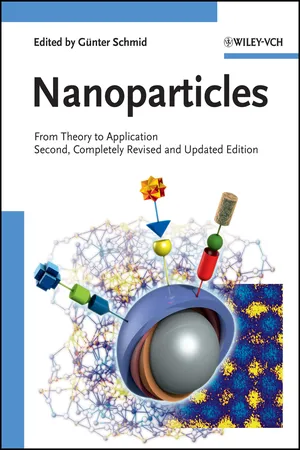
Very small particles are able to show astonishing properties. For example, gold atoms can be combined like strings of pearls, while nanoparticles can form one-, two- and three-dimensional layers. These assemblies can be used, for instance, as semiconductors, but other electronic as well as optical properties are possible.
An introduction to the booming field of "nanoworld" or "nanoscience", from fundamental principles to their use in novel applications.
With its clear structure and comprehensive coverage, backed by numerous examples from recent literature, this is a prime reference for chemists and materials scientists working with and developing nanoparticle systems.
A bestselling title in its second edition. A must-have reference for chemists and materials scientists.
- English
- ePUB (mobile friendly)
- Available on iOS & Android
eBook - ePub
About this book
Information
1
General Introduction
General Introduction
Sixyears after the publication of the First Edition of Nanoparticles, in 2004, the Second Edition became necessary due to the impressive developments in the important field of nanosciences and nanotechnology. Today, the predictions made in the “General Introduction” in 2004 have, more or less, all been confirmed. In other words, developments with regards to the study and application of nanoparticles have made decisive progress, and nanotechnology in the broader sense has today become a general expression for technical progress which, in public discussions, is often used in a scientifically incorrect sense. Nevertheless, the public have become very much aware of these new techniques, and have accepted them to a great extent.
This Second Edition of Nanoparticles: From Theory to Application is, of course, based on the construction of the First Edition, with most of the chapters having been considerably renewed, extended or even totally rewritten, largely as the result of scientific progress made during the past six years.
The changes in Chapter 2 on “Quantum Dots” are only marginal, as the original chapter contained mainly the basic physical facts regarding the nature of nanoparticles; however, some new relevant literature has been added. Chapter 3, on “Synthesis and Characterization” begins with a new Section 3.1 on “Homoatomic and Intermetalloid Tetrel Clusters,” a contribution which contains details of the latest results in the field of the famous Zintl ions (especially of Ge, Sn, and Pb), although those with endohedral transition metal atoms are also considered. Particular importance is attached to inter-cluster relationships, to form oligomeric and polymeric nanostruc- tures. The following Sections 3.21–3.23, on “Semiconductor Nanoparticles,” have been adjusted to the development of literature. In particular, those sections on Group II-VI and Group Ib-VI semiconductor nanoparticles are now complemented by the latest published results. Both, Section 3.3.1 and Section 3.3.2, on the synthesis and characterization of noble metal and magnetic nanoparticles, respectively, have consequently also been renewed and extended, following the preconditions of literature. The same is valid for Chapter 4, which deals with the “Organization of Nanoparticles.” The increase in knowledge concerning “Properties,” in Chapter 5, differs depending on the systems to be considered. While the progress of “Optical and Electronic Properties of Group III-Vand Group II—VI Nanoparticles” (Section 5.1.1) is obviously limited, that of Group Ib-VI nanoparticles (Section 5.1.2) is much more marked. There has also been a considerable increase in information concerning the “Electrical Properties of Metal Nanoparticles,” as can be seen from the extended Section 5.2. Finally, it must be noted that nanoscience and nanotechnology have definitely arrived in the biosciences, including medicine. Therefore, the former Chapter 6 on “Biomaterial-Nanoparticle Hybrid Systems” has been quantitatively substituted by a new chapter “Semiconductor Quantum Dots for Analytical and Bioanalytical Applications.” Semiconductor quantum dots, meanwhile, have acquired a decisive role as molecular sensors and biosensors, due to their photophysical properties. Fundamental studies conducted during the past few years have demonstrated the ability of semiconductor quantum dots to act as biosensors, not only as passive optical labels as in the past but, based on the progress of molecular and biomolecular modifications, as indicators of biocatalytic transformations and conformational transitions of proteins. Comparable progress has been achieved in the field of chemical sensors, such that specific recognition ligands are now capable of sensing for ions, molecules, and macromolecules.
Altogether, this Second Edition provides an actual insight into the present situation on the development of metal and semiconductor nanoparticles.
It should be mentioned at this point that not all aspects of the world of nano- particles can be considered in a single volume. For instance, the rapidly developing field of nanorods and nanowires has again not been considered, as these species are indeed worthy of their own monographs. The terminus “Nanoparticles,” as in the First Edition, is restricted to metal and semiconductor species. Numerous other materials exist as nanoparticles, while nonmetallic and oxidic nanoparticles exist and exhibit interesting properties, especially with respect to their applications. Nevertheless, from a scientific point of view, metal and semiconductor nanoparticles play perhaps the most interesting role, at least from the point of view of the Editor.
2
Quantum Dots
Quantum Dots
2.1
Introduction and Outline
Introduction and Outline
During the past decade, new directions of modern research, broadly defined as “nanoscale science and technology,” have emerged [1, 2]. These new trends involve the ability to fabricate, characterize, and manipulate artificial structures, the features of which are controlled at the nanometer level. Such trends embrace areas of research as diverse as engineering, physics, chemistry, materials science, and molecular biology. Research in this direction has been triggered by the recent availability of revolutionary instruments and approaches that allow the investigation of material properties with a resolution close to the atomic level. Strongly connected to such technological advances are the pioneering studies that have revealed new physical properties of matter at a level which is intermediate between atomic and molecular level, and bulk.
Materials science and technology is a field that is evolving at a very fast pace, and is currently making the most significant contributions to nanoscale research. It is driven by the desire to fabricate materials with novel or improved properties. Such properties might include strength, electrical and thermal conductivity, optical response, elasticity or wear-resistance. Research is also evolving towards materials that are designed to perform more complex and efficient tasks; examples include materials with a higher rate of decomposition of pollutants, a selective and sensitive response towards a given biomolecule, an improved conversion of light into current, or a more efficient energy storage system. In order for such, and even more, complex tasks to be realized, novel materials must be based on several components, the spatial organization of which is engineered at the molecular level. This class of materials – defined as “nanocomposites” – are made from assembled nanosized objects or molecules, their macroscopic behavior arising from a combination of the novel properties of the individual building blocks and their mutual interaction.
In electronics, the design and the assembly of functional materials and devices based on nanoscale building blocks can be seen as the natural, inevitable evolution of the trend towards miniaturization. The microelectronics industry, for instance, is today fabricating integrated circuits and storage media, the basic units of which are approaching the size of a few tens of nanometers. For computers, “smaller” goes along with higher computational power at lower cost and with higher portability. However, this race towards higher performance is driving current silicon-based electronics to the limits of its capability [3–6]. The design of each new generation of smaller and faster devices involves more sophisticated and expensive processing steps, as well as requiring the solution of new sets of problems, such as heat dissipation and device failure. If the trend towards further miniaturization persists, silicon technology will soon reach the limits at which these problems become insurmountable. In addition to this, it has been shown that device characteristics in very small components are strongly altered by quantum mechanical effects which, in many cases, will undermine the classical principles on which most of today’s electronic components are based. For these reasons, alternative materials and approaches are currently being explored for novel electronic components, in which the laws of quantum mechanics regulate their functioning in a predictable way. Perhaps in the near future a new generation of computers will rely on fundamental processing units that are made of only a few atoms.
Fortunately, the advent of new methods for the controlled production of nanoscale materials has provided new tools that can be adapted for this purpose. New terms such as nanotubes, nanowires and quantum dots (QDs) are now the common jargon of scientific publications. These objects are among the smallest, man-made units that display physical and chemical properties which make them promising candidates as the fundamental building blocks of novel transistors. The advantages envisaged here are a higher device versatility, a faster switching speed, a lower power dissipation, and the possibility to pack many more transistors on a single chip. Currently, the prototypes of these new single nanotransistors are being fabricated and studied in research laboratories, but are far from commercialization. How millions of such components could be arranged and interconnected in complex architectures, and at low cost, remains a formidable task.
With a completely different objective, the pharmaceutical and biomedical industries have attempted to synthesize large supramolecular assemblies and artificial devices that mimic the complex mechanisms of Nature, or that can potentially be used for more efficient diagnoses and better cures for diseases. Examples in this direction are nanocapsules such as liposomes, embodying drugs that can be selectively released in living organs, or bioconjugate assemblies of biomolecules and magnetic (or fluorescent) nanoparticles that might provide a faster and more selective analysis of biotissues. These prototype systems might one day evolve into more complex nanomachines, with highly sophisticated functional features, capable of carrying out complicated tasks at the cellular level in a living body.
This chapter is not intended as a survey on the present state and future developments of nanoscale science and technology, and the above-mentioned list of examples is far from complete. Nanoscience and nanotechnology will definitely have a strong impact on human-kind in many separate areas. Mention should be made, as the most significant examples, of information technology and the telecommunications industry, and of materials science and engineering, medicine and national security. The...
Table of contents
- Cover
- Title Page
- Copyright
- List of Contributors
- 1: General Introduction
- 2: Quantum Dots
- 3: Syntheses and Characterizations
- 4: Semiconductor Nanoparticles
- 5: Properties
- 6: Semiconductor Quantum Dots for Analytical and Bioanalytical Applications
- 7: Conclusions and Perspectives
- Index
Trusted by 375,005 students
Access to over 1.5 million titles for a fair monthly price.
Study more efficiently using our study tools.
Frequently asked questions
Yes, you can cancel anytime from the Subscription tab in your account settings on the Perlego website. Your subscription will stay active until the end of your current billing period. Learn how to cancel your subscription
No, books cannot be downloaded as external files, such as PDFs, for use outside of Perlego. However, you can download books within the Perlego app for offline reading on mobile or tablet. Learn how to download books offline
Perlego offers two plans: Essential and Complete
- Essential is ideal for learners and professionals who enjoy exploring a wide range of subjects. Access the Essential Library with 800,000+ trusted titles and best-sellers across business, personal growth, and the humanities. Includes unlimited reading time and Standard Read Aloud voice.
- Complete: Perfect for advanced learners and researchers needing full, unrestricted access. Unlock 1.5M+ books across hundreds of subjects, including academic and specialized titles. The Complete Plan also includes advanced features like Premium Read Aloud and Research Assistant.
We are an online textbook subscription service, where you can get access to an entire online library for less than the price of a single book per month. With over 1.5 million books across 990+ topics, we’ve got you covered! Learn about our mission
Look out for the read-aloud symbol on your next book to see if you can listen to it. The read-aloud tool reads text aloud for you, highlighting the text as it is being read. You can pause it, speed it up and slow it down. Learn more about Read Aloud
Yes! You can use the Perlego app on both iOS and Android devices to read anytime, anywhere — even offline. Perfect for commutes or when you’re on the go.
Please note we cannot support devices running on iOS 13 and Android 7 or earlier. Learn more about using the app
Please note we cannot support devices running on iOS 13 and Android 7 or earlier. Learn more about using the app
Yes, you can access Nanoparticles by Günter Schmid in PDF and/or ePUB format, as well as other popular books in Physical Sciences & Nanoscience. We have over 1.5 million books available in our catalogue for you to explore.