Separate sections in The Weather Almanac are devoted to tornadoes, hurricanes, thunderstorms, and lightening, flash floods, and winter storms, and they have been edited from official reports by governmental agencies. The new edition has been updated to include recent disasters such as the 2004 Indian Ocean Tsunami that devastated Indonesia as well as 2005's Hurricane Katrina. These chapters serve as a basic reference for severe weather and extreme conditions, which can assist in preparing for a weather emergency.
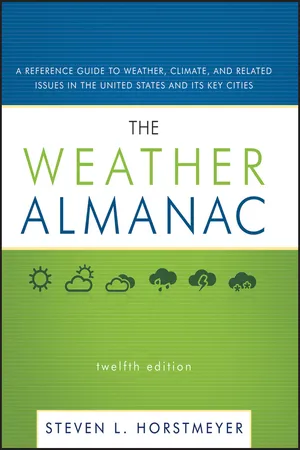
eBook - ePub
The Weather Almanac
A Reference Guide to Weather, Climate, and Related Issues in the United States and Its Key Cities
- English
- ePUB (mobile friendly)
- Available on iOS & Android
eBook - ePub
The Weather Almanac
A Reference Guide to Weather, Climate, and Related Issues in the United States and Its Key Cities
About this book
The Weather Almanac, 12th Edition is a resource for a variety of climate and meteorological data including both domestic and international weather trends, historical weather patterns dating back 1000 years, natural disasters, and a 20 page glossary of weather terminology. The book is complete with detailed maps, pictures, and tables compiling climate data from a variety of sources, including the National Weather Service and the US Geological Survey.
Information
1
Climate Maps of the United States

Weather is the day-to-day, sometimes minute-to-minute, changes in the atmosphere. Everyone has an intuitive idea what weather is. But when the time period is extended to months, seasons, years, decades, and longer, we talk about climate. Climate is the long-term state of the atmosphere. It is how you expect the atmosphere to behave.
The change of seasons is part of what climate is. In the Midwestern United States, residents expect hot, humid summer weather to gradually yield to autumn, characterized by cool mornings and toasty warm afternoons dominated by blue sky. In southern and central California, residents know that the brown hillsides that dominate the landscape from late spring into late autumn will begin to green as seasonal rains replenish soil moisture and plants begin to grow.
In Hawaii there is hardly any seasonal temperature change at all, but there are subtle differences from summer into winter in wind and rain events.
Climate is much more than seasonal change. It has been called the “average” of all weather, but it is still more. It can also be the daily, weekly, monthly, or annual range of a weather variable. Climate can be the frequency of occurrence of any weather event such as lightning. In addition there are more complex statistical measures, such as standard deviation that measures the variation about the average, that can help define climate.
Climate can be the average relative humidity at a specific hour of the day or the number of days the relative humidity drops below a certain value. The number of days snow fall exceeds a given amount gives you an idea of the frequency of traffic snarls, while the number of hours the average wind exceeds a given value during a year may help decide about the placement of a wind-powered turbine.
Climate can be defined however you need it to be. You decide what weather variables affect your project and develop a climatology that describes what to expect. The average afternoon temperature for a given place may give you an idea of how comfortable the location is but including a humidity variable and wind speed will give you a better idea of the “comfort climate.”
If you are projecting the heating cost of locating a new office facility, you would want detailed information about lowest temperatures, how long the temperature is colder than a particular value, how sunny the location is, and how windy it is. Each weather variable is part of the “natural gas for heating” climatology, and each affects the demand for natural gas for heating.
In summer a “residential cooling” climatology would include the same variables as for heating along with a humidity variable to account for electrical power demand.
Think of it this way: weather is a rainy day, while climate is a rainy place. All US cities have rainy days, but Seattle has a rainy climate. Portland, ME, has occasional hot days, but Orlando, FL, has a hot climate.
The 42 maps in this chapter represent a detailed picture, a climatology, of what you can expect over the long term in the lower 48 states.
The data were prepared and quality-controlled by the National Climatic Data Center (NCDC) of National Oceanic and Atmospheric Administration (NOAA) for the Climate Maps of the United States (CLIMAPS) database. The maps were redesigned and replotted for grayscale reproduction in this volume.
If you have experience with using or creating contour maps, you may be accustomed to having a fixed data interval between contour lines. That almost never works when creating climate maps because the distribution of...
Table of contents
- Cover
- Title Page
- Copyright
- Preface
- Chapter 1: Climate Maps of the United States
- Chapter 2: Renewable Energy
- Chapter 3: Extreme Weather—Disasters, Records, Floods, Heat, Cold, and Blizzards
- Chapter 4: Thunderstorms, Lightning, Hail, and Tornadoes
- Chapter 5: Tropical Cyclones
- Chapter 6: El Niño, La Niña, and the Southern Oscillation
- Chapter 7: Global Warming and Climate Change
- Chapter 8: Air Pollution
- Chapter 9: Climate Data from Around the World
- Chapter 10: Local Climatological Data Annual Summaries 2009
- Chapter 11: A Time Line of Meteorology: 9000 b.c.–2000 a.d.
- Index of Acronyms and Abbreviations
- General Index
- Index
- Index of Select Storms and Events
Trusted by 375,005 students
Access to over 1.5 million titles for a fair monthly price.
Study more efficiently using our study tools.
Frequently asked questions
Yes, you can cancel anytime from the Subscription tab in your account settings on the Perlego website. Your subscription will stay active until the end of your current billing period. Learn how to cancel your subscription
No, books cannot be downloaded as external files, such as PDFs, for use outside of Perlego. However, you can download books within the Perlego app for offline reading on mobile or tablet. Learn how to download books offline
Perlego offers two plans: Essential and Complete
- Essential is ideal for learners and professionals who enjoy exploring a wide range of subjects. Access the Essential Library with 800,000+ trusted titles and best-sellers across business, personal growth, and the humanities. Includes unlimited reading time and Standard Read Aloud voice.
- Complete: Perfect for advanced learners and researchers needing full, unrestricted access. Unlock 1.5M+ books across hundreds of subjects, including academic and specialized titles. The Complete Plan also includes advanced features like Premium Read Aloud and Research Assistant.
We are an online textbook subscription service, where you can get access to an entire online library for less than the price of a single book per month. With over 1.5 million books across 990+ topics, we’ve got you covered! Learn about our mission
Look out for the read-aloud symbol on your next book to see if you can listen to it. The read-aloud tool reads text aloud for you, highlighting the text as it is being read. You can pause it, speed it up and slow it down. Learn more about Read Aloud
Yes! You can use the Perlego app on both iOS and Android devices to read anytime, anywhere — even offline. Perfect for commutes or when you’re on the go.
Please note we cannot support devices running on iOS 13 and Android 7 or earlier. Learn more about using the app
Please note we cannot support devices running on iOS 13 and Android 7 or earlier. Learn more about using the app
Yes, you can access The Weather Almanac by Steven L. Horstmeyer in PDF and/or ePUB format, as well as other popular books in Biological Sciences & Science General. We have over 1.5 million books available in our catalogue for you to explore.