![]()
CHAPTER 1
Creating the Idea
The Need for Need-Driven Products
I don’t care about the invention. It’s the dimes I’m after.
—Isaac Singer
The first thing I learned long ago is that inventing is easy. I can dream up new inventions all day long. You probably can too—ideas just seem to keep popping up. However, what I also learned long ago is that, yes, inventing is easy, but the trick is to uncover what needs to be invented. That’s not so easy. It doesn’t matter if your idea is for a new kitchen gadget, a new software application, or a new Internet business, if you’ve not uncovered a need, or not found a problem demanding a solution, then success is difficult to achieve. Inventing a product that’s neither wanted nor needed is not the path to success that you should embark on.
For instance, take the inventor Stanley Weston, mentioned in the Preface. As you’ll recall, he’s the originator of G.I. Joe. Inventing the character itself was the easy part. There was a TV show at the time called The Lieutenant, and he just copied that character for his own character. The real brilliance of Weston’s idea—and what needed to be invented—was a doll that boys could play with. What Weston noticed that apparently no one else had was that boys like to play with dolls just as girls do, but there were no dolls made expressly for them. There were tin soldiers, but no dolls. And since you can’t sell a doll to a little boy, he coined the name “action figure.” Now, of course, it would be hard to find any little boy here in America who doesn’t have one or more G.I. Joe action figures somewhere in his toy chest. First Weston uncovered the need—a doll that didn’t look like a doll or would be called a doll (but still was a doll) for little boys to play with. That’s the need to be filled. The invention part, what G.I. Joe himself looks like, was easy; any of us could have done it. First uncover the need, and then create the product. You’d be surprised how many inventors do it the other way around. They have an idea, become enamored with it, develop it, and then create imaginary scenarios where this product is just what’s needed. “No home will be without it!” they exclaim. But you look at it, scratch your head, and say, “What are you supposed to do with this thing?”
It’s not difficult to find products that folks might like to have to solve one or another of those pesky little problems that seem to plague all of us, if we have a mind-set to look for them. Picture yourself, about 20 years ago, sitting in an airport waiting for your plane, watching passengers going by, lugging heavy suitcases. You might have said to yourself, “This is so stupid, why doesn’t someone invent little fold-up carts for these folks to use?” That’s the need—something to make lugging luggage through airports easier. Inventing the cart itself was easy once the need was observed. And, of course, someone observing the same thing did invent and start manufacturing collapsible little luggage carts and was soon selling them as fast as they could make them.
And then, a few years later, we might again find you sitting in an airport waiting for a flight, and you might again notice passengers pulling their luggage through the aisles, only this time on collapsible metal carts—and you might again have said to yourself, “This is so stupid. Why do they need these dumb carts? Why not just put wheels on the bags themselves?” And, of course, someone did; the carts have virtually disappeared, and now it’s almost impossible to find luggage that doesn’t have built-in wheels. Inventing the cart was easy, as was inventing a way to put wheel on the luggage itself. You or I could have easily done that. The credit, however, goes to the person who noticed the need and did something about it.
WHEN IS AN IMPROVEMENT NOT ONE?
Through my website I offer to evaluate invention ideas from other inventors and I receive them by the boatload. Many are “improvements” on existing products, adding a new feature or two to a standard product, long in the marketplace. While these little tweaks might be fine, they represent the most difficult type of product to license. Since the so-called improved version of an existing product is not likely to attract a new company into the field, the likely licensee candidate would come from the ranks of those already in the business. But what’s in it for them? They already have their own product and probably already know how to do what the inventor is proposing. Why pay out royalty dollars for something that, at best, might switch some sales from product A to product B? All retail products have a perceived value, and if the new features add to cost without adding to value, they’re not worth bothering with. Yes, true, the new features might be enjoyed by consumers, but would they pay extra for them? It’s likely that the prospective licensee has already made that determination and decided not. Otherwise he’d have already done it. My point is that most of these inventors are inventing what doesn’t need to be invented.
I’m not suggesting that these improvements offered by the inventor aren’t intelligently conceived—they may very well be—but a product’s potential for sales and its potential for licensing are not the same thing; each has its own requirements. Companies exist by tweaking their product to make it a little different than the competition’s; that’s what their design departments do all day. However, tweaking is rarely enough for a licensing deal. The licensee might be quite interested in a fresh, new kind of product to bring in new sources of income, not a product in competition to what he’s already selling. What good is that? In order to get a signature on a licensing agreement, the invention has to rise to the level of excitement, exclusivity, and profitability to perhaps make the prospective licensee say, “Wow!” as he rubs his hands together in greedy anticipation. That’s not as difficult as I’m making it sound, but it is important to understand what the prospective licensee is hoping to see when you walk into his office.
“MOMMY, WHERE DO IDEAS COME FROM?”
There’s a widely held misconception that creativity flourishes best in an unstructured environment. However, interviews with creative people show that their environments and work habits tend to be quite regulated. Ask some author about all he does before he starts writing; how every pencil has to be in a certain order, and how he has to be in a certain place at a certain time of day, and you’ll start to think this guy is from another planet. But it’s precisely this self-discipline that lets him do his job. It’s his way of notifying his brain that it’s time to get down to work. People who rely on the creation of new ideas as a profession have always known this. If there was no system, how could they stay in business? Systems are like the banks of a river; without them the river of creativity wanders all over the place, eventually disappearing.
In analyzing my own creativity process and breaking it down into steps—and in reading about creativity in general—I came to learn a few things. First, I learned that my system of creating ideas is the same system that has been identified and proved since classical times, so I wasn’t doing anything new. Second, I learned that all of us have more creative ability than we could possibly imagine. Apparently, with all the research on the subject of creativity that has been conducted, no correlation exists between an exceptionally high IQ and creativity. Few of us are geniuses, but, lucky for us, that’s not a requirement. What we need and what we can all acquire is the proper mind-set and a degree of discipline. The third thing I learned is to write everything down!
What works best for me, and just about everyone I know, is simple doodling. Nothing concentrates the mind more than putting a pencil to paper. I always have a notebook and a pen in my pocket. Always. I’m not alone; creative people have been doing that for centuries. In his diaries, Leonardo da Vinci, perhaps the most creative person in history, noted that his best ideas came while doodling, which he called “scribbling.”
In truth, I confess, half the stuff I scribble in my notebooks is gibberish—I either can’t understand what I wrote or I don’t know why I wrote it—but the other half is what keeps me in business. It’s like John Wanamaker, the famous department store founder, who once noted that he knows that half of his advertising is wasted but he doesn’t know which half.
INTRODUCING THE FAMOUS REESE I.C.I.C.L.E. SYSTEM OF CREATIVITY
Here are the six steps to creativity, and if you told them to Aristotle back around 350 B.C., he’d probably say, “That old stuff? I knew that ages ago.” As a mnemonic device, here’s my six-step I.C.I.C.L.E method for remembering what the steps to creativity are:
I. Identify your general goal or objective. Define the general problem.
C. Concentrate on developing a solution. Fill your head with research.
I. Identify your goal again—but this time narrow it down to its most basic element.
C. Concentrate again—really hard—this time on the narrowly defined objective.
L. Let it go. Go to sleep, go to a party—let your subconscious go to work.
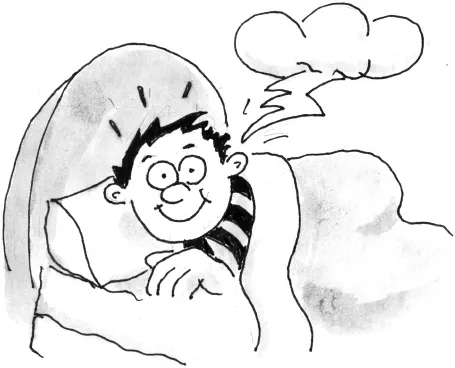
E. Eureka! Suddenly, seemingly out of the blue, the idea just seems to pop into your head. That’s not by accident; it’s because you gave your brain an assignment and it’s ready to deliver the goods. There’s no saying how long this might take—seconds or weeks—and there’s no promise that you won’t have to repeat the process, but it does work. You can take that to the bank.
You know how you meet someone you know on the street, chat for a moment, then each of you goes his own way—and for the life of you, you can’t think of his name? And you think, and you think as hard as you can, but it just doesn’t come. Chester? Charles? Something beginning with a C, you’re sure, but your mind draws a blank. And then, hours later, while in the middle of taking your tango dance lesson, suddenly it pops into your head. Frank! Good old Frank! How could you forget? And suddenly you remember everything about Frank that you ever knew, and maybe some things you wish you didn’t. That’s just the I.C.I.C.L.E process at work. You identified the problem in the most basic way (“What’s that guy’s name?”), concentrated on it as hard as you could, let your subconscious do its work, and suddenly your wonderful brain delivered the goods.
THIS IS A TEST
Just now, while I’m writing this, for the fun of it, I decided to give myself a little test.
I. I identified my problem: To come up with an Internet business for myself.
C. I concentrated on that goal, thinking about other Internet businesses I’m familiar with.
I. I decided I don’t want a business that involves investing in inventory, so it has to be some sort of service business. That’s my narrow objective: an Internet business with no inventory investment. And so I concentrated again, now on the narrow objective.
C.L.E. All three of these steps happened in a jumble. I thought about what kind of service business might interest me that lends itself to the Internet, and the idea for one immediately popped into my head. All of this took less than a minute—but it could have taken an hour or a week—that’s not the point. The point is that it’s a process, and when you’re conscious that it is a process and you apply it, it does produce results.
The Internet business my little test produced is to offer hand-painted portraits in oil of children, loved ones, pets, the purchaser himself, or the dearly departed. All the customer needs to do is send me a photo of the subject and his or her credit card information. Half of the cost would be charged upon acceptance of the assignment and the other half after the customer saw a photo of the finished portrait and gives an approval.
As I discuss later in this book, in order to license an Internet business, there has to be something unique about it to give the licensee an advantage. The unique advantage that I would give to my licensee is my personal connection to some talented artists in China who can turn out beautiful portraits and who work at much lower rates than here in the United States. I’d submit the customer’s photo to one of my artist friends who’d do the portrait. When the portrait was complete I’d post a picture of it on a website for the customer to visit and give his approval. The portrait would be shipped to the customer, the artist would be paid for his work, and I’d add my profit and charge the customer’s credit card. Simple! The only investment would be in creating and promoting the website. Since I’m an artist, I tend to think in those directions, but so what? All of us have talents and interests that might push in one direction or another. You might be an avid fisherman and so your Internet business idea might involve fishing products. If you involve yourself in a field that you like, success is a lot easier to achieve.
Now, perhaps when I do the numbers I’ll find that my portrait idea is not such a great idea after all—but I have the confidence that if I repeat the process, I can come up with something else—and that might be just what I’m looking for. But I’m no smarter than you are. If I can do it, I’m sure you can too. It all has to do with the process. If you want to start an Internet business, you can; I’m sure of it. Let me know when you’ve done it; maybe I’ll become a customer.
This thinking process works for anything. Suppose you, like many of us, watch reality TV shows and think, “This program is so stupid. I know I could come up with something better.” The TV networks love reality shows because they’re cheaper to make than dramas and some of them rack up huge audiences. So if you have a brilliant idea for a new show, why not give it a shot? Maybe you’ll be a hero to one of these networks.
So, again, let’s follow the process:
I. You’ve identified the general objective: to create a new reality show.
C. Next you’re going to concentrate on this general objective by researching all the different kinds of reality shows there are. Let’s see, there are documentary shows that show real people doing their jobs, such as cops arresting people; there are all sorts of dating reality shows that match prospective mates; there are hidden camera shows where people do dumb things; there are adventure shows where men and women are placed in exotic jungle locations; there are singing and dancing talent shows; there are contests where professional cooks or dress designers compete—and ...