Covering the complete range of companion animal zoonoses, each topic begins with information on etiology, geographic distribution, epidemiology, and pathophysiology. The discussion then moves into clinical presentation, diagnosis, and management, alongside prevention information for both animals and humans. Companion Animal Zoonoses is an essential reference for practicing veterinarians, public health veterinarians, and veterinary students. It will also appeal to physicians who wish to better understand zoonotic diseases.
- English
- ePUB (mobile friendly)
- Available on iOS & Android
eBook - ePub
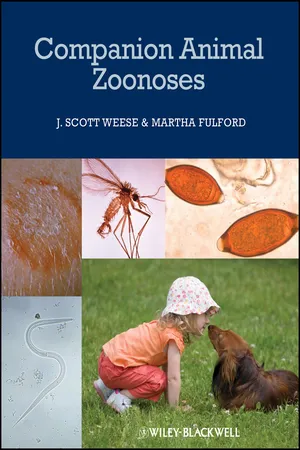
Companion Animal Zoonoses
About this book
Companion Animal Zoonoses is a comprehensive resource on diseases transmissible between animals and humans. Presenting detailed prevention and control strategies for zoonotic diseases, the book is an in-depth guide to practical information on the spread of disease between pet animals and humans. This relevant work provides up-to-date information on emerging issues, disease incidence and risk, and management measures.
Information
1
Parasitic Diseases
Introduction
Companion animals can harbor a wide range of parasites, some of which are transmissible to humans. The overall burden of human diseases attributable to companion animal-associated parasites is unknown and varies greatly between regions. The risks associated with some are often overstated while others are largely ignored, and the range of illness can extend from mild and self-limited to fatal.
Ascaris lumbricoides
Introduction
A. lumbricoides is a roundworm that has typically been considered host specific to humans; however, there is evidence of infection of dogs and the potential for dogs to be an uncommon source of human infection.
Etiology
As with other intestinal nematodes, A. lumbricoides is a nonsegmented, elongated, cylindrical parasite that undergoes sexual reproduction. Like other ascarids, as well as hookworms and Trichuris, A. lumbricoides undergoes a maturation stage in soil and is therefore sometimes referred to as a geohelminth.1 Female worms are larger than males and can reach 40 cm in length and 6 mm in diameter.2
Life cycle
Adult worms live within the small intestinal lumen of humans and excrete massive numbers of eggs per day. As with other ascarids, eggs are not immediately infective and must mature to infective third-stage larvae in the environment over a period of days. After embryonated eggs are ingested by a human, larvae hatch, penetrate the intestinal mucosa, and reach the liver via portal circulation. After migrating through the liver, the larvae eventually reach the lungs, penetrate the airways, ascend the tracheobronchial tree, and are coughed up and swallowed. They mature into adults in the small intestinal lumen and complete the life cycle. The time from ingestion of infective eggs to development of adults is approximately 8 weeks.2
Geographic distribution/epidemiology
A. lumbricoides is one of the most prevalent nematodes in humans and is most common in tropical and subtropical regions, infecting approximately 25% of the world’s population.3–5 Up to 80% of people can be infected in some areas.1,4,6–9 The regional prevalence varies depending on factors such as climate, sanitation, socioeconomic status, and human behavior. Areas with warm, humid climates facilitate maturation and survival of infective eggs. Poor sanitation leads to an increased risk of contamination of the environment with human feces. Outdoor defecation similarly results in increased likelihood of contamination, and outdoor activities in contaminated areas that are accompanied by suboptimal hand hygiene increase the risk of fecal–oral infection. A. lumbricoides eggs can be found in the soil in public places such as parks10,11 and can survive outdoors for years in favorable environmental conditions.1 Infections are more common in children.
Some older studies reported the presence of ascarid eggs that could have been A. lumbricoides in canine feces.12,13 More recently, convincing evidence of the presence of A. lumbricoides in dogs has been reported. A study of dogs in tea-growing communities in northern India identified A. lumbricoides eggs in 18–37% of dogs.7 In that study, dogs were at increased risk of shedding A. lumbricoides if one or more household members regularly defecated outdoors. Simply finding eggs in feces, particularly in an environment where dogs may ingest human feces, does not necessarily indicate that dogs are involved in the biological cycle of the organism. Indeed, there has been some thought that dogs only act as mechanical vectors and that eggs passed in feces simply moved passively through the intestinal tract. However, a recent study of dogs in an area in Egypt where outdoor defecation by humans is common reported detection of adult A. lumbricoides in 8% of dogs.14 Furthermore, viable eggs were detected, suggesting that dogs can truly be infected and could potentially play a role in the life cycle of this human parasite. It has also been suggested that the dog’s coat could be a source of exposure since the eggs are “sticky” and highly tolerant of environmental effects, and could potentially adhere and mature to the infective stage on the animal.14
A study of young Nigerian children indicated that children whose families owned dogs were 3.5 times as likely to be shedding A. lumbricoides compared with non-dog-owning families.15 In contrast, contact with dogs was not a risk factor in a study of adult humans in northern India.7 Whether there truly is a risk from dogs is unclear, but the limited data indicate that consideration of the role of pets, particularly dogs, in the transmission of this predominantly human-associated parasite is required.
Animals
Clinical presentation
Little is known about A. lumbricoides in dogs. While it was previously thought that dogs shedding the parasite represented a mechanical, not biological, vector, there is now evidence that adult worms can grow in the canine intestinal tract. It is not known whether this can result in disease.
Diagnosis
Diagnosis is based on the detection of eggs in feces using fecal flotation and subsequent speciation of the parasite by evaluation of micromorphological features14 or using molecular methods such as PCR-RFLP.7
Management
No specific data are present, but presumably, any prophylactic or therapeutic agent that is used for the treatment of Toxocara in dogs would be effective against A. lumbricoides. These include milbemycin oxime, moxidectin, fenbendazole, and pyrantel.
Humans
Clinical presentation
Various presentations can occur, but most infections are asymptomatic.1,2 Large worm burdens can result in malnutrition, nonspecific gastrointestinal signs, or, in rare cases, intestinal obstruction.2 Obstruction of the bile duct can result in cholangitis, biliary colic, or pancreatitis.2 Chronic infections can produce insidious disease, with growth retardation and negative effects on cognitive function in children.5 During larval migration, acute pulmonary signs (Loeffler’s syndrome), fever, and marked eosinophilia can occur.2 There is also increasing concern about the broad effects of ascarid infection on the immune system, something that may be particularly important with concurrent infections such as malaria or for the development of allergic diseases,16,17 though more research needs to be performed in this area.
Diagnosis
Eggs are usually easily detectable in stool because of the large numbers that are shed by adult worms. Rarely, adult worms will be passed in stool or vomitus.2 Adult worms may also be identified ultrasonographically as an incidental finding or during investigation of gastrointestinal complaints.
Management
A single dose of albendazole, mebendazole, or pyrantel pamoate has high cure rates (88–95%).18 Three days of mebendazole or a single dose of ivermectin has also been recommended in people over 2 years of age.2 Nitazoxanide is also effective.19 Retesting of stool 2 weeks after treatment has been recommended.2 Most drugs are only effective against adult parasites, so repeated treatment may be needed.
Prevention
Prevention of zoonotic transmission of A. lumbricoides, should it occur, involves basic measures to reduce the incidence of exposure of dogs, to reduce contamination of the environment by dog feces, and to prevent fecal–oral exposure in humans. Evidence-based data are not available for any of these areas, but reasonable recommendations can be made.
Reducing exposure involves decreasing the chance that dogs will ingest infective A. lumbricoides eggs, which are predominantly found in human feces. Reducing “promiscuous defecation” by humans, something that is common in some developing regions,14 is a means of achieving this and involves both education and improved infrastructure.
Reducing contamination of the environment by dogs is as discussed for similar organisms like Toxocara canis (e.g., reducing worm burdens, and therefore shedding levels, by routine antiparasitic chemoprophylaxis). Decreasing the numbers of free-roaming dogs and prompt removal of feces, particularly from public areas such as parks, would presumably help achieve that goal. General hygiene practices are the key to reducing inadvertent ingestion of infective larvae by humans, including good attention to hand hygiene and proper washing of food.
Prophylactic use of albendazole, mebendazole, or pyrantel pamoate in humans can be practical and affordable in endemic areas, particularly in school-age children.2,20 Based on the commonness of the parasite in humans in some regions and the very rare incidence of patent infections in dogs, prophylactic treatment of dogs directed specifically against A. lumbricoides is not indicated. However, routine deworming targeted against other roundworms will be effective against this parasite.
Baylisascaris procyonis
Introduction
B. procyonis is a large nematode that is highly prevalent in healthy raccoons in many regions.21 Human infections are very rare but can be devastating. Neural larva migrans is the most common form of this rare disease, but visceral (VLM) and ocular larva migrans (OLM) can also develop.
Dogs can shed B. procyonis in feces and can also theoretically be a source of human exposure through transporting infective eggs into the household on their hair coat. While objective evidence of a risk from pets is minimal, the severity of disease in humans indicates that basic measures should be taken to reduce the risk of exposure to this parasite.
Etiology
B. procyonis belongs to the order Ascaridida, along with Toxocora canis and T. cati.21 The North American raccoon (Procyon lotor) is the definitive host, and B. procyonis is often termed the “raccoon roundworm.” An unusual aspect of B. procyonis is its ability to infect a wide range of animal species, causing neural larva migrans in over 100 avian and mammalian species.21
Life cycle
Adult worms are found in the small intestine of raccoons. They are large, tan roundworms that can be up to 22 cm long. Female worms are prodigious egg layers, and infected raccoons can pass millions of eggs in feces per day, leading to heavy contamination of the environment. Eggs are not immediately infective, and second-stage larvae must develop in eggs in the environment before infection is possible. This usually requires 2–4 weeks, but may occur as quickly as 11 days in some situations.21 After ingestion, infective eggs hatch in the small intestine. In intermediate hosts, larvae can penetrate the intestinal mucosa and migrate via portal circulation to the liver, then to the lungs, where they are subsequently distributed throughout the body via the systemic circulation. Larvae that reach the central nervous system (CNS) continue to migrate and grow, causing neurological dam...
Table of contents
- Cover
- Half title page
- Title page
- Copyright page
- Preface
- Contributors
- 1 Parasitic Diseases
- 2 Bacterial Diseases
- 3 Viral Diseases
- 4 Fungal Diseases
- 5 Pets and Immunocompromised Individuals
- 6 Pet Bites
- Index
Trusted by 375,005 students
Access to over 1.5 million titles for a fair monthly price.
Study more efficiently using our study tools.
Frequently asked questions
Yes, you can cancel anytime from the Subscription tab in your account settings on the Perlego website. Your subscription will stay active until the end of your current billing period. Learn how to cancel your subscription
No, books cannot be downloaded as external files, such as PDFs, for use outside of Perlego. However, you can download books within the Perlego app for offline reading on mobile or tablet. Learn how to download books offline
Perlego offers two plans: Essential and Complete
- Essential is ideal for learners and professionals who enjoy exploring a wide range of subjects. Access the Essential Library with 800,000+ trusted titles and best-sellers across business, personal growth, and the humanities. Includes unlimited reading time and Standard Read Aloud voice.
- Complete: Perfect for advanced learners and researchers needing full, unrestricted access. Unlock 1.5M+ books across hundreds of subjects, including academic and specialized titles. The Complete Plan also includes advanced features like Premium Read Aloud and Research Assistant.
We are an online textbook subscription service, where you can get access to an entire online library for less than the price of a single book per month. With over 1.5 million books across 990+ topics, we’ve got you covered! Learn about our mission
Look out for the read-aloud symbol on your next book to see if you can listen to it. The read-aloud tool reads text aloud for you, highlighting the text as it is being read. You can pause it, speed it up and slow it down. Learn more about Read Aloud
Yes! You can use the Perlego app on both iOS and Android devices to read anytime, anywhere — even offline. Perfect for commutes or when you’re on the go.
Please note we cannot support devices running on iOS 13 and Android 7 or earlier. Learn more about using the app
Please note we cannot support devices running on iOS 13 and Android 7 or earlier. Learn more about using the app
Yes, you can access Companion Animal Zoonoses by J. Scott Weese, Martha Fulford, J. Scott Weese,Martha Fulford in PDF and/or ePUB format, as well as other popular books in Medicine & Veterinary Medicine. We have over 1.5 million books available in our catalogue for you to explore.