eBook - ePub
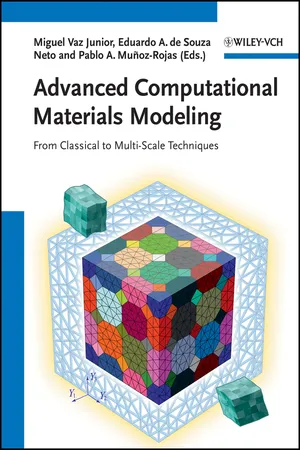
Advanced Computational Materials Modeling
From Classical to Multi-Scale Techniques
- English
- ePUB (mobile friendly)
- Available on iOS & Android
eBook - ePub
Advanced Computational Materials Modeling
From Classical to Multi-Scale Techniques
About this book
With its discussion of strategies for modeling complex materials using new numerical techniques, mainly those based on the finite element method, this monograph covers a range of topics including computational plasticity, multi-scale formulations, optimization and parameter identification, damage mechanics and nonlinear finite elements.
Trusted by 375,005 students
Access to over 1 million titles for a fair monthly price.
Study more efficiently using our study tools.
Information
Chapter 1
Materials Modeling – Challenges and Perspectives
1.1 Introduction
The development of materials modeling has experienced a huge growth in the last 10 years. New mathematical approaches (formulations, concepts, etc.), numerical techniques (algorithms, solution strategies, etc.), and computing methods (parallel computing, multigrid techniques, etc.), allied to the ever-increasing computational power, have fostered the research growth observed in recent times. Numerical implementation of some modeling concepts, such as multiscale formulations and optimization procedures, were severally restricted two decades ago due to limitation of computing resources. What were once perspectives of new advancements have become a reality in the last few years and longstanding difficulties have been overcome.
It is important to emphasize that materials modeling is not a recent concept or a new research topic. Some material descriptions widely accepted and used these days were actually proposed in the late eighteenth century. For instance, within the framework of modeling inelastic deformation of metals, the French engineer Henri Tresca (1814–1884), professor at the Conservatoire National des Arts et Métiers (CNAM) in Paris, was the first to define distinct rules for the onset of plastic flow in ductile solids [1]. Tresca’s groundbreaking studies established a material-dependent critical plastic threshold given by the maximum shear stress. The apparently simple concept gave rise to a completely new approach to studying deformation of solid materials, and, today, his principle is known as Tresca’s yield criterion. It is interesting to mention that, in spite of many years of proposition, numerical implementation of Tresca’s criterion is not straightforward because of the sharp corners of the yield locus and its association with the plastic-normality flow rule [2, 3].
The search for alternate modeling descriptions is also not a new endeavor. For similar problems, Maksymilian Tytus Huber (1872–1950), a Polish engineer, postulated that material strength depends upon the spatial state of stresses and not on a single component of the stress tensor [4]. Independently, the Austrian mathematician and engineer, Richard von Mises (1883–1953), indicated that plastic deformation of solids is associated with some measure of an equivalent stress state [5]. The assumption indicates that plastic deformation is initiated when the second deviatoric stress invariant reaches a critical value. A few years later, the German engineer, Heinrich Hencky (1885–1952), still within the criterion introduced by Huber and von Mises, suggested that the onset of plastic deformation takes place when the elastic energy of distortion reaches a critical value [6]. An alternate physical interpretation was proposed by Roš and Eichinger, who demonstrated that the critical distortional energy principle is equivalent to defining a critical shear stress on the octahedral plane [7], generally known as maximum octahedral shear stress criterion. The aforementioned elastic–plastic modeling assumptions are known today as the Huber–Mises–Hencky yield criterion. A brief review of the early works on modeling of plastic deformation of metals illustrates the drive toward understanding the physics of material behavior and its translation into mathematical descriptions.1
Despite the fact that the principles of plasticity theory have long been established, application to realistic problems or advanced materials using only mathematical tools is difficult or even impossible. Following the example on deformation of metals, when addressing computational modeling of elastic–plastic deformation at finite strains, the solution requires a physical/material description (e.g., the classical Huber–Mises–Hencky equation), a mathematical formulation able to handle geometrical and material nonlinearity (e.g., multiplicative decomposition of the gradient of deformation tensor into elastic and plastic components), and a computational approximation/discretization of the physical and mathematical problem (e.g., iterative procedures such as the Newton–Raphson and arc-length methods). This class of problems has already been exhaustively investigated in the last 30 years, and the literature shows a wide variety of strategies (see, for instance, Ref. [11] and references therein).
The illustration on the development of physical/mathematical/numerical formulations of elastic–plastic deformation of ductile solids shows that a proper material modeling requires
1) understanding of the physics involved in the problem;
2) comprehensive theoretical and mathematical treatment of the phenomena;
3) sound and consistent numerical approximation/discretization of the governing and constitutive equations; and
4) adequate computing resources.
These principles are extensive to modeling and simulation of any materials-processing operation. In a broader context of materials modeling, the literature has shown an increasing pace in the evolution of each one of the aspects mentioned in items (1–4). Advancements in mathematical and numerical tools have prompted investigation in areas of materials modeling ranging from electronic and atomistic level to complex structures within the continuum realm [12]. Despite this considerable progress, there are still pressing challenges to be overcome, mainly those associated with more realistic materials-processing operations or simulation of complex materials structures. This chapter highlights some modeling issues under current and intense scrutiny by researchers and does not intend to be exhaustive. The other chapters of this book present deeper insights into materials modeling and simulation of some class of problems that, in a way, we hope, will serve as a springboard for further realistic applications.
1.2 Modeling Challenges and Perspectives
Materials modeling is as vast as the types of existing materials. For decades, emphasis has been placed on structural (metals, polymers, composites, etc.) and geotechnical (soils and rocks) classical materials. Behavior prediction of such materials subjected to a given load (mechanical or thermal) in process operations or stress–strain/heat transfer analysis has constituted the bulk of numerical approaches available in the literature. The existing solution approaches are comprehensive and provide accurate results for most classical materials subjected to strain paths of reasonable complexity. However, the constant search for technological advances and understanding of some classes of complex materials and processes has posed new challenges, urging scientists to seek new mathematical and computational tools. The following sections discuss general aspects of (i) the modeling of ductile deformation and mechanical degradation leading to fracture; (ii) the modeling of cellular materials; and (iii) multiscale approaches. Many other constitutive modeling issues and material types could have been included in the list; however, the above aspects have attracted substantial attention of academia and industry due to perspectives of realistic applications in a relatively short term.
1.2.1 Mechanical Degradation and Failure of Ductile Materials
In the last few years, numerical simulation of metal-forming operations has been incorporated into the design procedures of many manufacturing processes. Industry is seeking not only to estimate forming loads and energy requirements with higher accuracy but also to predict possible defects and tool life. Forging, extrusion, and deep drawing are some examples of forming processes that are particularly prone to material failure. For instance, a faulty design of extraction angles, tool radius, or workpiece geometry might lead to either external or internal defects. Therefore, aiming at prediction of fracture onset associated with elastic–(visco)plastic deformation, the modeling of mechanical degradation of ductile materials has been extensively studied in the last few years. A brief literature survey shows many research groups engaged in the aspects listed below, which are intrinsically related to ductile failure:
- Prediction of failure onset: numerical and experimental investigation of failure criteria for manufacturing processes (e.g., forming limit diagrams for sheet metal forming);
- Material response to loading: computation of stress–strain distribution and loads in multistep forming operations (e.g., springback and residual stress evaluation);
- Multiscale modeling: approximations for strongly coupled scales, homogenization strategies, and heterogeneous multiscale techniques (e.g., damage modeling, cohesive failure, biomaterials applications, microstructure design, crystal plasticity, and texture evolution);
- Anisotropic materials: modeling anisotropic behavior of materials (e.g., complex yield criteria and its interaction with material failure);
- Nonlocal models: material modeling including nonlocal effects (e.g., new weighted averages in nonlocal formulations and suitable gradients in gradient approaches. Applications to nonhomogeneous materials);
- Deformation and failure under complex stress states: derivation of material models and failure criteria able to describe plastic deformation under complex stress–strain paths (e.g., failure criteria for tensile and compressive-dominant processes);
- Parameter identification: identification of material parameters (e.g., identification of elastic–plastic, damage, and fracture parameters using techniques for inverse problems).
The aforementioned topics are not exhaustive and other aspects associated with modeling of the ductile failure process could be added. Furthermore, some topics can (σH/σeq) also be interrelated to each other, for example, deformation and failure under complex stress states using nonlocal damage models. In order to illustrate the challenges faced by researchers and perspectives eagerly awaited by industry, some issues related to deformation and failure under complex stress states are discussed in the following paragraphs.
The literature shows many attempts to describe the mechanical degradation process and failure initiation based on postproces...
Table of contents
- Cover
- Half Title page
- Title page
- Copyright page
- Preface
- List of Contributors
- Chapter 1: Materials Modeling – Challenges and Perspectives
- Chapter 2: Local and Nonlocal Modeling of Ductile Damage
- Chapter 3: Recent Advances in the Prediction of the Thermal Properties of Metallic Hollow Sphere Structures
- Chapter 4: Computational Homogenization for Localization and Damage
- Chapter 5: A Mixed Optimization Approach for Parameter Identification Applied to the Gurson Damage Model
- Chapter 6: Semisolid Metallic Alloys Constitutive Modeling for the Simulation of Thixoforming Processes
- Chapter 7: Modeling of Powder Forming Processes; Application of a Three-invariant Cap Plasticity and an Enriched Arbitrary Lagrangian–Eulerian FE Method
- Chapter 8: Functionally Graded Piezoelectric Material Systems – A Multiphysics Perspective
- Chapter 9: Variational Foundations of Large Strain Multiscale Solid Constitutive Models: Kinematical Formulation
- Chapter 10: A Homogenization-Based Prediction Method of Macroscopic Yield Strength of Polycrystalline Metals Subjected to Cold-Working
- Index
Frequently asked questions
Yes, you can cancel anytime from the Subscription tab in your account settings on the Perlego website. Your subscription will stay active until the end of your current billing period. Learn how to cancel your subscription
No, books cannot be downloaded as external files, such as PDFs, for use outside of Perlego. However, you can download books within the Perlego app for offline reading on mobile or tablet. Learn how to download books offline
Perlego offers two plans: Essential and Complete
- Essential is ideal for learners and professionals who enjoy exploring a wide range of subjects. Access the Essential Library with 800,000+ trusted titles and best-sellers across business, personal growth, and the humanities. Includes unlimited reading time and Standard Read Aloud voice.
- Complete: Perfect for advanced learners and researchers needing full, unrestricted access. Unlock 1.4M+ books across hundreds of subjects, including academic and specialized titles. The Complete Plan also includes advanced features like Premium Read Aloud and Research Assistant.
We are an online textbook subscription service, where you can get access to an entire online library for less than the price of a single book per month. With over 1 million books across 990+ topics, we’ve got you covered! Learn about our mission
Look out for the read-aloud symbol on your next book to see if you can listen to it. The read-aloud tool reads text aloud for you, highlighting the text as it is being read. You can pause it, speed it up and slow it down. Learn more about Read Aloud
Yes! You can use the Perlego app on both iOS and Android devices to read anytime, anywhere — even offline. Perfect for commutes or when you’re on the go.
Please note we cannot support devices running on iOS 13 and Android 7 or earlier. Learn more about using the app
Please note we cannot support devices running on iOS 13 and Android 7 or earlier. Learn more about using the app
Yes, you can access Advanced Computational Materials Modeling by Miguel Vaz Junior,Eduardo A. de Souza Neto,Pablo A. Munoz-Rojas in PDF and/or ePUB format, as well as other popular books in Technology & Engineering & Materials Science. We have over one million books available in our catalogue for you to explore.