Beam Structures
eBook - ePub

Beam Structures

Classical and Advanced Theories

  1. English
  2. ePUB (mobile friendly)
  3. Available on iOS & Android
eBook - ePub

Beam Structures

Classical and Advanced Theories

About this book

Beam theories are exploited worldwide to analyze civil, mechanical, automotive, and aerospace structures. Many beam approaches have been proposed during the last centuries by eminent scientists such as Euler, Bernoulli, Navier, Timoshenko, Vlasov, etc.  Most of these models are problem dependent: they provide reliable results for a given problem, for instance a given section and cannot be applied to a different one.

Beam Structures: Classical and Advanced Theories proposes a new original unified approach to beam theory that includes practically all classical and advanced models for beams and which has become established and recognised globally as the most important contribution to the field in the last quarter of a century.

The Carrera Unified Formulation (CUF) has hierarchical properties, that is, the error can be reduced by increasing the number of the unknown variables. This formulation is extremely suitable for computer implementations and can deal with most typical engineering challenges. It overcomes the problem of classical formulae that require different formulas for tension, bending, shear and torsion; it can be applied to any beam geometries and loading conditions, reaching a high level of accuracy with low computational cost, and can tackle problems that in most cases are solved by employing plate/shell and 3D formulations.

Key features:

  • compares classical and modern approaches to beam theory, including classical well-known results related to Euler-Bernoulli and Timoshenko beam theories
  • pays particular attention to typical applications related to bridge structures, aircraft wings, helicopters and propeller blades
  • provides a number of numerical examples including typical Aerospace and Civil Engineering problems
  • proposes many benchmark assessments to help the reader implement the CUF if they wish to do so
  • accompanied by a companion website hosting dedicated software MUL2 that is used to obtain the numerical solutions in the book, allowing the reader to reproduce the examples given in the book as well as to solve other problems of their own www.mul2.com

Researchers of continuum mechanics of solids and structures and structural analysts in industry will find this book extremely insightful. It will also be of great interest to graduate and postgraduate students of mechanical, civil and aerospace engineering.
Frequently asked questions

Yes, you can cancel anytime from the Subscription tab in your account settings on the Perlego website. Your subscription will stay active until the end of your current billing period. Learn how to cancel your subscription.
No, books cannot be downloaded as external files, such as PDFs, for use outside of Perlego. However, you can download books within the Perlego app for offline reading on mobile or tablet. Learn more here.
Perlego offers two plans: Essential and Complete
  • Essential is ideal for learners and professionals who enjoy exploring a wide range of subjects. Access the Essential Library with 800,000+ trusted titles and best-sellers across business, personal growth, and the humanities. Includes unlimited reading time and Standard Read Aloud voice.
  • Complete: Perfect for advanced learners and researchers needing full, unrestricted access. Unlock 1.4M+ books across hundreds of subjects, including academic and specialized titles. The Complete Plan also includes advanced features like Premium Read Aloud and Research Assistant.
Both plans are available with monthly, semester, or annual billing cycles.
We are an online textbook subscription service, where you can get access to an entire online library for less than the price of a single book per month. With over 1 million books across 1000+ topics, we’ve got you covered! Learn more here.
Look out for the read-aloud symbol on your next book to see if you can listen to it. The read-aloud tool reads text aloud for you, highlighting the text as it is being read. You can pause it, speed it up and slow it down. Learn more here.
Yes! You can use the Perlego app on both iOS or Android devices to read anytime, anywhere — even offline. Perfect for commutes or when you’re on the go.
Please note we cannot support devices running on iOS 13 and Android 7 or earlier. Learn more about using the app.
Yes, you can access Beam Structures by Erasmo Carrera,Gaetano Giunta,Marco Petrolo in PDF and/or ePUB format, as well as other popular books in Physical Sciences & Mechanics. We have over one million books available in our catalogue for you to explore.

Information

Publisher
Wiley
Year
2011
Print ISBN
9780470972007
eBook ISBN
9781119951049
Edition
1
Subtopic
Mechanics
1
Fundamental equations of continuous deformable bodies
This chapter recalls the geometrical and constitutive equations of continuum structural mechanics in the linear case. Symbols and reference systems that will be used throughout the book are also introduced.
1.1 Displacement, strain, and stresses
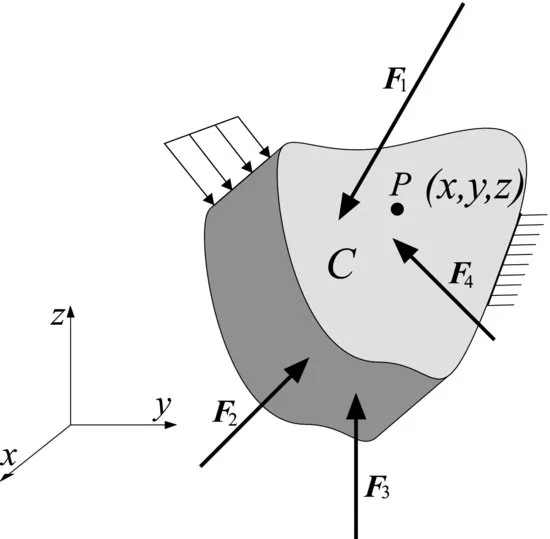
Let us consider a continuous deformable body C with volume V in a three-orthogonal Cartesian system x, y, z as shown in Figure 1.1. The following relevant variables are introduced:
Figure 1.1 Geometry and notations for a 3D deformable body.
nc01f001.eps
  • Displacements,
    inline
    , of a point P:
Unnumbered Display Equation
When the body C is subjected to mechanical and natural boundary conditions, the three continuous functions ux(x, y, z), uy(x, y, z), uz(x, y, z) give the deformed state of C. The calculation of such a deformed state remains the fundamental problem of 3D elasticity.
  • Strains,
    inline

    Unnumbered Display Equation

    These nine terms describe the deformed configuration in a three-orthogonal term of unit vectors (
    inline
    ) in P. The axial deformations are
    Unnumbered Display Equation

    Shear strains, which are symmetric, are
    Unnumbered Display Equation
  • Stresses, σ, at a point P:
    Unnumbered Display Equation

    Axial stresses are
    Unnumbered Display Equation

    Shear stresses, which are symmetric, are
    Unnumbered Display Equation
1.2 Equilibrium equations in terms of stress components and boundary conditions
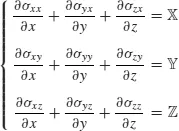
At a generic point of the body C the following fundamental equilibrium equations hold:
(1.1)
Numbered Display Equation
where
inline
,
inline
, and
inline
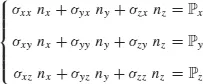
are the body forces per unit volume. On the boundary of the body C, the stress vector components at a generic point must fulfill the following conditions:
(1.2)
Numbered Display Equation
where nx, ny, and nz are the direction cosines, and
inline
is the resultant of the external forces per unit area acting on the boundary of C. These are known as mechanical boundary conditions. Geometrical conditions can also be imposed stating that
(1.3)
Numbered Display Equation
where
inline
,
inline
, and
inline
are imposed displacements on the outer surface of C.
1.3 Strain displacement relations
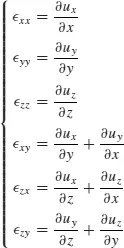
Strains are related to displacements by the following geometrical relations that are valid under the assumption of linearity:
(1.4)
Numbered Display Equation
inline
and
inline
are the engineering strain components which are usually denoted as
inline
and
inline
. In this book both symbols
inline
and γ are used to indicate the engineering strain components.
1.4 Constitutive relations: Hooke’s law
Stress and strain comp...

Table of contents

  1. Cover
  2. Title Page
  3. Copyright
  4. About the Authors
  5. Preface
  6. Introduction
  7. Chapter 1: Fundamental equations of continuous deformable bodies
  8. Chapter 2: The Euler–Bernoulli and Timoshenko theories
  9. Chapter 3: A refined beam theory with in-plane stretching: the complete linear expansion case
  10. Chapter 4: EBBT, TBT, and CLEC in unified form
  11. Chapter 5: Carrera Unified Formulation and refined beam theories
  12. Chapter 6: The parabolic, cubic, quartic, and N-order beam theories
  13. Chapter 7: CUF beam FE models: programming and implementation issue guidelines
  14. Chapter 8: Shell capabilities of refined beam theories
  15. Chapter 9: Linearized elastic stability
  16. Chapter 10: Beams made of functionally graded materials
  17. Chapter 11: Multi-model beam theories via the Arlequin method
  18. Chapter 12: Guidelines and recommendations
  19. Index