Probability, Statistics, and Stochastic Processes
eBook - ePub

Probability, Statistics, and Stochastic Processes

  1. English
  2. ePUB (mobile friendly)
  3. Available on iOS & Android
eBook - ePub

Probability, Statistics, and Stochastic Processes

About this book

Praise for the First Edition

"... an excellent textbook... well organized and neatly written."
— Mathematical Reviews

"... amazingly interesting..."
— Technometrics

Thoroughly updated to showcase the interrelationships between probability, statistics, and stochastic processes, Probability, Statistics, and Stochastic Processes, Second Edition prepares readers to collect, analyze, and characterize data in their chosen fields.

Beginning with three chapters that develop probability theory and introduce the axioms of probability, random variables, and joint distributions, the book goes on to present limit theorems and simulation. The authors combine a rigorous, calculus-based development of theory with an intuitive approach that appeals to readers' sense of reason and logic. Including more than 400 examples that help illustrate concepts and theory, the Second Edition features new material on statistical inference and a wealth of newly added topics, including:

  • Consistency of point estimators

  • Large sample theory

  • Bootstrap simulation

  • Multiple hypothesis testing

  • Fisher's exact test and Kolmogorov-Smirnov test

  • Martingales, renewal processes, and Brownian motion

  • One-way analysis of variance and the general linear model

Extensively class-tested to ensure an accessible presentation, Probability, Statistics, and Stochastic Processes, Second Edition is an excellent book for courses on probability and statistics at the upper-undergraduate level. The book is also an ideal resource for scientists and engineers in the fields of statistics, mathematics, industrial management, and engineering.

Frequently asked questions

Yes, you can cancel anytime from the Subscription tab in your account settings on the Perlego website. Your subscription will stay active until the end of your current billing period. Learn how to cancel your subscription.
No, books cannot be downloaded as external files, such as PDFs, for use outside of Perlego. However, you can download books within the Perlego app for offline reading on mobile or tablet. Learn more here.
Perlego offers two plans: Essential and Complete
  • Essential is ideal for learners and professionals who enjoy exploring a wide range of subjects. Access the Essential Library with 800,000+ trusted titles and best-sellers across business, personal growth, and the humanities. Includes unlimited reading time and Standard Read Aloud voice.
  • Complete: Perfect for advanced learners and researchers needing full, unrestricted access. Unlock 1.4M+ books across hundreds of subjects, including academic and specialized titles. The Complete Plan also includes advanced features like Premium Read Aloud and Research Assistant.
Both plans are available with monthly, semester, or annual billing cycles.
We are an online textbook subscription service, where you can get access to an entire online library for less than the price of a single book per month. With over 1 million books across 1000+ topics, we’ve got you covered! Learn more here.
Look out for the read-aloud symbol on your next book to see if you can listen to it. The read-aloud tool reads text aloud for you, highlighting the text as it is being read. You can pause it, speed it up and slow it down. Learn more here.
Yes! You can use the Perlego app on both iOS or Android devices to read anytime, anywhere — even offline. Perfect for commutes or when you’re on the go.
Please note we cannot support devices running on iOS 13 and Android 7 or earlier. Learn more about using the app.
Yes, you can access Probability, Statistics, and Stochastic Processes by Peter Olofsson,Mikael Andersson in PDF and/or ePUB format, as well as other popular books in Mathematics & Operations. We have over one million books available in our catalogue for you to explore.

Information

Publisher
Wiley
Year
2012
Print ISBN
9780470889749
eBook ISBN
9781118231326
Edition
2
Subtopic
Operations
Chapter 1
Basic Probability Theory

1.1 Introduction

Probability theory is the mathematics of randomness. This statement immediately invites the question “What is randomness?” This is a deep question that we cannot attempt to answer without invoking the disciplines of philosophy, psychology, mathematical complexity theory, and quantum physics, and still there would most likely be no completely satisfactory answer. For our purposes, an informal definition of randomness as “what happens in a situation where we cannot predict the outcome with certainty” is sufficient. In many cases, this might simply mean lack of information. For example, if we flip a coin, we might think of the outcome as random. It will be either heads or tails, but we cannot say which, and if the coin is fair, we believe that both outcomes are equally likely. However, if we knew the force from the fingers at the flip, weight and shape of the coin, material and shape of the table surface, and several other parameters, we would be able to predict the outcome with certainty, according to the laws of physics. In this case we use randomness as a way to describe uncertainty due to lack of information.1
Next question: “What is probability?” There are two main interpretations of probability, one that could be termed “objective” and the other “subjective.” The first is the interpretation of a probability as a limit of relative frequencies; the second, as a degree of belief. Let us briefly describe each of these.
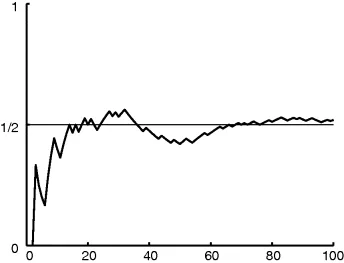
For the first interpretation, suppose that we have an experiment where we are interested in a particular outcome. We can repeat the experiment over and over and each time record whether we got the outcome of interest. As we proceed, we count the number of times that we got our outcome and divide this number by the number of times that we performed the experiment. The resulting ratio is the relative frequency of our outcome. As it can be observed empirically that such relative frequencies tend to stabilize as the number of repetitions of the experiment grows, we might think of the limit of the relative frequencies as the probability of the outcome. In mathematical notation, if we consider n repetitions of the experiment and if Sn of these gave our outcome, then the relative frequency would be fn = Sn/n, and we might say that the probability equals lim n→∞ fn. Figure 1.1 shows a plot of the relative 3 frequency of heads in a computer simulation of 100 hundred coin flips. Notice how there is significant variation in the beginning but how the relative frequency settles in toward
img
quickly.
Figure 1.1 Consecutive relative frequencies of heads in 100 coin flips.
img
The second interpretation, probability as a degree of belief, is not as easily quantified but has obvious intuitive appeal. In many cases, it overlaps with the previous interpretation, for example, the coin flip. If we are asked to quantify our degree of belief that a coin flip gives heads, where 0 means “impossible” and 1 means “with certainty,” we would probably settle for
img
unless we have some specific reason to believe that the coin is not fair. In some cases it is not possible to repeat the experiment in practice, but we can still imagine a sequence of repetitions. For example, in ...

Table of contents

  1. Cover
  2. Title Page
  3. Copyright
  4. Preface
  5. Preface to the First Edition
  6. The Book
  7. The People
  8. Chapter 1: Basic Probability Theory
  9. Chapter 2: Random Variables
  10. Chapter 3: Joint Distributions
  11. Chapter 4: Limit Theorems
  12. Chapter 5: Simulation
  13. Chapter 6: Statistical Inference
  14. Chapter 7: Linear Models
  15. Chapter 8: Stochastic Processes
  16. Appendix A: Tables
  17. Appendix B: Answers to Selected Problems
  18. Further Reading
  19. Index