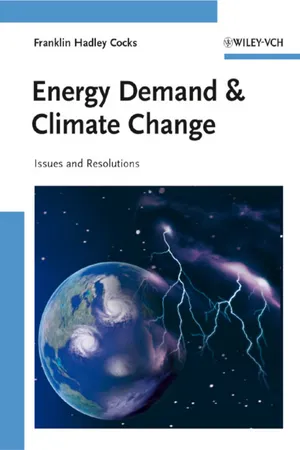
This scientifically sound, yet easily readable book provides the fundamentals necessary to understand today's energy and climate problems and provides possible answers based on current technology such as solar, water and geothermal power. Moreover, it introduces the reader to new concepts that are already or may soon be realized, such as nuclear fusion or a hydrogen-based economy.
Aimed at a wide readership ranging from educated laypeople and students to practitioners in engineering and environmental science.
- English
- ePUB (mobile friendly)
- Available on iOS & Android
eBook - ePub
About this book
Information
Part I
Questions
Introduction
Civilizations come and go, but why? There are many reasons, especially the proverbial four horsemen of the Apocalypse–war, famine, disease, and death. Battles have been won or lost. Droughts have desolated rich agricultural lands, and animals have been hunted to extinction. Epidemics have waxed and waned. In the 21st century our planet supports a larger population than ever before in its long history. The climate of the world has begun to change, and that unfolding event will affect everyone. Those four horsemen might begin to saddle up, armed now with nuclear weapons and virulent diseases. The number of mouths to be fed and the world’s demand for energy grow larger with each passing day. The Earth is not infinite in extent, and neither are its resources. How is this to end?
Recent history shows that average birth rates may decline as living standards improve, and in many lands living conditions have been progressing. Before the advent of chemical means of birth control, better living conditions usually led to an increased rate of population growth, except under particular conditions. The French aristocracy in the 1811 century, for example, made special attempts to limit any increase in their numbers in order to decrease difficulties associated with inheritance and the subdivision of estates. But as a general rule, increased prosperity can reduce population growth by making birth control and education available to more men and women, who have a greater expectation that their children will survive to adulthood. Overpopulation, posited in 1798 by the English demographer Thomas Malthus in his Essay on the Principle of Population, has been kept at bay by improved farming technology, genetic manipulation of crops, better education, birth control, greater prosperity, and the increased use of energy. In the year 2000 the world’s population was 10 times higher than it was 300 years earlier. The population of the Earth has increased from 2.5 billion to more than 6 billion since 1950 alone, and average energy consumption per person more than doubled in that same period. The peril of runaway population growth might be eliminated if the world’s economic output could increase sufficiently. Standards of living and energy consumption rise in unison. The energy from fossil fuels is the horse out in front pulling the world’s economic wagon, but fossil fuels are not inexhaustible. Petroleum is especially limited in its total planetary supply. When there is demand for more oil than the Earth can readily yield, its cost will increase until supply and demand balance. Living standards may be depressed by the weight of higher energy costs.
The world economy is now interconnected as never before, and changing energy prices and economic crises spin rapidly around the globe. Coal remains abundant, but burning it releases carbon dioxide and a host of pollutants, including mercury, sulfur dioxide, radioactive isotopes, and many others. Natural gas is also abundant, and burning it produces much less carbon dioxide than burning coal, but its supply also has limits. Nuclear generation of energy produces radioactive waste, which must be stored indefinitely somehow, but has little effect on the atmosphere. Advances in engineering and science may yet meet ever-growing energy needs, if proper measures are adopted and steps taken in good time. Unlike the steady growth of population predicted by Thomas Malthus, primitive societies, especially those on isolated Pacific islands, sometimes suffered rapid declines in population as local resources were depleted. In modern societies, energy problems might develop rapidly, with accompanying disruptions of the social order, some of them violent. The current rate of growth of the world economy and extrapolated demographics based on increasing living standards indicate a topping out of world population at just over 10 billion souls. What if energy shortages cause the world economy to decline? Living standards would very likely degrade, throwing us back upon the tender mercies of Thomas Malthus.
How will these intertwined factors evolve in the years to come? There is always the unlikely possibility of changing human nature, but inventing, working, and thinking our way to a prosperous and sustainable future is a more achievable goal. Properly applied, science and engineering can offer solutions to humanity’s ever-increasing need for energy, which might otherwise be our Achilles heel. The next four chapters give a planetary-scale view of the energy and climate problems we face over a time frame long in human terms, but short in the lifetime of the world on which we live.
Recommended Reading
Diamond, Jared. Collapse: How Societies Choose to Fail or Succeed. New York: Viking/Penguin, 2005.
Spengler, Oswald. The Decline of the West. Abridged edition. New York: Oxford University Press, 1926.
1
Ancient Days and Modern Times
But I [Zeus] will give men as the price for fire an evil thing in
which they may all be glad of heart while they embrace their
own destruction.
Hesiod, Works and Days c. 800 B.C.
which they may all be glad of heart while they embrace their
own destruction.
Hesiod, Works and Days c. 800 B.C.
In the mythology of ancient Greece, fire was enshrouded in the legend of Prometheus, who stole its secret from Zeus and gave it to mankind. Because fire was not intended for us, humanity was punished for accepting it by the advent of Pandora, who opened the great box of woe, releasing disease, toil, and sorrow upon the world, saving only the gift of hope. This legend strikes a chord even now, as our use of energy expands seemingly without limit even as consequences begin to appear. Prometheus suffered greatly for giving fire to humanity, and we may yet suffer greatly from our overwhelming dependence upon it. Only time will tell if the gift of Prometheus turns out to be the blessing in the future that it has been in the past.
There is no limit to the amount of energy humanity may want. But there are certainly limits to the amount available from fossil fuels. Through the rise and fall of successive civilizations and empires, the energy needs of the ancient world were supplied by renewable sources, including food, firewood, wind, flowing water, draft animals, and slaves, with only tiny amounts from coal and oil. The 18thcentury witnessed the invention of steam engines that could turn heat into useful work. Because of this advance in technology, energy usage for the first time began to grow faster than population. The heat from burning coal powered the industrial revolution. Soon afterward it was discovered that devices such as steam engines are limited in the fraction of heat they can convert into work. By immutable laws of thermodynamics, steam turbines like those used in power plants typically waste more than half the energy they consume. Although work can be converted completely into heat, the reverse is not true. Heat cannot be converted completely into work, no matter how many engineering advances are made.
Now, at the beginning of the third millennium, the world’s average annual energy consumption per person is about 100 times higher than it was 2000 years ago, when there were only perhaps 200 million people in the world. Presently, there are more than 6 billion souls on the face of the Earth. Over the last two millennia, world energy usage has risen by a factor of more than 3000 and has been increasing at a rate of around 2% per year. This 2% increase per year is all by itself 60 times more energy than the total annual energy consumption of the ancient world. The amount of energy used per person varies enormously from country to country. If all countries consumed as much energy per person as the richest do, world energy usage would be an order of magnitude higher than it is. Such an increase in energy may be unachievable with fossil fuels alone and, in any case, is not sustainable.
Almost everyone wants a higher standard of living. Energy and living standards go hand in hand. How can continuously increasing demands for energy be satisfied? Can energy use double in the next 40 years and keep increasing with no end in sight? Right now human energy needs are met primarily through the gift of Prometheus, from fires fed by fossil fuels. But all fossil fuels contain carbon, and burning it produces carbon dioxide. As the amount of carbon dioxide in the air increases, so does the Earth’s average temperature, because carbon dioxide acts to slow down Earth’s heat loss. Changes in global weather accompanying increasing planetary temperature will become greater as energy production from fossil fuels goes up.
Beyond fossil fuels, the energy contained in certain atomic nuclei can also be set loose, as was proven dramatically by the detonation of the first atomic bomb at Alamogordo, New Mexico, on 16 July 1945. Of more peaceful potential was the earlier proof that energy locked inside uranium atoms could be released control-lably. It did not take long to demonstrate that the controlled release of nuclear energy can be used to generate electricity. Heat from the reactor built in 1943 in Oak Ridge, Tennessee, to demonstrate the production of plutonium from uranium, was used to generate electric power before the first nuclear weapon was detonated. (This reactor has long been decommissioned but still exists as a museum.) Although the amount of electric power produced was only symbolic, this test did prove the principle of the concept. Before the hazards and costs associated with nuclear reactors were fully realized, extravagant claims were made about the ability of this new energy source to supply electricity cheaply, notably the claim in the 1950s that electricity from nuclear reactors would become too inexpensive to meter. New technologies inevitably generate new problems as well as new possibilities, and the balance, if there is one, is always between cost and benefit.
The production of electrical energy using the heat from nuclear fission has increased far less rapidly than first expected. The combination of complex engineering, serious concerns about radioactive waste, and the role of reactors in making nuclear weapons have all inhibited the growth of nuclear-powered electricity generation. Where and how to store radioactive waste for millennia is not a simple problem. The politics of nuclear weapons are not simple either.
The impact of worldwide climate change needs scarcely to be emphasized. To understand why such climate changes are underway, it is important to know the scientific facts that determine our planet’s temperature. While the details of this issue are extremely complicated, the fundamental principles are straightforward. The next chapter gives an overview of why ice ages and global warming cycles come and go. What happens if glaciers start growing again, the next ice age begins, and we’re out of fuel?
Recommended Reading
Eberhart, Mark E. Feeding the Fire: The Long History and Uncertain Future of Mankind’s Energy Addiction. New York: Harmony House, 2007.
Thirring, Hans. Energy for Man: Windmills to Nuclear Power. Bloomington, IN: Indiana University Press, 1958. (This book was one of the earliest to evaluate quantitatively humanity’s energy situation, and much of its information is still relevant.)
2
Ice Ages–Past and Future
The glaciers creep like snakes that watch their prey,
from their far fountains, slow rolling on.
Percy Bysshe Shelley, Mont Blanc, 1816
In my opinion, the only way to account for all these facts and
relate them to known geological phenomena is to assume that at
the end of the geological epoch which preceded the uplifting of
the Alps, the earth was covered by a huge ice sheet ...
Louis Agassiz, Studies on Glaciers, 1837
from their far fountains, slow rolling on.
Percy Bysshe Shelley, Mont Blanc, 1816
In my opinion, the only way to account for all these facts and
relate them to known geological phenomena is to assume that at
the end of the geological epoch which preceded the uplifting of
the Alps, the earth was covered by a huge ice sheet ...
Louis Agassiz, Studies on Glaciers, 1837
Global warming is now the question for our age, but this wasn’t always so. At one time, the preeminent issue in Earth science was global cooling. The existence of glaciers has been known ever since humanity migrated toward the poles, but in 1837 the Swiss-American zoologist, geologist, and eventual Harvard professor Louis Agassiz (1807–1873) proposed the idea that glaciers could sometimes start growing and expand across large portions of the Earth’s surface. What causes the Earth to cool and glaciers to advance across the land and then retreat again towards the poles? The answer lies partly in the Earth’s periodic orbital changes, whose effects on climate were not understood until the 20th century. Even the very existence of times when the Earth was inundated with ice was not known until the 19th century.
The Discovery of Ice Ages
Louis Agassiz became convinced that the Earth had experienced periods in the past when glaciers were extremely large and widespread, covering most of Europe. Others had earlier entertained similar thoughts, but as president of the Swiss Society of Natural Sciences, Agassiz was in the right position to advance the theory he began to believe after observing deep scratches in the rocks near Neuchâtel in Switzerland. He concluded that these deep scratches could only have been made by the forced motion of boulders caught up in the moving ice of a glacier, which must have previously covered the area. This idea, that there have been times in the past when glaciers were far larger than they are now, was presented to the Society of Natural Sciences and immediately led to heated debate. Had he not made excessive claims for the maximum extent of these earlier ice sheets (that they extended to the Mediterranean and even further south, for example), the concept of ice ages might have been adopted sooner. But in the end, the idea that glaciers can advance and then retreat was accepted. Agassiz was one of those fortunate scientists who lived to see their ideas vindicated and accepted. He lies buried in Mt. Auburn Cemetery in Cambridge, Massachusetts. The tombstone he shares with his wife, Elizabeth, is a large boulder that had been transported by the Swiss glacier Aar to the area where he first observed the deep rock scratches that led him to conclude that glaciers wax and wane. The question then was posed: Why does the Earth sometimes heat up and then cool down again?
The Heat Balance of the Earth
Our planet has basked in the light of its yellow sun for more than five billion years. All this long while, the Earth’s temperature has been determined by the balance between the energy it receives and the energy it loses. The Earth’s energy input is delivered almost entirely by direct sunlight, which is 450,000 times more than we receive from moonlight and about 5000 times greater than the heat diffusing up from the Earth’s core. Its energy loss is entirely in the form of the infrared radiation it emits. The fraction of incident sunlight that is reflected is called the albedo, from the Latin word albus, meaning white, and it varies as atmospheric conditions change. When white clouds are especially numerous across the face of the Earth, reflected sunlight increases sharply as the albedo increases. Sunlight reflected from the Earth can sometimes be strong enough to make visible the outline of the darkened portion of the moon within the arms of the bright lunar crescent. The renowned Italian renaissance painter, architect, and engineer Leonardo da Vinci (1452–1519) may have been the first to suggest that earthlight gives rise to this lunar phenomenon. Averaged over time, the Earth reflects about one-third of incident sunlight and absorbs about two-thirds.
Earth’s heat loss is entirely in the form of infrared radiation, like the heat you can feel on your hand but can’t see with your eyes when the electric coil...
Table of contents
- Cover
- Title Page
- Copyright
- Dedication
- Acknowledgements
- Prologue
- Part I: Questions
- Part II: Answers
- Part III: Dreams
- Part IV: Nightmares
- Epilogue: ORBITuary
- Credits
- Appendix I
- Appendix II
- Index
Trusted by 375,005 students
Access to over 1.5 million titles for a fair monthly price.
Study more efficiently using our study tools.
Frequently asked questions
Yes, you can cancel anytime from the Subscription tab in your account settings on the Perlego website. Your subscription will stay active until the end of your current billing period. Learn how to cancel your subscription
No, books cannot be downloaded as external files, such as PDFs, for use outside of Perlego. However, you can download books within the Perlego app for offline reading on mobile or tablet. Learn how to download books offline
Perlego offers two plans: Essential and Complete
- Essential is ideal for learners and professionals who enjoy exploring a wide range of subjects. Access the Essential Library with 800,000+ trusted titles and best-sellers across business, personal growth, and the humanities. Includes unlimited reading time and Standard Read Aloud voice.
- Complete: Perfect for advanced learners and researchers needing full, unrestricted access. Unlock 1.5M+ books across hundreds of subjects, including academic and specialized titles. The Complete Plan also includes advanced features like Premium Read Aloud and Research Assistant.
We are an online textbook subscription service, where you can get access to an entire online library for less than the price of a single book per month. With over 1.5 million books across 990+ topics, we’ve got you covered! Learn about our mission
Look out for the read-aloud symbol on your next book to see if you can listen to it. The read-aloud tool reads text aloud for you, highlighting the text as it is being read. You can pause it, speed it up and slow it down. Learn more about Read Aloud
Yes! You can use the Perlego app on both iOS and Android devices to read anytime, anywhere — even offline. Perfect for commutes or when you’re on the go.
Please note we cannot support devices running on iOS 13 and Android 7 or earlier. Learn more about using the app
Please note we cannot support devices running on iOS 13 and Android 7 or earlier. Learn more about using the app
Yes, you can access Energy Demand and Climate Change by Franklin Hadley Cocks in PDF and/or ePUB format, as well as other popular books in Physical Sciences & Organic Chemistry. We have over 1.5 million books available in our catalogue for you to explore.