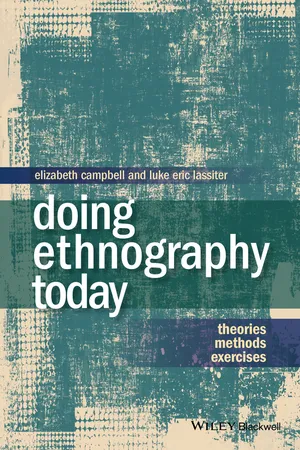
Doing Ethnography Today explores the methodologies and theories behind contemporary, collaborative ethnography and provides an opportunity to cultivate experience with included exercises.
• Presents ethnography as creative and artful rather than analytical or technical
• Emphasises the collaborative nature of ethnography
• Structured exercises cultivate practical experience
• Includes a discussion on indexing and interpreting project materials
• Provides guidance on interview questions and selecting appropriate field equipment
eBook - ePub
Doing Ethnography Today
Theories, Methods, Exercises
- English
- ePUB (mobile friendly)
- Available on iOS & Android
eBook - ePub
About this book
Information
Chapter 1
Introduction: Conceptualizing Ethnography
Ethnography is traditionally described as both a fieldwork method and an approach to writing. As fieldworkers, ethnographers participate in the lives of others, observing and documenting people and events, taking detailed fieldnotes, conducting interviews, and the like. As writers, ethnographers organize, interpret, and inscribe this collected and, as many argue, constructed information as text. Over the last century or so, ethnography's fieldwork and writing have come to signal very particular sets of assumptions, epistemologies, and expectations, and to yield recognizable – some might say, predictable – textual forms.
Though its histories and methodologies mix elements of both the sciences and the arts and their histories, ethnography also inhabits very particular ways of being, by which we mean ways of encountering, thinking about, interpreting, and acting in the world around us. Ethnographers often identify as and talk about “being ethnographers,” and although they may argue about whether what they do is science or art or both, most would agree that being ethnographers changes how we think, how we interact with others, and even how we move through the world. It does so because it brings us directly into contact with diverse people leading varying ways of life. Ethnomusicologist Nicole Beaudry points out that doing ethnographic fieldwork “remains a challenging experience because it teaches us that there are many different ways for human beings to be themselves.”1
What Beaudry says of ethnographic fieldwork has certainly been the case for us. Between us, we have done various kinds and differing levels of ethnographic work, all of which have brought us into contact with many different kinds of people. We have worked with K-12 math and science teachers, activists and community organizers, and descendants of a pre-Civil War plantation in West Virginia; African American pioneer descendants, black Civil War re-enactors, “Middletown” residents, and state and county fair participants in Indiana; Waldensians, tobacco farmers, and Lumbee Indians in North Carolina; recovering addicts, historic preservationists, and bikers in the urban South; students and faculty in a university-based digital technologies center; tradition bearers in rural Kentucky; and Kiowa Indians in southwestern Oklahoma. We have written fieldnotes and conducted interviews; recorded songs and taken photographs; traced maps (physical as well as social); dug into national, state, and local archives; documented folk culture and traditions; organized focus groups; collected life histories; participated in a whole host of activities; and, of course, produced ethnographic reports that have ranged from academic ethnographies to performance pieces to museum exhibits to briefs for state agencies. Though our fieldwork methods have generated a wide range of recognizably ethnographic products, they have also consistently led to other outcomes, often unexpected, for us and for the diverse people with whom we have worked, from educational programs, to National Register nominations, to political action, to other applied, and often activist, work.
The processes of doing fieldwork, producing texts, and connecting to unexpected – and not always directly related – outcomes have both challenged and changed us, sometimes in profound ways. Ethnography, when done with the experiential and intellectual depth it deserves, brings us face-to-face with our own assumptions and ethnocentrisms. As we study with and learn from others – who often seem very unlike ourselves – we are pushed to move beyond understanding and toward transformation. Our own ethnographic work has fundamentally shifted our understandings of what it means to be, for instance, a biker, an addict, or a Kiowa singer, and in bringing about those shifts, has also affected how we relate to others and, for that matter, to ourselves. Some projects forced us to examine how we may have stereotyped or over-generalized the experiences of some people. Other projects have forced us to think about class or race or gender in new ways. And still others have led us to navigate relationships differently. For example, an ethnographic project on bikers that Beth did as a folklore graduate student unexpectedly healed a rift that had long existed between her and one of her sisters. Although family therapy had not been a goal at the outset of that project, being with bikers – and talking with them, and writing about them, and sharing emerging understandings with them – brought the very different worlds she and her sister then lived in closer together. That proximity led both to imagine, and then to create, different ways of being together.
Such experience is not at all unusual when it comes to doing ethnography. In an ethnographic study of a small Iowa community where he grew up, anthropologist Douglas Foley describes in The Heartland Chronicles how a complex matrix of relationships between and among whites and Mesquaki Indians yield multi-layered ethnic and racial negotiations through time. But he also describes how the processes of ethnographic fieldwork helped him understand his own experiences and memories growing up in the town, and of how the process of “one person trying to understand him- or herself enough to understand other people” can lead us to understand others and our relations with them better. In Foley's case, he was led to learn more about his father (whom he never met) and make connections with his mother (who helped shape his views of Indians from an early age) that he had not made before, which, in turn, helped him understand on a deeper level the subject of his study. He writes, for example, that “knowing Mom better was absolutely crucial for understanding abandoned Mesquaki mothers and grieving Mesquaki men.” Importantly, though, Foley points out that the process of ethnographic fieldwork and cross-cultural understanding “takes much more than simple empathy. It takes endless hours of listening to people and observing, constant recording and reflecting, a grab-bag of theories to ply. But knowing yourself always seems like the biggest part of understanding others.”2
As Foley suggests, knowing yourself as you come to know others is a big part of “being an ethnographer.” But as Foley also suggests, so is learning to be with – and listen to and take seriously – others. It should not come as a surprise, then, that many ethnographers doing ethnography today emphasize more than a purely methodological approach, calling attention instead to ethnography's histories, philosophies, epistemologies, and ontologies. Although learning the “how to's” of ethnographic fieldwork and writing are necessary for doing ethnographic work, actually “being an ethnographer” requires us to reach beyond method. Consider, for example, this quotation from the late communication studies scholar and ethnographer, H. L. “Bud” Goodall:
[T]he choice of “being an ethnographer” is a profound philosophical commitment that very much transcends ordinary concerns about the utility of fieldwork methods or even prose styles. Not everyone is suited for this line of work. Unlike traditional methods of social science, ethnography is not theory-driven, method-bound, or formulaic in its research report. Ethnography requires a person who is comfortable living with contingencies, who is good at associating with others from widely diverse backgrounds and interests, and who likes to write. As such, ethnography is more of a calling than a career, and the decision to do it – as well as the ability to do it well – seems to require more of a particular, identifiable, but oddly ineffable attitude toward living and working than belief in method.3
Not everyone may see ethnography as a kind of “calling.” But everyone should, at the very least, understand that ethnographic practice requires commitments that are different from other research approaches. One of the most important of these is committing to a particular way of being with people, which brings up an important consideration for any student of ethnography, regardless of whether or not you are invested in “being an ethnographer” as such: in spite of its many different approaches (and there are many), at the end of the day, doing and writing ethnography is about engaging in, wrestling with, and being committed to the human relationships around which ethnography ultimately revolves. Folklorist Carl Lindahl, whose home discipline is rooted in the processes and relationships of ethnographic fieldwork, has this to say: “I regularly tell students on the verge of their first foray into fieldwork that folklore, done as it should be, is as personal as it gets: fieldwork can easily double the number of birthday cards you send and funerals you attend.”4 To Lindahl's statement – with which we absolutely concur – we add this: the relationships that emerge “in the field” are as rewarding and challenging and “real” as any others, especially because they encourage us to know others as well as ourselves. Understanding that ethnography will necessarily expand and complicate your own personal web of relationships is, we think, a very important place to start in conceptualizing ethnography.
*****
This book is grounded in the idea that ethnography begins and ends with people. Ethnography, as we understand and practice it, articulates a very particular way of being that foregrounds the personal and relational; assumes an underlying collaborative perspective; necessarily implicates an interpretive and hermeneutic approach; works within the realm of the cultural; and depends on the very human arts of understanding. To elaborate exactly what we mean by all of this, in the sections below we briefly outline some of the basic assumptions we bring to the practice of ethnography and thus to this book. We think you should know what we are up to right up front.
Ethnography is as Personal as it Gets
As Lindahl says so poetically, engaging the complexities of fieldwork also means engaging the complexities of human relationships. Those relationships, of course, are framed by the dynamics of experience, through which we participate in people's lives and engage them in dialogue. To be open to this process is to be open to experience itself, to its often unanticipated twists and turns, and to the unexpected places it may take us. We see experience as an apt metaphor for the ever-emergent qualities of both ethnographic fieldwork and ethnographic writing. But more than this, we also see experience and the human relationships it generates as the crucial and vital space within which the contours of ethnographic practice – from its design to its composition – are negotiated. As such, we see the processes of doing ethnography as deeply personal and “positioned” activities. This implicates a complex intersection of worldviews, sensibilities, agendas, hopes, and aspirations that are an inevitable part of each individual endeavor, and of every relationship into which an individual may insert her- or himself, including the relationships that constitute ethnography.
If, as we believe, doing ethnography is deeply personal and positioned, then it is also deeply subjective. In this sense, we adhere to a long tradition of philosophical and critical thought that scrutinizes (and is skeptical of) the very idea of objectivity, and that considers the pursuit of a purely objective point of view a misdirected foray. In our view, ethnography proceeds not from an objective, or even reasonably objective, research position – an idea which we believe masks rather than erases one's worldviews, sensibilities, agendas, hopes, and aspirations. Rather, ethnography develops out of an unambiguous consideration of one's own experiences, positions, and subjectivities as they meet the experiences, positions, and subjectivities of others. In this way, ethnographic practice is a relationship-based intersubjective practice that demands honest and rigorous appraisals of our own assumptions and ethnocentrisms as we learn about those of our ethnographic collaborators through co-experience and shared dialogue.
Ethnography is Collaborative
Ethnography has always depended, at least to some extent, on collaboration. Indeed, it would be hard to imagine any ethnographic project without at least some level of shared work. But collaboration in ethnography has most often been limited to fieldwork processes. In the field, for example, ethnographers work closely and talk deeply with key “informants” or “consultants,” collaboratively constructing and interpreting cultural concepts, practices, and so on. Writing up the “results” of these dialogic collaborations, however, has traditionally been left to the ethnographer, and control over the final work (and often its dissemination) usually remains in her or his hands. This kind of collaboration tends to begin and end in the field; it is more a collection method or strategy than an underlying perspective or philosophy for doing and writing ethnography.
We do want to say that there can be good reasons for carrying out ethnograph...
Table of contents
- Cover
- Table of Contents
- Title page
- Copyright page
- Dedication
- Preface
- Chapter 1: Introduction: Conceptualizing Ethnography
- Chapter 2: Fields of Collaboration
- Chapter 3: Emergent Design
- Chapter 4: Engagement: Participant Observation and Observant Participation
- Chapter 5: Interviews and Conversations
- Chapter 6: Inscriptions: On Writing Ethnography
- Index
- End User License Agreement
Trusted by 375,005 students
Access to over 1.5 million titles for a fair monthly price.
Study more efficiently using our study tools.
Frequently asked questions
Yes, you can cancel anytime from the Subscription tab in your account settings on the Perlego website. Your subscription will stay active until the end of your current billing period. Learn how to cancel your subscription
No, books cannot be downloaded as external files, such as PDFs, for use outside of Perlego. However, you can download books within the Perlego app for offline reading on mobile or tablet. Learn how to download books offline
Perlego offers two plans: Essential and Complete
- Essential is ideal for learners and professionals who enjoy exploring a wide range of subjects. Access the Essential Library with 800,000+ trusted titles and best-sellers across business, personal growth, and the humanities. Includes unlimited reading time and Standard Read Aloud voice.
- Complete: Perfect for advanced learners and researchers needing full, unrestricted access. Unlock 1.5M+ books across hundreds of subjects, including academic and specialized titles. The Complete Plan also includes advanced features like Premium Read Aloud and Research Assistant.
We are an online textbook subscription service, where you can get access to an entire online library for less than the price of a single book per month. With over 1.5 million books across 990+ topics, we’ve got you covered! Learn about our mission
Look out for the read-aloud symbol on your next book to see if you can listen to it. The read-aloud tool reads text aloud for you, highlighting the text as it is being read. You can pause it, speed it up and slow it down. Learn more about Read Aloud
Yes! You can use the Perlego app on both iOS and Android devices to read anytime, anywhere — even offline. Perfect for commutes or when you’re on the go.
Please note we cannot support devices running on iOS 13 and Android 7 or earlier. Learn more about using the app
Please note we cannot support devices running on iOS 13 and Android 7 or earlier. Learn more about using the app
Yes, you can access Doing Ethnography Today by Elizabeth Campbell,Luke Eric Lassiter in PDF and/or ePUB format, as well as other popular books in Sciences sociales & Anthropologie culturelle et sociale. We have over 1.5 million books available in our catalogue for you to explore.