![]() PART ONE: BACKGROUND
PART ONE: BACKGROUND![]()
CHAPTER ONE
WHY SOCIAL MEDIA?
There are a number of reasons to use social media in educational settings. First, social media have the potential to enhance learning and meet pedagogical needs thanks to the array of media characteristics and functionality. Next, many instructors and students are already using social media in their personal and professional lives. They have a familiarity with most social media, which may lead them to be more open to using social media for their classes. Social media are “social” in that they facilitate the creation and sharing of information, and they have the potential to enhance dialogue and collaboration as well. In the past few decades, scholars and researchers have come to the conclusion that the social variables in the classroom and throughout a university are more important in influencing student outcomes than their demographic variables (Kuh, Pace, & Vesper, 1997). Most notably, many scholars have stressed the importance of interactivity and engagement on student learning (Carini, Kuh, & Klein, 2006). According to Chickering and Gamson (1987), good practices in undergraduate education include encouraging contact between students and faculty, developing a reciprocity and cooperation among students, and encouraging active learning. Social media have the potential to enhance these good practices.
Researchers have been highlighting the importance of interactivity on student outcomes (e.g., learning, retention, satisfaction) for decades. Recently, the focus has been more on the construct of engagement, which is a transformation of early research focusing on interactions. Many college campuses administer the National Survey of Student Engagement (NSSE), a national survey that measures engagement on college campuses, and the College Student Experiences Questionnaire (CSEQ). They serve as a benchmark for universities and have many items in common. Items in these surveys have been noted as indicators for Chickering and Gamson’s (1987) good practices of student interaction, cooperation among students, and active learning. These indicators are also considered to be reliable and valid indicators of student outcomes (Chickering & Gamson, 1991; Kuh, Pace, & Vesper, 1997).
In addition, the research has been exploring interactions in and out of the classroom and the effect they have on student outcomes. Some researchers argue that these interactions have the greatest impact on students (Wilson, Gaff, Diensky, Wood, & Bavry, 1975) and are an important part of a quality undergraduate experience (Kuh, 1981). Others have noted the impact on student satisfaction (Astin, 1977), retention (Astin, 1977, 1993), and academic achievement (Astin, 1993). Further, participating in learning communities has proven to increase engagement (Shapiro & Levine, 1999; Zhao & Kuh, 2004). It is clear that students’ interactions with faculty and other students can have a great impact on several student outcomes and could be considered pivotal to their success. It is through the enhancement of student engagement and interactivity that social media can affect student learning.
The purpose of this book is to be a guide for educators who are interested in using social media to enhance their teaching and have a positive impact on student learning. The book will examine the concept of social media, share how social media can be used for professional development by instructors and students, consider the ways in which educators can use social media activities to enhance teaching and learning, explore media characteristics and features of social media, and discuss considerations in implementing social media.
Popularity of Social Media
The adoption of social media has greatly increased over the past few years. Facebook has 800 million users (Facebook, 2011), Twitter has 200 million users (BBC, 2011), and LinkedIn has 100 million users (LinkedIn, 2011). Facebook is the most popular social networking tool in our society and with our students today. It is where they already live. More than 70% of adults, young adults, and teens who are online use Facebook (Lenhart, Purcell, Smith, & Zickuhr, 2010). Previously, reports from undergraduate students indicate that 85.2% of students overall with 95.1% of 18- and 19-year-olds use social media, primarily Facebook, and usually on a daily basis (Salaway, Borreson Caruso, & Nelson, 2008). More recently, 96% of undergraduate students reported using Facebook (Smith & Caruso, 2010). With the dominant use by students, educators look to harness the power of Facebook.
Other social media, such as Twitter and LinkedIn, are quickly growing in their use. In a survey designed to examine social media habits, my students reported heavy use of Facebook; although most of these young people had heard of Twitter at the time, they were not using it (Joosten, 2009; Parry, 2009). Though the majority of teens do not tweet, we have seen these numbers increasing over the past couple years. As Young (2010b) reported on the findings of a Pew Internet study, “College students are far more likely to use Twitter than are other segments of the U.S. population … full-time or part-time college students who go online [to use Twitter] is 18 percent” (para 1). Also, researchers reported that 43.3% of undergraduate students reported updating microblogs like Twitter (Smith & Caruso, 2010). We are also seeing tremendous growth in use of LinkedIn and other social media depending on the discipline, age, and other variables. For example, senior students who are preparing for graduation and looking to secure a career path are more likely to use LinkedIn (Salaway, Borreson Caruso, & Nelson, 2008), but the overall use by students is still fairly low at 11.2% (Smith & Caruso, 2010). The newest to arrive is Google+ with over 25 million users (Albanesius, 2011). Social media are popular, and we continue to see tremendous growth even for the less popular sites.
Mobile devices can play an important role in facilitating the use of social media for teaching and learning. Many social media have functions that allow students to receive and send text messages or updates through mobile apps or applications. Researchers report 90% of 18- to 29-year-olds use their mobile phones to send and receive text messages (Smith, 2010); teens send and receive over 3,000 text messages a month (Neilson, 2010); and traditional-aged students send and receive over 1,600 a month (Neilson, 2010). Again, in my survey of students’ use of technology, students reported high use of text messaging with their mobile devices, 88.4%, and they desire to receive text messaging updates of course information, 70.5% (Joosten, 2009).
Other social media use among students includes video-sharing sites and social bookmarking.
- 71% of online adults and 92% of traditional college-aged students reported watching videos on a video-sharing site, e.g., YouTube and Vimeo (Moore, 2011).
- 42.4% contribute to video-sharing sites (Smith & Caruso, 2010).
- 25.1% of students contribute to social bookmarking sites, e.g., Diigo and Delicious (Smith & Caruso, 2010).
The growth seen in the social use of technology by students (or incoming students), whether through a desktop computer or a device like their mobile phone, deserves our attention. Through their own use of social media, educators are realizing that social media offers the functionality to enhance student outcomes in the classroom.
What Is Social Media?
There are a number of social media that individuals use on a daily and weekly basis. However, many of these users have difficulty defining the term social media (Segreto, 2011). In an attempt to build a shared meaning of social media, social media were utilized to “crowdsource” a definition to form a comprehensive construct. Crowdsourcing, which is a distinctive characteristic of social media, occurs when an act, such as problem solving, is outsourced to a network of individuals who offer an array of solutions (see Brabham, 2008; Howe, 2006). Also, these solutions can represent the ideas and opinions of a sample of professional colleagues.
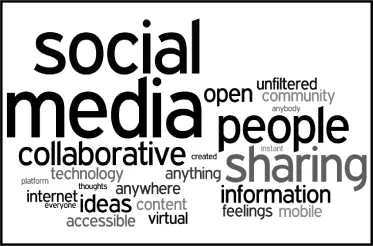
As previously mentioned, not only will this book be about social media, but the book’s content, at least in part, is a product of social media activities. Using several social media, individuals sharing a common interest in education and technology were asked to answer the question, “What is social media?” These colleagues were asked to tag their responses with a hashtag, #edusocmedia, so that the comments and posts of individuals would be easy to search and locate the conversations. In addition to primarily text-based messages (e.g., Twitter), individuals were encouraged to post their video definitions to YouTube. Dozens of tweets and YouTube videos from colleagues were collected. Examples of posts are available in Table 1.1. These responses were collected and analyzed using a visualization tool, Wordle, where popular words used to describe social media increase in size based on their frequency (see Figure 1.1). The key words and themes evident in the visualization were then constructed into the following statement: A virtual place where people share; everybody and anybody can share anything anywhere anytime.
TABLE 1.1. WHAT IS SOCIAL MEDIA #EDUSOCMEDIA TWEETS
@sholtutm social media is about the social not the media. People connecting to people. #edusocmedia
@dolanatpsu #edusocmedia a channel that allows for instant, unfiltered conversation, collaboration & community
@ericaabramson defining social media: collaborative, accessible, no boundaries #edusocmedia
@spennell98 Social media is about anybody, anywhere sharing information about anything on an accessible space. #edusocmedia
@gjerdery #edusocmedia is a distributed comm. platform where you control the degree to which you participate, tending to be more open than private.
@athlwulf Social media is technologies used to assist in facilitating connections and interactions between people #edusocmedia
@sholtutm “Media” will change … “social” will not. #edusocmedia
@ifoundbob Our def of #edusocmedia is “Digital Socialization—a virtual sharing life, learning and self.” |
Web 2.0
Perceptions of social media are indicative of the characteristics and features of the technology and the user. Social media are considered Web 2.0 applications, which are an array of online tools and services that are web-based and dynamic in nature. They are user-centered and encourage interaction, collaboration, and democracy (Graham, 2005). Specifically, Web 2.0 applications provide “community and collaboration on a scale never seen before” (Grossman, 2011, para 3). Examples of popular Web 2.0 technologies, which have been explored by educators as a way to improve teaching and learning, include blogs, wikis, social bookmarking, and social networking sites. The potential of Web 2.0 to connect people, facilitate collaboration, and build community is well known (Hoegg, Martignoni, Meckel, & Stanoevska, 2006). Individuals, businesses, and educational institutions are taking note and advantage of the evolution, which offers new tools that are free (at some level), open, and accessible. In comparison to traditional institutional applications, these applications have increased functionality and have a greater reach to accomplish needed tasks.
Social media are Web 2.0 applications that have the potential to increase interactions among individuals through creating and sharing. Some examples of the most popular and growing social media, which have been mentioned, are Facebook, Twitter, LinkedIn, and YouTube, and there are numerous additional technologies that can be considered social media. Kaplan and Haenlein (2010) clarify the relation of social media to Web 2.0 by explaining social media as “a group of Internet-based applications that build on the ideological and technological foundations of Web 2.0, which allows the creation and exchange of user-generated content” (p. 61). User-generated content (UGC) in social media at a rudimentary level means digital text, images, audio, and video that are created and shared. Social media include a variety of web-based applications that facilitate communication (Twitter, Facebook, blogs), collaboration (wikis, social bookmarking), and multimedia sharing (Flickr, YouTube) through the creation and exchange of UGC.
Social networking sites are one of the most popular types of social media and Web 2.0 technologies. Social networking sites include sites that enable you to create a profile, make connections, and share your connections in order to build relationships and networks. Boyd and Ellison (2007) defined social networking sites (SNS) as “web-based services that allow individuals to
1. construct a public or semi-public profile within a bounded system;
2. articulate a list of other users with whom they share a connection; and
3. view and traverse their list of connections and those made by others within the system” (para 4).
Therefore, social networking sites are social media, which both can be considered Web 2.0 technologies (see Figure 1.2). In summary, social networking sites facilitate the creat...