- Focuses on British Romanticism while also addressing continental and transatlantic Romanticism and earlier periods
- Utilizes keywords such as imagination, sublime, poetics, philosophy, race, historiography, and visual culture as points of access to the study of Romanticism and the theoretical concerns and the culture of the period
- Explores topics central to Romanticism studies and the critical trends of the last thirty years
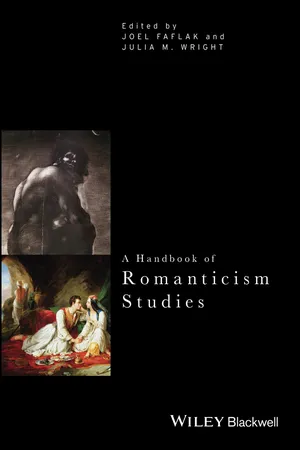
eBook - ePub
A Handbook of Romanticism Studies
- English
- ePUB (mobile friendly)
- Available on iOS & Android
eBook - ePub
A Handbook of Romanticism Studies
About this book
The Handbook to Romanticism Studies is an accessible and indispensible resource providing students and scholars with a rich array of historical and up-to-date critical and theoretical contexts for the study of Romanticism.
Information
Part 1
Aesthetics and Media
Chapter 1
Imagination
On the Romantic Imaginations We Want and Imaginations We Don't1
Perhaps no single entity was more important to Romantic writers than the imagination. Blake wanted “this world of imagination” to be “the world of eternity,” to the God dwelling within every human breast (555). Percy Bysshe Shelley wanted the imagination to be “the great instrument of moral good” and it could function as such by operating as an organ of sympathy (517). In her “Ode to Imagination Under the denomination of Fancy,” Scottish novelist and poet Elizabeth Hamilton addressed the imagination as “Offspring of celestial light, / Spirit of the subtlest kind, / Fancy! Source of genius bright – / Illuminator of the mind!” In one go, she desires the imagination to embody fecundity, Enlightenment, spirit, genius, and mind. That this linkage is accomplished by the figure of apostrophe, the fictive figure of address, perhaps hints at the inability of the imagination to be all these things, even as her insistence on “denomination,” based on the Latin meaning “calling by a name,” generates more naming by adding fancy to imagination.2 The very powers of naming and addressing are thereby undermined. In her final stanza, Hamilton renders this initially ungendered “offspring” a “daughter,” and femininity enables her to close the gap between “thee,” “thy,” and “thou” (the imagination) – which appear fifteen times – and her “my” in the final line (used once). Hamilton thus demands thinking about how the imagination can heal the gap between wanting and being, and invites us to consider what we are to do with this gap.
The gap between wanting and being is well worth thinking about, especially with regard to the critical history of the imagination. This essay deliberately begins a few miles above Romantic accounts of the imagination because it charts the competing ways in which Romantic critics have invoked the imagination to perform critical work. Why have critics wanted one version of the imagination over another? The fact that these positions so often mirror and/or reverse previous positions signals that our very definitions and theories of the Romantic imagination have something, perhaps everything, to do with critical desire. Indeed, this history shows that the Romantic imagination oscillates from being pure of ideology to the very embodiment of it, and now to being more wary of ideology than critics of the evasive or ideological imagination have recognized. At bottom, then, I will argue, this debate – this need to read ideology where others have read imagination – is conditioned by our increasing skepticism about the role of literature in the world, and the uses or uselessness of literary methods of reading to that world. The symptom of this skepticism is that contemporary critics have renamed the imagination “history,” the “social,” and “ideology.” And yet, as we shall see, what counts as “history” and “ideology” is a particularly literarily centered history or ideology whose core is figuration or language or reading. The irony here is that Romantic writers had no need to name the imagination as history or ideology because it was for them inextricable from history or ideology. Their notions of history, however, took different forms of material embodiment. The clear-cut distinctions between text and context, literature and history, verbal figures and action, are ours, not theirs, and they are ours because of our faith that to make literature historical or ideological is to do meaningful intellectual work. I will then propose some future directions of study that attempt to return to what the Romantics wanted to do with the imagination, what they found wanting in it, and why.
Romantic Histories of the Imagination
Originally published in 1953, M. H. Abrams's The Mirror and the Lamp is still read and cited today. Few critical books have an off-the-shelf life of almost sixty years. Abrams distinguished Romanticism from the Enlightenment because it offered a revolutionary expressive theory of art instead of a mimetic one: against Locke's metaphor of the mind as a mirror, the Romantics conceptualized the mind in terms of a lamp that is “bathed in an emotional light he himself [sic] projected” (52). This theory enabled Abrams to show that whereas previous writers had made the world central to the work of art, Romantic writers made themselves central to the work of art.
In terms of his concept of the imagination, Abrams emphasized a gap between mechanical fancy and the organic imagination (ch. 7). He defines “organicism” as “the philosophy whose major categories are derived metaphorically from the attributes of living and growing things” (168). Underlying both is an associationalist psychology that moves from understanding the mind in terms of a mechanical combination of ideas to a more “organic” synthesis and fusing: in the same way that a plant unfolds “spontaneously from within” and assimilates “to its own nature the materials needed for its nourishment and growth” (167), the imagination works organically. Where the imagination before organicism was doomed to combine and recombine previous “unit images of sense,” the Romantic imagination could assimilate and digest such images (172). Abrams concludes this chapter with speculation that this idea of the imagination “incorporates our need to make the universe emotionally as well as intellectually manageable” (183). This of course raises the issue of what he has done to make his version of the imagination as valuable, including setting up clear binary oppositions between mechanism and organicism, mirrors and lamps – oppositions that will not hold up to rigorous scrutiny.
Like The Mirror and the Lamp, James Engells's The Creative Imagination is a major milestone in the critical scholarship on the imagination. Situating the Romantic imagination within multiple Enlightenment contexts ranging from Humean empiricism to Kantian transcendentalism, Engells highlights the key developments in aesthetics, psychology, philosophy, and art that contributed to the growing influence of the imagination. Where Hume believed that it was possible to know the things of this world – hence his empiricist leanings – Kant argued, by contrast, that since things could only be apprehended through our modes of apprehension of them, we could only know about how we know, and the things themselves could never become objects of knowledge. As the name for the relationship between sensory information and mind, the imagination thus became central to knowing.
If Engells admirably charts the manifold ways in which the imagination was defined and used by male English and German writers, psychologists, philosophers, and artists, he stresses synthesis over difference. Like Abrams, Engells's creative imagination harmonizes difference under the rubric of growth (ix), when in fact the clashes he so ably documents threaten the imagination's coherence. For instance, although Engells insists that the Germans provide the foundation for the rise of the imagination in Britain, insofar as they systematically think about it, Gavin Budge has recently argued that German idealism was an outgrowth and reaction to British Common Sense Philosophy, embodied in the school of Thomas Reid and Dugald Stewart (12). “The Common Sense school's emphasis on the semiotic nature of perception situates human reason within a theological and providentialist framework” (30), a framework that not only belies neat distinctions between British empiricism and Romanticism, but also undermines the general alignment of British Romanticism and German idealism. The foundations of anything, thus, change according to what is counted in the historical sample. In order to measure growth, growth must be charted against some baseline, and the narrative of growth is contingent upon what counts as the baseline. This growth narrative further obscures interpretative choice: the selection of beginning and endpoint undermines the claims to organic growth.
Responding to what he saw as a tendency of Romantic critics such as Abrams and Engells to recapitulate a Romantic ideology of seeing poetry as non-ideological, Jerome McGann made in his 1983 The Romantic Ideology one of the signal interventions in Romantic criticism. “Today the scholarship and interpretation of Romantic works is dominated by an uncritical absorption in Romanticism's own self-representations” (137), he announced. Symptomatic of this uncritical absorption was the tendency to frame the imagination as having “transcend[ed] the age's doctrinal conflicts and ideological shifts” (68). In stressing the organic imagination, and in refusing to think about the ideology of organicism – how could the imagination be doctrinal if it were like a plant? – both Abrams and Engells were guilty of such “uncritical absorption.” McGann elaborates, “When Romantic poems deal with Nature and the Imagination, then, they are invoking a specific network of doctrinal material” (69). What he meant by doctrine and ideology was a kind of false consciousness, a “particular socio-historical vantage [that] hence embodies certain ideological presuppositions” (28).
With a few clicks of a keyboard, the very thing that escaped ideology became the very thing that embodied it. The imagination thus became the doctrine that enabled an illusory escape from doctrine. This maneuver had two consequences: one, the value of a critical position became measurable to the extent to which it was at critical distance from Romanticism's idealisms; two, Romanticism itself became the object of critical suspicion, despite the fact that McGann repeatedly recognized how the Romantics understood the precariousness of the ideal (72), and the critic's work became valuable to the extent that it manifested such suspicion.
It is the absolutist framing of this position that leads me to ask if the imagination's relation to ideology can be captured by so blunt an instrument as suspicion. More recently, defenders of the imagination such as John Whale and Deborah White have argued that the imagination was used far more self-consciously than has been credited. If, for McGann, literature as ideology locates the capacity for critical distance in historical distance, then lost in such a position is the possibility of critical sympathy with the Romantics' belief in the imagination and its capacity to change the world. For McGann, it seems, critical sympathy is not possible. More importantly, Romantic writers had their own suspicions about the imagination. Alexander Schlutz has shown the ways in which Kant worried about how the imagination's connection to the “realm of receptivity” might disable it from producing an “actual cognition worthy of the name” (85). Yet McGann's book has had such impact that the twelve-step recovery program for Romanticists has yet to be fully written.
If Abrams and Engells stress growth – the imagination constantly grew in relation to Enlightenment developments – Denise Gigante has recently argued that critics such as McGann have oversimplified organicism by forgetting that “the very concept of organic development, indicated by the German word Bildung, merges the diverse fields of biology and aesthetics” (46). Against a narrow version of poetic form as ideology, Gigante argues that “the concept of vital power upon which they [the Romantics] relied made possible a world in which material structures were plastic and subject to ongoing change” (48). And against the synthesizing organicism of Abrams and Engells, Gigante insists that one logical outgrowth of organicism was monstrosity. Here, she aligns monstrosity with Kant's definition of it: “an object is monstrous . . . if by its magnitude it nullifies the purpose that constitutes its concept” (47). Read in a Kantian light, organicism has the power to frustrate itself and thus cannot be reduced to ideology. Perhaps McGann would respond by insisting that this is yet another form of uncritical absorption into Romantic ideas.
Like McGann, Alan Liu counts himself among historicist critics of Romanticism who see “not so much historical reference in the text as the historical groundedness or determinateness of the lack of reference itself” (579n). In other words, and in a typical deconstructive move, the absence of historical reference speaks to the presence of history. To help with the idea of a lack as presence, imagine a smoker who is trying to quit, for whom absence conditions awareness. For Alan Liu, “there is no imagination” (39) because the imagination names the denial of history that is, in effect, the only possible engagement with it. Let me untangle this paradox. As Liu explains, one can never experience history as history because “the stuff of history is manifestly not ‘here,’ available for such ordinary means of verification as sight or touch,” and consequently “the reason poetic denial is ipso facto a realization of history . . . is that history is the very category of denial” (39). Because engagement with history is only possible through its denial, Liu returns to the famous Simplon Pass episode of Book 6 of Wordsworth's The Prelude (1850), and where Geoffrey Hartman named the self as filling the gap between nature and nature's source in order to reformulate the self so that it is about the connections between “history, nature, self” (4), Liu adds, “The theory of denial is Imagination” (5). Because the sourcehood of the self is elsewhere and because the “self” needs an “ad hoc definition of history at its contact point with experience: a sense not yet formulated into idea” (5), this denial must be doubly imagined and such imagining is the very condition of a selfhood partly constituted by history. He then goes on to show how Wordsworth's crossing of the Alps is mapped onto Napoleon's crossing, and these crossings – through the figure of chiasmus, the Greek word for crossing – figure the crossing of literature and history. Wordsworth adds his paean to the imagination to the earlier draft because imagination serves as a “canny double for an uncanny ‘Napoleon” (24). “Imagination at once mimics and effaces Napoleon . . . to purge tyranny by containing tyranny within itself as the empire of the Imagination” (24).
One must pause and admire the deftness and formalist elegance of this reading.3 Rarely has chiasmus had such force. Notice how crossing enables Liu to capture the doubleness of every act: denial is engagement, mimicry is effacement, purging is containment, postcolonialism is empire of the imagination, literature is history. If New Historicists such as Liu turn to chiasmus to get away from totalizing histories, they often return to such histories when they employ chiasmus as a form of synecdoche for history as Liu does (Thomas 12). Liu's theory of the imagination, moreover, in part attempts to grapple with “a blurred confusion between notions of passive and of active engagement in cultural process” (579n). He...
Table of contents
- Cover
- Wiley-Blackwell Critical Theory Handbooks
- Title Page
- Copyright
- Acknowledgments
- Notes on Contributors
- Introduction
- Part 1: Aesthetics and Media
- Part 2: Theories of Literature
- Part 3: Ideologies and Institutions
- Part 4: Disciplinary Intersections
- Index
Trusted by 375,005 students
Access to over 1.5 million titles for a fair monthly price.
Study more efficiently using our study tools.
Frequently asked questions
Yes, you can cancel anytime from the Subscription tab in your account settings on the Perlego website. Your subscription will stay active until the end of your current billing period. Learn how to cancel your subscription
No, books cannot be downloaded as external files, such as PDFs, for use outside of Perlego. However, you can download books within the Perlego app for offline reading on mobile or tablet. Learn how to download books offline
Perlego offers two plans: Essential and Complete
- Essential is ideal for learners and professionals who enjoy exploring a wide range of subjects. Access the Essential Library with 800,000+ trusted titles and best-sellers across business, personal growth, and the humanities. Includes unlimited reading time and Standard Read Aloud voice.
- Complete: Perfect for advanced learners and researchers needing full, unrestricted access. Unlock 1.5M+ books across hundreds of subjects, including academic and specialized titles. The Complete Plan also includes advanced features like Premium Read Aloud and Research Assistant.
We are an online textbook subscription service, where you can get access to an entire online library for less than the price of a single book per month. With over 1.5 million books across 990+ topics, we’ve got you covered! Learn about our mission
Look out for the read-aloud symbol on your next book to see if you can listen to it. The read-aloud tool reads text aloud for you, highlighting the text as it is being read. You can pause it, speed it up and slow it down. Learn more about Read Aloud
Yes! You can use the Perlego app on both iOS and Android devices to read anytime, anywhere — even offline. Perfect for commutes or when you’re on the go.
Please note we cannot support devices running on iOS 13 and Android 7 or earlier. Learn more about using the app
Please note we cannot support devices running on iOS 13 and Android 7 or earlier. Learn more about using the app
Yes, you can access A Handbook of Romanticism Studies by Joel Faflak, Julia M. Wright, Joel Faflak,Julia M. Wright in PDF and/or ePUB format, as well as other popular books in Literature & English Literary Criticism. We have over 1.5 million books available in our catalogue for you to explore.