![]()
Chapter 1
Rose Blumkin—Magic Carpet Ride
Rose Blumkin became the first-ever female Berkshire Hathaway manager when Nebraska Furniture Mart was acquired by Berkshire Hathaway in 1983. Rose was just shy of 90 years old at the time and still working 60-plus hours per week in the store. You would assume that this change in ownership would signal retirement for Rose, Chairman of the Board of “the Mart,” but she still worked for more than a decade longer, 12 to 14 hours each day, seven days a week, until she reached age 103.
Buffett later joked that he would have to alter the company’s mandatory retirement age of 100. “My god. Good managers are so scarce I can’t afford the luxury of letting them go just because they’ve added a year to their age.”1
By the time Berkshire Hathaway acquired Nebraska Furniture Mart, Rose was already a successful executive, having founded the furniture store in Omaha in 1937, at the age of 43, and growing it to a business with an annual profit of $15 million.
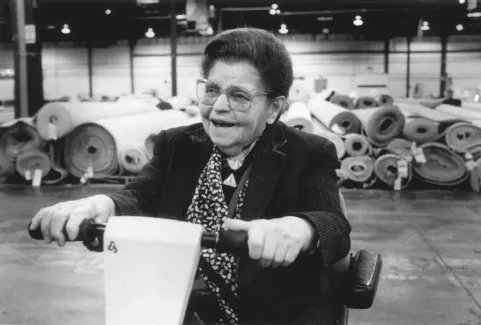
My first encounter with Rose Blumkin was as a customer at Nebraska Furniture Mart in the late 1980s. At this time, “Mrs. B” was well into her nineties and drove around the store on a motorized scooter (Figure 1.1).
She was a tiny woman, standing just four foot ten when she dismounted from her scooter (which I never witnessed). She stopped to speak with customers in her thick Russian-Yiddish accent, encouraging them to make a decision and assuring them that they wouldn’t get a better deal anywhere else.
There are numerous tales of her berating the employees and enjoying lively negotiations with customers. Mrs. B thrived in an era of what would now be considered a “harsh” management style. She was tough, but earned respect from her employees and the community alike.
The Mart was immense even at that time. It now occupies 77 acres of central Omaha with 500,000 square feet of retail space, including a Burger King restaurant. There are also another 500,000 square feet of warehousing and distribution and over 2,800 employees.
Most independent and national furniture stores have found it futile to attempt to compete in Omaha with Nebraska Furniture Mart. The Electronic Mega Mart, a separate electronics department, opened in 1994, has grown substantially in recent years along with consumer demand. It occupies 102,000 square feet. The furniture department still consistently brings in the most revenue of the four divisions (furniture, flooring, electronics, and appliances).
Nebraska Furniture Mart added a second location in Des Moines, Iowa, when they purchased Homemaker’s Furniture in 2001. A third store was built from scratch on 80 acres in Kansas City, Kansas, and opened in 2003. Next, Nebraska Furniture Mart plans to build a new store in suburban Dallas, Texas. The project, consisting of 1.8 million square feet of retail and warehouse space on 433 acres, is slated to open by 2016.
Although Mrs. B has been gone since 1998, her presence is still felt in Nebraska Furniture Mart and her likeness appears in photos scattered around the store. “My grandmother is still the front man of Nebraska Furniture Mart,” says Mrs. B’s grandson and vice-president of the Mart, Robert Batt. “She’s the symbol of the company.”2
Bob started working at the store when he was age 14. On his office walls hang photos and newspaper clippings of many of the major events of the company. There are also several “Going Out of Business” advertisements from competitors’ stores framed and hanging on the wall. These, he explains, are displayed so that the company will “never forget about the other stores who put themselves out of business, how it can happen to anyone, and that it must be avoided.”3 As he explains, if you forget history, you’re doomed to repeat it. And what an interesting history it is. . . .
Dosveydanya!
The tale of Rose Blumkin is a quintessential immigrant’s success story. Rose was born in 1893 to Solomon and Chasia (Kimmelman) Gorelick near Minsk, Russia, in the village of Shchedrin (Scadryn/Chadrin). She and her seven siblings (three brothers and four sisters) lived in a two-room log cabin, sleeping on straw mats. Her father was a rabbi, spending his days in religious study, and her mother ran a small general store. “My father was so religious. She had to support us. He only prayed.”4
Rose later recalled her homeland: “The trees were beautiful. I remember our little house. It was right by the lake. The mosquitoes used to eat us up.” Shchedrin was governed by Russia at that time, but is now part of Belarus. Belarus is remarkably similar in geography to Nebraska, with far-flung horizons stretching over fields of corn, barley, wheat, and sugar beets. Minsk, like Omaha, is an inland river town.
According to the 1897 Russian census, Minsk had 91,494 inhabitants, of which Jews accounted for approximately one-third. The village of Shchedrin was established in about 1844 by over 300 Jewish families.5 It consisted of two parallel streets surrounded by farmland and forests. The population was close to 4,000 at the time of Rose’s birth.
It was customary in this village for the men to study and the women to earn a living for the family by selling fruit and vegetables or handiwork. Only boys received an education. Rose never attended school. But she started helping her mother in the store at the age of six and she learned arithmetic. She absorbed a valuable business education from her mother.
As a child, she once woke up in the middle of the night and saw her mother washing clothes and baking bread for the next day. Young Rose said, “When I grow up you’re not going to work so hard. I can’t stand it, the way you work day and night.”6
Rose left home at age 13, walking barefoot for 18 miles to preserve the soles of her shoes. She stowed away on a train, and got off at the town of Gomel, 300 miles away, near the Ukrainian border. Gomel must have caused Rose some culture shock. It had a population of approximately 47,000 in 1906, and slightly over half were Jewish.
Rose went from shop to shop looking for a job and a place to stay. “You’re a kid,” one store owner said. “I’m not a beggar,” Rose shot back. With only four cents in her pocket, she asked to sleep in the house that night. “Tomorrow I go to work,” she said. The owner relented and Rose got up before dawn the next morning and cleaned the store. She stayed, becoming manager of the store and overseeing the work of six married men by the age of 16.7
She then went to a larger town, got another job in a men’s clothing store, and met Itzik (Isadore) Rosevich (Blumkin), a shoe salesman. They married in 1914. Mrs. B later remembered her wedding day, saying, “My mother brought me two pounds of rice and two pounds of cookies. That was the wedding feast.”8
World War I erupted that same year and many inhabitants of Russia fled. Isadore would have been drafted to fight in the Russian army, but was able to emigrate to the United States shortly after he and Rose married. By 1915, Minsk was a battlefront city.
“We didn’t have the money for two passages, and my husband had to go.” Mrs. B said. According to family legend, this was when Isadore changed his surname from Rosevich to Blumkin. The story has it that he took papers off a dead soldier named Blumkin and used them to leave the country.9
America had been in Rose’s dreams since the age of nine when she first learned that there were people in the world who did not like Jews. “I hated the Cossacks,” said Mrs. B. “I didn’t want to live in Russia anymore.” She worked in a dry goods store, squeezed every penny, and finally, in 1917, took a train to the Chinese-Siberian border. For three years after Isadore’s departure, Rose didn’t know exactly where he was. She knew only that he was in the United States. It was fortunate that she didn’t delay leaving any longer, however. Minsk was governed by the Russian empire for over 100 years, but Russia had to relinquish Belarus to Germany at the close of World War I in 1918.
“I had no passport. At the China-Russia frontier a soldier was standing guard with a rifle. I said to him ‘I am on the way to buy leather for the Army. When I come back I’ll bring you a big bottle of vodka.’ I suppose he’s still there waiting for his vodka,” she laughed. She made her way from China to Japan and booked passage on the freighter Ava Maru, a Japanese peanut boat that made several stops on the way to America.10 The ship had been in use for several years for the purpose of exporting lumber from the state of Washington to Asia.11
“I bought first class, but they were crooks,” she said. “Took me six weeks to get here. So many peanuts. I thought I’d never get here.” After six miserable weeks, the ship docked in Seattle. Mrs. B had no entry permit. “If you were healthy, you got in,” she said. “And healthy, I was.” She had 200 rubles ($66) in her purse.12
The Red Cross helped Rose to find Isadore in Iowa. “I came to Fort Dotchivie (Fort Dodge) and the people were out of this world. I never knew such a people—how they treated me. The friendship, the devotion, the goodness. I thought that anyone in this country is the luckiest one in the world. To such a people to come. They never knew me, and they treated me li...