![]()
Part I
Challenges to Supporting Complex Projects
There is no simple accepted definition of a complex project. The best we have to offer are some of its characteristics from the proceedings of the 2008 NASA Project Management Challenge Conference (Mulenburg, Jerry, “What Does Complexity Have to do With It? Complexity and the Management of Projects,” 2008):
- Details: Number of variables and interfaces
- Ambiguity: Lack of awareness of events and causality
- Uncertainty: Inability to pre-evaluate actions
- Unpredictability: Inability to know what will happen
- Dynamics: Rapid rate of change
- Social Structure: Numbers and types of interactions
Complex projects are filled with uncertainty and unexpected change. Complexity, uncertainty, and the pace of the project all contribute positively to project risk. Risk increases as any of these three variables increases. In most cases these projects are trying to find solutions to critical problems whose solutions have evaded even the most creative professionals. These projects can also be seeking to take advantage of heretofore untapped business opportunities without a clear path as to how to do that. If organizations are to be successful in this environment they must:
- Employ management processes that are flexible.
- Empower the client and the project team.
- Provide an open environment in which creativity can flourish.
- Base decisions on what is best for adding business value.
- Avoid encumbering project managers with non-value-added work.
These are significant challenges because they require senior managers to step outside of their comfort zone and embrace frequent change and high risk.
The Project Landscape (Chapter 1)
It is not sufficient to simply say that complex projects are filled with uncertainty, risk, and unexpected change. That does not give a senior manager anything concrete to help them support such projects. In order to act intelligently senior managers need some structure that defines complex projects and stipulates strategies for dealing with different types of complex projects. The purpose of Chapter 1 is to define a simple but intuitive project classification scheme that can be used as an infrastructure to organize and discuss senior manager support strategies.
Project Management Life Cycle Models (Chapter 2)
Accompanying the complex project landscape are several Project Management Life Cycle (PMLC) Models. These models map to the project landscape and provide an intuitive senior management strategy and approach to generating business value. Chapter 2 defines these models and summarizes their characteristics, strengths, weaknesses, and when to use them.
The Complex Project Team (Chapter 3)
The complex project manager is not your father's project manager. The most effective among them are a multidisciplinary professional who can adapt to the uncertainty, unexpected change, and risk they are asked to manage. In Chapter 3 you will learn about those disciplines and the goal of the human resource executive to develop such professionals.
![]()
Chapter 1
The Project Landscape
The first bit of business for you as a member of the senior management team (SMT) is to understand the project environment within which your project, program, and portfolio managers and their teams must work, and within that environment, the challenges you will face in establishing and supporting an effective project management environment. The needs of that environment have changed dramatically in the last 15 years especially with respect to the tools, templates, and processes that support it. The result is confusion and the introduction of yet another silver bullet every Tuesday. Those silver bullets appear very enticing but let me make it clear that there are no silver bullets now nor have there ever been. There are strategies and you are going to learn them from this book but they will require work on your part in order to implement them and continuing attention from your office for them to become and remain effective in your organization. I recognize your dilemma in the faces and through the reactions of my client organizations as they attempt to support complex project management and offer you what I have learned over the years.
Let me try to put this in a context that relates directly to the SMT. A recent worldwide survey (IBM, “Capitalizing on Complexity: Insights from the Global Chief Executive Officer Study,” 2010) conducted by IBM from September 2009 through January 2010 reported that over half of the 1541 executives from the 60 countries that they interviewed admitted that they were not prepared to support the complex and uncertain environment in which they were forced to conduct business and they didn't know what to do about it. If that isn't a wake-up call to action, I don't know what is.
The following quote from that IBM report highlights the efforts of standout organizations to manage complexity. Their efforts provide a roadmap for us.
- Embody creative leadership: CEOs now realize that creativity trumps other leadership characteristics. Creative leaders are comfortable with ambiguity and experimentation. To connect with and inspire a new generation, they lead and interact in entirely new ways.
- Reinvent customer relationships: Customers have never had so much information or so many options. CEOs are making “getting connected” to customers their highest priority to better predict and provide customers with what they really want.
- Build operational dexterity: CEOs are mastering complexity in countless ways. They are redesigning operating strategies for ultimate speed and flexibility. They embed complexity that creates value in elegantly simple products, services, and customer interactions.
The messages from this survey are clear and validate the goal of this book. The solution offered herein is a logical approach to mitigating the complexity problem that over half of the CEOs interviewed admitted having. Which half of the population do you align with? If you want to prepare yourself to handle complexity, this book is mandatory reading and prepares you to take action. If you are a standout organization, congratulations but you should still read this book because in these pages you will find some gems to help you stay on top of changing complexity and uncertainty.
There was a time when you may have distanced yourself from projects. Your feeling was that projects were operational level activities and of little importance to someone at your management level. In the past 20 years you've probably rethought that position and now see projects as investments and part of a portfolio that has an investment strategy. You may in fact be the manager that determines that strategy. For that reason you are challenged to do what you can to maximize the return on investment (ROI) to your organization from the projects you recommend for the portfolio and that you support directly. How you have responded to this situation depends on your roles and responsibilities with respect to the project, the project teams, and the portfolio. You may have primary responsibility for supporting or managing project managers or have a role supporting those who do have primary responsibility for supporting or managing project managers. In any case, this book offers you the advice you will need to help you and your organization succeed.
The business environment has changed significantly in the last 20 years and has ushered in new project management challenges that the old ways simply cannot support. Business as usual with respect to projects no longer works and may have never worked. Contemporary projects are projects of high complexity and great uncertainty and you must deal with them under those conditions. All of the simple projects have been done! Specifically:
- Complex project managers need the confidence and support of their management.
- Complex project teams must be empowered so they can be successful.
- Complex project portfolios must be aligned with staff resources.
- Complex projects are unique and so are their management approaches.
- Complex projects are high-risk projects.
- Complex projects require a creative approach to discovering solutions.
- Complex projects require meaningful client involvement.
- Complex projects require flexible support services.
In the pages that follow you will see just how you can and must positively impact all of these challenges. So let's get started with a brief introduction to the complex project environment. Understanding that environment is the foundation on which you will be able to build your support strategy.
The Nature of Project Complexity and Uncertainty
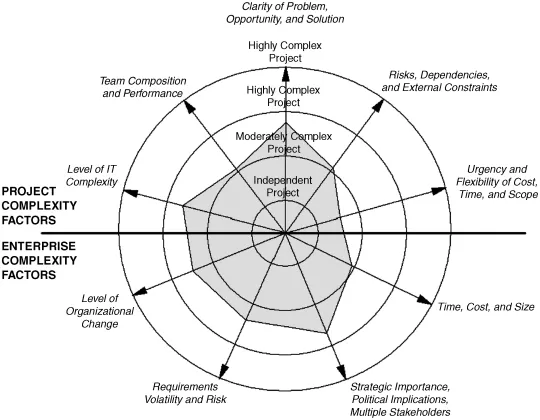
Kathleen B. Hass (Managing Complex Projects: A New Model, Vienna, VA: Management Concepts, 2009) offers the most in depth treatment of complexity that we have. She describes complexity in terms of:
- Time, cost, and size
- Team composition and performance
- Urgency and flexibility of cost, time, and scope
- Clarity of problem, opportunity, and solution
- Requirements volatility and risk
- Strategic importance, political implications, multiple stakeholders
- Level of organizational change
- Risks, dependencies, and external constraints
- Level of IT complexity
In a paper written shortly after her book was published (presented at the 2010 PMI Global Congress Proceedings, Washington, DC) she updates the complexity definition with a four-point scale (Independent Projects, Moderately Complex Projects, Highly Complex Projects, and Highly Complex Programs) and displays the values for a specific project in the form of a spider chart. Figure 1.1 is a hypothetical example adapted from her updated definition and published with her permission.
The project illustrated in ...