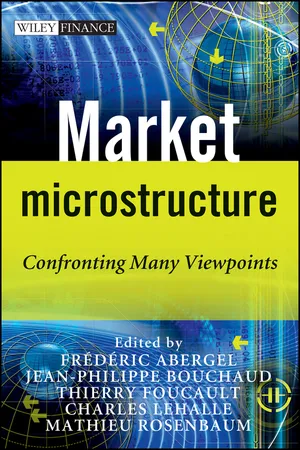
Based on the December 2010 conference on market microstructure, organized with the help of the Institut Louis Bachelier, this guide brings together the leading thinkers to discuss this important field of modern finance. It provides readers with vital insight on the origin of the well-known anomalous "stylized facts" in financial prices series, namely heavy tails, volatility, and clustering, and illustrates their impact on the organization of markets, execution costs, price impact, organization liquidity in electronic markets, and other issues raised by high-frequency trading. World-class contributors cover topics including analysis of high-frequency data, statistics of high-frequency data, market impact, and optimal trading. This is a must-have guide for practitioners and academics in quantitative finance.
eBook - ePub
Market Microstructure
Confronting Many Viewpoints
- English
- ePUB (mobile friendly)
- Available on iOS & Android
eBook - ePub
Market Microstructure
Confronting Many Viewpoints
Part I
Economic Microstructure Theory
1
Algorithmic Trading: Issues and Preliminary Evidence
1.1 INTRODUCTION
In 1971, while the organization of trading on the NYSE had not changed much since its creation in 1792, Fischer Black (1971) was asking whether trading could be automated and whether the specialist's judgement could be replaced by that of a computer (the specialist is a market-maker designated to post bid and ask quotes for stocks listed on the NYSE). Forty years later, market forces have given a positive reponse to these questions.
Computerization of trading in financial markets began in the early 1970s with the introduction of the NYSE's “designated order turnaround” (DOT) system that routed orders electronically to the floor of the NYSE. It was then followed with the development of program trading, the automation of index arbitrage in the 1980s, and the introduction of fully computerized matching engines (e.g., the CAC trading system in France in 1986 or the Electronic Communication Networks in the US in the 1990s). In recent years, this evolution accelerated with traders using computers to implement a wide variety of trading strategies, e.g., market-making, at a very fine time scale (the millisecond).
The growing importance of these “high frequency traders” (HFTs) has raised various questions about the effects of algorithmic trading on financial markets. These questions are hotly debated among practitioners, regulators, and in the media. There is no agreement on the effects of HFTs.1 As an example consider these rather opposite views of the HFTs' role by two Princeton economists, Paul Krugman and Burton Malkiel. Krugman has a rather dim view of HFTs:
High-frequency trading probably degrades the stock market's function, because it's a kind of tax on investors who lack access to those superfast computers – which means that the money Goldman spends on those computers has a negative effect on national wealth. As the great Stanford economist Kenneth Arrow put it in 1973, speculation based on private information imposes a “double social loss”: it uses up resources and undermines markets. (Paul Krugman, “Rewarding Bad Actors”, New York Times, 2 August 2009).
In contrast, for Malkiel, high frequency traders have a more positive function:
In their quest to find trading profits, competition among high-frequency traders also serves to tighten bid-offer spreads, reducing transactions costs for all market participants, both institutional and retail. Rather than harming long-term investors, high-frequency trading reduces spreads, provides price discovery, increases liquidity and makes the market a fairer place to do business. (Burton Malkiel, ``High Frequency Trading is a Natural Part of Trading Evolution'', Financial Times, 14 December 2010).
Concerns have also been voiced that HFTs could manipulate markets to their advantage, exacerbate market volatility and that high frequency trading could be a new source of fragility and systemic risk for the financial system. In particular, some have suggested that HFTs may have been responsible for the flash crash of 6 May 2010.
Not surprisingly, given these concerns and lack of consensus on the exact role of algorithmic traders, debates are now raging about whether actions should be taken to regulate algorithmic trading. A (certainly incomplete) list of questions raised in these debates is as follows (see SEC, 2010, Section IV, or CESR, 2010a and 2010b):
1. Liquidity. What is the effect of algorithmic trading on market liquidity? Is liquidity more likely to evaporate in turbulent times when it is provided by HFTs?
2. Volatility. Do algorithmic traders dampen or exacerbate price volatility?
3. Price discovery. Does algorithmic trading make prices closer to fundamental values?
4. Distributional issues. Do “fast traders” (HFTs) make profits at the expense of “slow” traders (long-term investors, traditional market-makers, etc.)? Or can fast trading benefit all investors?
5. Systemic risk. Does algorithmic trading increase the risk of market crashes and contagion? Does it make securities markets more fragile? Does it increase the risk of evaporation of liquidity in periods of crisis?
6. Manipulation. Are securities markets more prone to price manipulation with the advent of algorithmic trading?
7. Market organization. What are the effects of differentiating trading fees between fast and slow traders or between investors submitting limit orders and those submitting market orders?2 Should exchanges be allowed to sell ticker tape information? Should there be “speed limits” in electronic trading platforms? etc.
The goal of this report is to discuss some of these issues in the light of recent empirical findings. In Section 1.2, I first define more precisely what algorithmic trading is while in Section 1.3, I describe the close relationships between changes in market structures and the evolution of algorithmic trading. Section 1.4 describes possible costs and benefits of algorithmic trading while Section 1.5 reviews recent empirical findings regarding the effects of algorithmic trading.
Throughout this report I use results from various empirical studies. There are as yet relatively few empirical studies on algorithmic trading (especially high frequency trading) as it is a relatively new phenomenon and data identifying trades by algorithmic traders are very scarce. Consequently, one must be careful not to generalize the results of these studies too hastily: they may be specific to the sample period, the asset class, the identification method used for the trades of algorithmic traders, and the type of algorithmic trading strategy considered in these studies. For this reason, in Table 1.1 (in the Appendix), I give, for each empirical study mentioned in this article, the sample period, the type of asset considered in the study, and whether the study uses direct data on trades by algorithmic traders or has to infer these trades from more aggregated data.
1.2 WHAT IS ALGORITHMIC TRADING?
1.2.1 Definition and typology
Algorithmic trading consists in using computer programs to implement investment and trading strategies.3 The effects of algorithmic trading on market quality are likely to depend on the nature of the trading strategies coded by algorithms rather than the automation of these strategies in itself. It is therefore important to describe in more detail the trading strategies used by algorithmic traders, with the caveat that such a description is difficult since these strategies are not yet well known and understood (see SEC, 2010).
Hasbrouck and Saar (2010) offer a useful classification of algorithmic traders based on the distinction between Agency Algorithms (AA) and Proprietary Algorithms (PA).
Agency Algorithms are used by brokers or investors to rebalance their portfolios at the lowest possible trading costs. Consider, for instance, a mutual fund that wishes to sell a large position in a stock. To mitigate its impact on market prices, the fund's trading desk will typically split the order in “space” (i.e., across trading platforms where the stock is traded) and over time, in which case the trading desk has to specify the speed at which it will execute the order. The fund can also choose to submit a combination of limit orders and market orders, access “lit” markets or dark pools, etc. The fund manager's objective is to minimize its impact on prices relative to a pre-specified benchmark (e.g., the price when the manager made his portfolio rebalancing decision). The optimal trading strategy depends on market conditions (e.g., the prices standing in the different markets, the volatility of the stock, the persistence of price impact, etc.), and the manager's horizon (the deadline by which its order must be executed).4
The implementation of this strategy is increasingly automated: that is, computers solve in real-time for the optimal trading strategy and take the actions that this strategy dictates. The software and algorithms solving these optimization problems are developed by Quants and sold by brokers or software developers to the buy-side.
Proprietary Algorithms are used by banks' proprietary trading desks, hedge funds (e.g., Citadel, Renaissance, D.E. Shaw, SAC, etc.), proprietary trading firms (GETCO, Tradebot, IMC, Optiver, Sun Trading, QuantLab, Tibra, etc.), or even individual traders for roughly two types of activities: (i) electronic market-making and (ii) arbitrage or statistical arbitrage trading.
As traditional dealers, electronic market-makers post bid and ask prices at which they are willing to buy and sell a security and they accommodate transient imbalances due to temporary mismatches in the arrival rates of buy and sell orders from other investors. They make profits by earning the bid-ask spread while limiting their exposure to fluctuations in the value of their positions (“inventory risk”).
In contrast to traditional dealers, electronic market-makers use highly computerized trading strategies to post quotes and to enter or exit their positions in multiple securities at the same time. They also hold relatively small positions that they keep for a very short period of time (e.g., Kirilenko et al., 2010, find that high frequency traders in their study reduce half of their net holdings in about two minutes on average). Moreover, they typically do not carry inventory positions overnight (see Menkveld, 2011). In this way, electronic market-makers achieve smaller intermediation costs and can therefore post more competitive bid-ask spreads than “bricks and mortar” market-makers. For instance, they considerably reduce their exposure to inventory risk by keeping positions for a very short period of time and by acting in multiple securities (which better diversify inventory risk over multiple securities). Moreover, as explained in Section 1.5.2, by reacting more quickly to market events, electronic market-makers better manage their exposure to the risk of being picked off, thereby decreasing the adverse selection cost inherent to the market-making activity (Glosten and Milgrom, 1985).
Arb...
Table of contents
- Cover
- Series
- Title Page
- Copyright
- Introduction
- About the Editors
- Part I: Economic Microstructure Theory
- Part II: High Frequency Data Modeling
- Part III: Market Impact
- Part IV: Optimal Trading
- Combined References
- Index
Trusted by 375,005 students
Access to over 1.5 million titles for a fair monthly price.
Study more efficiently using our study tools.
Frequently asked questions
Yes, you can cancel anytime from the Subscription tab in your account settings on the Perlego website. Your subscription will stay active until the end of your current billing period. Learn how to cancel your subscription
No, books cannot be downloaded as external files, such as PDFs, for use outside of Perlego. However, you can download books within the Perlego app for offline reading on mobile or tablet. Learn how to download books offline
Perlego offers two plans: Essential and Complete
- Essential is ideal for learners and professionals who enjoy exploring a wide range of subjects. Access the Essential Library with 800,000+ trusted titles and best-sellers across business, personal growth, and the humanities. Includes unlimited reading time and Standard Read Aloud voice.
- Complete: Perfect for advanced learners and researchers needing full, unrestricted access. Unlock 1.5M+ books across hundreds of subjects, including academic and specialized titles. The Complete Plan also includes advanced features like Premium Read Aloud and Research Assistant.
We are an online textbook subscription service, where you can get access to an entire online library for less than the price of a single book per month. With over 1.5 million books across 990+ topics, we’ve got you covered! Learn about our mission
Look out for the read-aloud symbol on your next book to see if you can listen to it. The read-aloud tool reads text aloud for you, highlighting the text as it is being read. You can pause it, speed it up and slow it down. Learn more about Read Aloud
Yes! You can use the Perlego app on both iOS and Android devices to read anytime, anywhere — even offline. Perfect for commutes or when you’re on the go.
Please note we cannot support devices running on iOS 13 and Android 7 or earlier. Learn more about using the app
Please note we cannot support devices running on iOS 13 and Android 7 or earlier. Learn more about using the app
Yes, you can access Market Microstructure by Frédéric Abergel, Jean-Philippe Bouchaud, Thierry Foucault, Charles-Albert Lehalle, Mathieu Rosenbaum, Frédéric Abergel,Jean-Philippe Bouchaud,Thierry Foucault,Charles-Albert Lehalle,Mathieu Rosenbaum in PDF and/or ePUB format, as well as other popular books in Business & Finance. We have over 1.5 million books available in our catalogue for you to explore.