![]()
PART I
Planning for Growth
![]()
CHAPTER 1
The Shortcut
Having an effective growth planning system is the best indicator of whether your company will grow.
—Steven S. Little, Author
Congratulations on your commitment to develop your own One Hour Plan for Growth. There are three basic ways to use this book.
1. Take the Shortcut. You’ll have a plan in one hour including the one most important strategy to grow your business.
2. Read through the book if you want to do the in-depth version of the plan including several strategies to grow your business.
3. Involve your team in the process to create greater commitment and buy-in (see www.1Hour2Plan.com).
Think of each step in this process as a piece of your planning puzzle. At this time you don’t know what the final picture will look like. As you build your plan, it may not make sense until you are done. So, you must trust the process. Let’s get started. Here are the steps to the planning process.
Step 1: Where Do You
Want to Go? Write Down the Long-Term Aspirations that Drive You and Your Team (25 minutes)
• 1:1 Vision Exercise—Define the big goal that will inspire you and your team (see Chapter 3).
• 1:2 Mission Exercise—Define why your organization exists, the ultimate contribution you make to your customers’ lives (see Chapter 4).
• 1:3 Values Exercise—Define the standards of behavior that will help your team enjoy working together (see Chapter 5).
• 1:4 Objectives Exercise—Define the measures of your success and organizational performance (see Chapter 6).
Step 2: Where Are You Now? Write Down the Brutal Realities Facing Your Team (10 minutes)
• 2:1 Issues Exercise—Identify the big issues that must be addressed (see Chapter 7).
Step 3: How Will You
Get from Here to There? Write Down the Areas of Work and Who Needs to Do What by When. (25 minutes)
• 3:1 Strategies Exercise—Define the major categories of work to be done (see Chapter 8).
• 3:2 Priorities Exercise—Define who needs to do what by when (ee Chapter 9).
![]()
CHAPTER 2
An Overview of the One Hour Plan
It does not take much strength to do things, but it requires a great deal of strength to decide what to do.
—Elbert Hubbard, Philosopher and Writer
The best way to
predict your future is to create it.
—Stephen R. Covey, Author
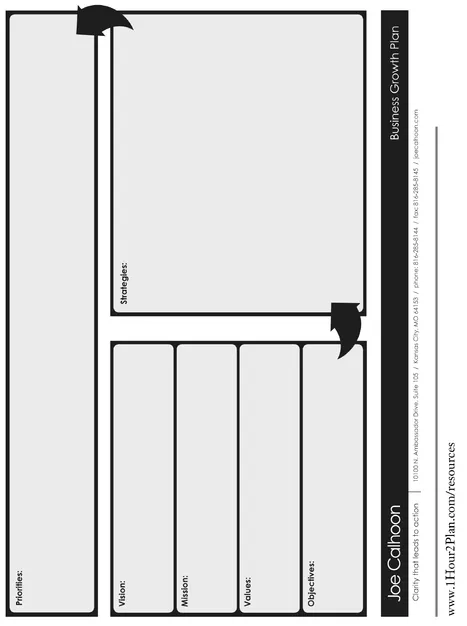
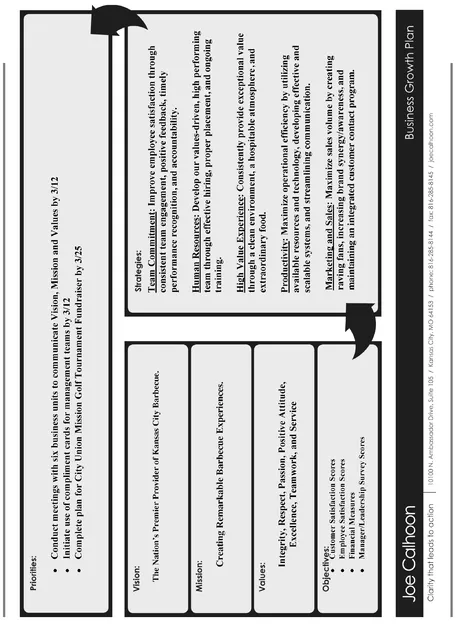
A sngle sheet of paper is enough to describe your organization’s Vision, Mission, Values, Objectives, and Strategies, plus help focus an individual’s Priorities.
As you read this book, write these six elements of your plan on the following page. See Table 2.1.
Table 2.1 Blank Template—The One Hour Plan for Growth
Table 2.2 Example Template—Jack Stack Barbecue
The Problems with Planning
Effective Planning strengthens people, productivity, and profitability. So, why do so few companies take the time to plan?
There are five problems with planning:
1. Most plans are too long.
2. Most planning takes too much time.
3. Too few people are engaged in planning—it’s an event.
4. Many plans end up sitting on a shelf.
5. Many plans have little impact on organizational performance.
There
is a better way:
• Develop a plan that fits on a single sheet of paper.
• Invest hours, not days or weeks, in the planning process.
• Engage your team in the planning process.
• Use your plan to keep on track.
• Set, achieve, and celebrate progress on priorities.
The Three-Step Planning Process
Step 1: Where do you want to go? Start by defining the long-term aspirations that drive you and your team. These include your vision, mission, and values. This builds hope. It’s more important to know what big goal will inspire you and your team, what contribution you make to your customers lives, and what standards will help your team enjoy working together than having “perfect verbiage.” In this first step, you will also define your measures of success, your objectives.
Step 2: Where are you now? After you know where you want to go, it’s time to identify where you are now. What are the big issues that must be addressed? Identify your 5 to 10 most important issues.
Step 3: How will you get to there from here? Last, identify how you will get from where you are to where you want to go. Define the major categories of work to be done, your strategies, and who will do what by when, priorities.
That’s it. The process is easy and effective. Let’s get started.
If you would like to go deeper into Planning, continue reading.
To take the shortcut, turn to Chapter 3.
You Have a Mountain to Climb
The experienced mountain climber is not intimidated by a mountain—he is inspired by it. The persistent winner is not discouraged by a problem—he is challenged by it. Mountains are created to be conquered; adversities are designed to be defeated; problems are sent to be solved.
—William Arthur Ward, Author
Mount Everest represents the highest achievement to climbers around the world.
In 1984, Warren Thompson envisioned a Mount Everest climb with men and women from China, Russia, and the United States. With leadership from Jim Whittaker, the first American to climb Everest, the multinational team reached the highest place in the world on Earth Day in 1990, and returned safely.
A few years after the climb, Warren Thompson participated in a three-day leadership workshop that I facilitated in Washington State. Warren and I discussed leadership and the vital role of planning. Here’s the big takeaway from our conversations. Can you imagine how the climbing team might have performed had they not clearly defined the answers to these six questions? See Table 2.3.
Many businesses fail to grow because they have not clearly answered these six fundamental questions. Individuals and organizations are meant to climb, to achieve, and to make significant contributions. As you define each of these six essential elements, you will create your business growth plan.
Table 2.3 Six Questions to Engage Your Team
| 1. What mountain are we climbing? | Vision |
| 2. Why are we climbing it? | Mission |
| 3. How will we treat each other along the way? | Values |
| 4. How will we measure our progress? | Objectives |
| 5. What work needs to be done? | Strategies |
| 6. Who will do what by when? | Priorities |
Engage Your Team in the Planning Process
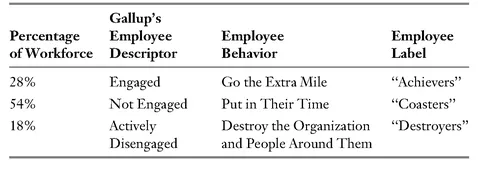
According to Gallup Research, there are three types of employees in any organization—people who are engaged, not engaged, or actively disengaged.
Only 28 percent of the workforce is engaged. These workers are the achievers (the climbers) who go the extra mile to make good things happen.
Unfortunately, the majority of the workforce (54 percent) is not engaged. These workers are the coasters (the campers) who simply put in their time.
Another group (18 percent) is actively disengaged. These workers are the destroyers (the quitters) who have given up on their highest hopes and aspirations. These people often become bitter and resentful. Their motto is, “I’m going down and I’m taking everybody with me.”
Too many people live for the weekend. People live happier, healthier, and more productive lives when they live all week long. See Table 2.4.
Table 2.4 Employee Engagement
In order to engage the best efforts of today’s workers, it’s recommended to involve your team in this planning process. You can create a plan without any involvement from your team, but you won’t have as much buy-in. Here’s the principle. No involvement, no commitment. Engaging your team is addressed in greater detail in Chapter 11, “What’s Next?”
The Six Elements and the Three Time Frames
Your plan to grow your business does not have to be complicated. There are only six essential elements.
In your organization, the first three elements are long-term: vision, mission, and values. Once established, they remain consistent for years to come. The next two elements are mid-term: objectives and strategies. They are usually redefined every year. The last element is short-term: priorities. Priorities are defined and achieved within 30 to 90 days.
Long Term: 5 to 25 years
These elements provide the stable core around which everything else flows. “What big goal will inspire you and your team?” (Vision), “What contribution do you make to your customers’ lives?” (Mission), and “What standards will help your team enjoy working together?” (Values). These first three elements of your plan tend to be timeless and foundational to all your other choices. Let’s think about these first three elements and their value to your team.
Vision. Without a unifying vision, a clear destination, people will wander aimlessly with no end in mind. People will lack focus and waste time. Without one vision, you may have division. “Di” means two. You might have two visions or three. The Americans might climb one mountain, the Russians another, and the Chinese a third. Or worse yet, you might end up with a large group of people just staying at base camp giving up on the climb.
Mission. Without a mission, your team will lack common...