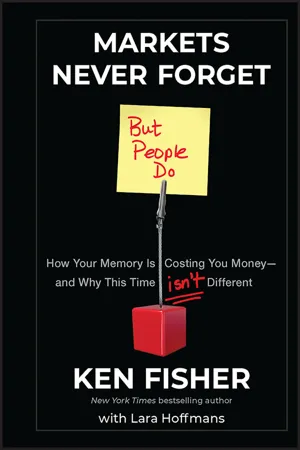
In Markets Never Forget But People Do: How Your Memory Is Costing You Money and Why This Time Isn't Different, long-time Forbes columnist, CEO of Fisher Investments, and 4-time New York Times bestselling author Ken Fisher shows how and why investors' memories fail them—and how costly that can be. More important, he shows steps investors can take to begin reducing errors they repeatedly make. The past is never indicative of the future, but history can be one powerful guide in shaping forward looking expectations. Readers can learn how to see the world more clearly—and learn to make fewer errors—by understanding just a bit of investing past.
eBook - ePub
Markets Never Forget (But People Do)
How Your Memory Is Costing You Money--and Why This Time Isn't Different
- English
- ePUB (mobile friendly)
- Available on iOS & Android
eBook - ePub
Markets Never Forget (But People Do)
How Your Memory Is Costing You Money--and Why This Time Isn't Different
About this book
Sir John Templeton, legendary investor, was famous for saying, "The four most dangerous words in investing are, 'This time it's different.'" He knew that though history doesn't repeat, not exactly, history is an excellent guide for investors.
CHAPTER 1
The Plain-Old Normal
Yes Sir, Sir John
“The four most expensive words in the English language are, ‘This time it’s different.’” So saith Sir John Templeton (1912–2008), forever and ever, amen. Of course, he was only talking about investing. Or maybe spirituality—or maybe both.
To say Sir John is legendary is an injustice to the word legendary. He was a mutual fund pioneer—founded and built one of the first big firms. He was a global investing pioneer, too—doing global for clients before anyone did. Sir John had ice water in his veins and really lived the idea: Don’t follow the herd. He knew to be greedy when others were fearful and vice versa before Buffett made that his. He never believed in chart voodoo, no matter how trendy it was. He was firmly grounded in fundamentals. He believed in what he called bargains.
I was fortunate to meet Sir John several times, and always paid him a lot of attention (not just because I realized we shared the same birthday almost a half century apart). To me, he was personal. He was also humble, understated, unflappable, soft-spoken, courtly, civil and gentlemanly in all circumstances. He was and is an ideal role model for almost anyone—I don’t care who you are.
Sir John was simply an all-around great guy. He gave heavily to charitable foundations (many he established himself), among other things the world’s largest financial prize, the Templeton Prize in Religion. He was thrifty—preferred driving junky used cars instead of being chauffeured in a limousine. He flew coach. He was knighted (through no fault of his own) but down-to-earth. He played a mean game of poker—put himself through Yale on his winnings. He, like me, thought the US government was a lousy steward of his, yours and his employees’ money, so he bolted for the Bahamas. He also built an ongoing business interest, which itself helped launched many thousands of good careers in a well-paying industry—lots of smart folks learned the business at Sir John’s knee—not to mention the countless numbers of investors who got wealthier investing with him. It was his success that first made me envision building a big investment firm.
He was a stunning spiritual thinker. If you can ever get your hands on a copy of his long-out-of-print spiritual book, The Humble Approach, I assure you, whatever your spiritual views, it will impact them somehow. Sir John was a deep, deep thinker.
But to my mind, one of his greatest contributions was that admirably short admonition. That if you think, “This time it’s different,” you’re in all likelihood dead wrong and almost surely about to cost yourself dearly.
This isn’t to say history repeats perfectly. It doesn’t—not exactly. That’s not what Sir John meant. But a recession is a recession. Some are worse than others—but we’ve lived through them before. Credit crises aren’t new, nor are bear markets—or bull markets. Geopolitical tension is as old as mankind, as are war and even terror attacks. Natural disasters aren’t new! And this idea that natural disasters are bigger, badder and more frequent now simply isn’t true. Only human arrogance allows us to believe we’re living in some new, unique age. Sure, we are—just like every previous generation did. And in that sense, Sir John understood the great value of studying and remembering history. Without that history anchor, you have no context to understand the here-and-now or any way to determine what’s reasonable to expect in the future. Sir John was a historian in a world in which most market practitioners’ sense of history is largely limited to their career span.
Sir John also knew then what every good investor should know now (but they don’t because they forget): Humans don’t evolve fast. We don’t! The same things that freaked us out during the early Mesopotamian market days are the types of things freaking us out in the twenty-first century. And because human nature is a slowly evolving beast, the scenery can change, but we still have the same basic reactions to things.
We have the same reactions because we don’t remember very well at all. My line on this subject is that societally, we’re like chittering chimpanzees with no memories. We chitter about whatever without any sense of history, data or analysis. Sir John was exquisite with all three and knew we falsely believe every recession that hits is more agonizingly painful than the last. Every credit crisis we live through we think beats all the rest. (Anyone who thinks the 2008 credit crisis was history’s worst knows zero about nineteenth-century history. Zippo!) Behaviorally, this is evolution’s gift to humanity so we don’t give up in despair.
And that’s why Sir John’s admonition that it’s never different this time is so eternally useful. No matter how big and scary something seems, we’ve almost always been through something similar before. And if you can remember that and find those times and learn the lessons from them, you can know better how to react—or not react. You can know that it’s never as bad or as great or as lasting as your Swiss-cheese monkey’s memory makes you think.
What’s also not different this time is how resilient economies and capital markets are—particularly in more developed countries. People forget that. Sir John never would. There’s this nonsense notion about secular bear markets lurking around every corner (Chapter 4). But if that’s true and if capital markets aren’t remarkably resilient, how can it be the value of all publicly traded stocks globally keeps rising over time—currently $54 trillion?1 Global economic output is now at $63 trillion!2 It was $31 trillion in 2000.3 (For all the 2000s being frequently referred to as a “lost decade,” somehow the global economy doubled.) It was $19 trillion in 1990.4 It will be higher still in 2020 and 2050 and 2083 and 3754. Exactly how much? I don’t have a clue. Neither would Sir John, were he still alive. But I only heard him say about 40 times over the decades it would be much higher and at about the same growth rates as we’ve seen before—maybe a little more or a little less. Almost no one ever believed him on that—particularly not when he said it in the midst of a bear market or recession. Yet he was always right.
Side note: One reason folks fall prey to the notion of long-term stagnancy now, I believe, is the death of journalism. Once upon a time, journalism was a serious pursuit. To be a journalist, you went to school, you interned, you learned your five W’s and your H—who, what, when, where, why and how. You put all the pertinent information in the first paragraph: Man bites dog in Tulsa suburb because dog stole his rib-eye steak. Then you elaborate. Editors knew they could “trim from the bottom.” Don’t need the details about the dog’s breed or creed (purple Pekinese with three legs and no tail) in paragraph seven? Trim that. Don’t need to know it was the man’s birthday party from paragraph five? Trim that.
On magazine and newspapers’ mastheads, there used to be a roster of staff writers. Some new, but many older and grizzled. They were the best and the core of the organ. They’d seen things. So when the young pups would say, “Golly gee! This Tech bubble is the biggest thing ever! The world is ending!” the Grizzled Veterans would say, “You don’t know anything. The Energy bubble in 1980 was just as bad or worse!” They’d been around the block—lots of times.
Now, traditional journalism is dying. Blame the Internet, blame cable, blame whatever you want. Doesn’t much matter! Traditional media is bleeding money. Pick up any newspaper or magazine. The masthead has been obliterated. Maybe there are just a few staff writers. Maybe those staff writers weren’t there five years ago. They let all the grizzled guys go a long time ago to hire cheap guys and often kids who write for pennies. Or maybe for free! Online blog sites get tons of free contributors—they’ll print any nonsense folks write. Or maybe they print just wire stuff and have a few go-to editorialists for some spice.
But most of the folks writing news today haven’t been around the block. Maybe 2007 to 2009 really was the biggest thing they’d ever seen. Maybe they were in college during the last recession and bear market or (eek!) high school. Maybe they weren’t even born for the one before that! They have no context. To them, the world really is ending and they can’t fathom how we get past this bad time (whenever it is) because they’ve never seen that happen before—not as an adult.
I’m not saying that’s it 100%. And there are still a very few old grizzled journalists around, but precious few. As a whole, we don’t remember even very recent events. But it doesn’t help when media confirms our worst nonsensical monkey memory fears.
Compounded by no-memory no-context journalism, it’s harder to pause, take a deep breath and ask, “What am I forgetting? Has this happened before? Have I seen this or something like this before?” Because, except for the truly young pups reading this, you probably have.
Believing “this time it’s different”—when it isn’t—is more than just seeing the world wrong. It can lead to serious investing errors. In my world, people make bets—bets with their own or frequently with other people’s money—based on their world views. The idea isn’t to be perfect. No one is. To do well at money management—whether for yourself or others—means being right more than wrong over long periods. That means you will still be wrong a lot and frequently in clumpy patches of wrongness. But being right more than wrong is easier if you see the world more correctly.
It matters because seeing the w...
Table of contents
- Cover
- Contents
- Title
- Copyright
- Dedication
- Preface
- Acknowledgments
- Chapter 1: The Plain-Old Normal
- Chapter 2: Fooled by Averages
- Chapter 3: Volatility Is Normal—and Volatile
- Chapter 4: Secular Bear? (Secular) Bull!
- Chapter 5: Debt and Deficient Thinking
- Chapter 6: Long-Term Love and Other Investing Errors
- Chapter 7: Poli-Ticking
- Chapter 8: It’s (Always Been) a Global World, After All
- Appendix
- Index
Trusted by 375,005 students
Access to over 1.5 million titles for a fair monthly price.
Study more efficiently using our study tools.
Frequently asked questions
Yes, you can cancel anytime from the Subscription tab in your account settings on the Perlego website. Your subscription will stay active until the end of your current billing period. Learn how to cancel your subscription
No, books cannot be downloaded as external files, such as PDFs, for use outside of Perlego. However, you can download books within the Perlego app for offline reading on mobile or tablet. Learn how to download books offline
Perlego offers two plans: Essential and Complete
- Essential is ideal for learners and professionals who enjoy exploring a wide range of subjects. Access the Essential Library with 800,000+ trusted titles and best-sellers across business, personal growth, and the humanities. Includes unlimited reading time and Standard Read Aloud voice.
- Complete: Perfect for advanced learners and researchers needing full, unrestricted access. Unlock 1.5M+ books across hundreds of subjects, including academic and specialized titles. The Complete Plan also includes advanced features like Premium Read Aloud and Research Assistant.
We are an online textbook subscription service, where you can get access to an entire online library for less than the price of a single book per month. With over 1.5 million books across 990+ topics, we’ve got you covered! Learn about our mission
Look out for the read-aloud symbol on your next book to see if you can listen to it. The read-aloud tool reads text aloud for you, highlighting the text as it is being read. You can pause it, speed it up and slow it down. Learn more about Read Aloud
Yes! You can use the Perlego app on both iOS and Android devices to read anytime, anywhere — even offline. Perfect for commutes or when you’re on the go.
Please note we cannot support devices running on iOS 13 and Android 7 or earlier. Learn more about using the app
Please note we cannot support devices running on iOS 13 and Android 7 or earlier. Learn more about using the app
Yes, you can access Markets Never Forget (But People Do) by Kenneth L. Fisher,Lara W. Hoffmans,Ken Fisher in PDF and/or ePUB format, as well as other popular books in Business & Investments & Securities. We have over 1.5 million books available in our catalogue for you to explore.