eBook - ePub
Adapting Configuration Management for Agile Teams
Balancing Sustainability and Speed
- English
- ePUB (mobile friendly)
- Available on iOS & Android
eBook - ePub
Adapting Configuration Management for Agile Teams
Balancing Sustainability and Speed
About this book
Adapting Configuration Management for Agile Teams provides very tangible approaches on how Configuration Management with its practices and infrastructure can be adapted and managed in order to directly benefit agile teams. Written by Mario E. Moreira, author of Software Configuration Management Implementation Roadmap, columnist for CM Crossroads online community and writer for the Agile Journal, this unique book provides concrete guidance on tailoring CM for Agile projects without sacrificing the principles of Configuration Management.
Information
CHAPTER 1
Introduction: Racing with Confidence
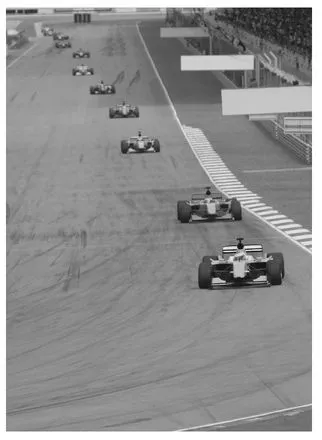
Effective Agile allows a team to move fast with confidence. In order to move with such speed and confidence, you need to have a very smooth, well-built, and maintained roadway. This ensures speed and the ability to stay on track. If you look at the road surface of automobile race tracks for the very fast racing cars (e.g. Formula 1, Indy car, stock car, and dragsters) you will find that the road surfaces are built with precision incorporating high-quality race construction and surface materials. All of this is to ensure the race-cars are allowed their maximum speed and maneuverability with a balance of minimal friction and maximum control.
Figure 1-1 CM raceway for Agile teams.
Configuration Management (CM) provides many of the same elements as a high-speed raceway. While a gravel road may allow for speeds of up to 40 or 50 mph without you getting thrown off course or crashing, and a standard paved roadway may allow for speeds of 120 mph, a smoothly paved and well-constructed raceway for high-speed race cars allows for speeds of 250 to 300 mph and beyond. Similarly, the values of CM and Agile can be a very powerful combination.
Agile methods, along with well-trained and seasoned Agile professionals, are the engine and the driver, while CM is the road surface. CM brings order and control to the world of Agile - an order that can be counted on and repeated with integrity, so that the Agile professionals can focus on the high-value tasks of building and delivering functionality to the customer for the checkered flag and the win!
Figure 1-2 Checkered flag for the Agile win!

On the one hand, CM professionals have seen Agile “pretenders” and “cowboys” claim that Agile is without process, tools, and discipline. This misrepresents Agile and damages its reputation. On the other hand, some Agile professionals have felt “heavy” CM adds too much process that burdens their velocity. The key is finding the balance that allows you to stay on the track while maintaining a high velocity.
Agile relies more on the strength of the team and their interactions than on processes and tools. However, Agile does not discard processes and tools, it just aims to use them in a lean way to strengthen the ability to interact more effectively and deliver value. This implies that the effort to define the need for processes and tools should be driven by the people and their interactions.
Pit Stop
Agile encourages change while CM is an enabler for change. This powerful combination ensures change can be frequent while under control.
CM should adapt to the needs of the lifecycle method (in this case Agile), which means it should be adjusted and honed for the changing needs of the method and the project without sacrificing the values of CM. Anyone who has ever established a CM infrastructure (environment, tools, and processes) knows that CM can be implemented in a number of different ways. I have implemented CM in over 100 different product lines and have adapted to the product, project, standards, framework, and method on numerous occasions. So why should implementing CM on a project using Agile be any different? Both Agile professionals and CM professionals should learn enough about each other’s values and principles in order to understand each other’s perspective to comprehend what it means to adapt CM to align with the values of Agile. Just like a racetrack, the goal is to establish CM so that it reduces friction between the Agile race-car and the road surface. But just like a well-constructed racetrack, the goal of CM is to ensure the car stays on track while allowing it to maintain a high velocity.
While both speed (for Agile) and control (for CM) are important, it is ultimately driven by the ability to quickly get value to the customer while maintaining the integrity of the deliverable, so that the customer can have confidence in what they are receiving.
Pit Stop
The goal with adapting CM for Agile teams is not to discard any of the values of each. Instead it is to determine how best to integrate the values through a leaner CM implementation that still provides those projects that follow Agile with the sticky surface needed to keep it on track and with the integrity the customer expects.
1.1 Focus of this Book
This book focuses on how Configuration Management (CM) with its practices and infrastructure can be adapted and managed in order to directly benefit Agile teams. It is intended to be a pragmatic guide but neither exhaustive nor prescriptive. It can be applied when a team is embarking on new product development following Agile methods or when being applied to legacy products that are introducing Agile methods. While this book focuses on those with an Agile mindset, please note that many of these adaptations can be done for traditional methods as well, and gain similar benefits.
1.2 Who should Use this Book
This book is intended for the following:
• The primary group who will benefit from this book includes:
• Agile professionals such as: Agile coaches, Agile project managers, Agile team members, and product managers. An Agile team member can be anyone with a background in programming, analysis, testing, architecture, design, quality assurance, (anyone who plays a full-time and active role on the project using Agile methods). This book will help Agile professionals broaden their perspective of CM and infrastructure and become familiar with CM values, and gain knowledge of CM, while considering leaner ways of implementing CM in the work context.
• CM professionals such as: CM managers, CM tool engineers, CM coordinators, and build & release engineers (i.e., anyone who plays a CM-related role). This book will help CM professionals broaden their perspective of Agile methods, become familiar with Agile values, and gain primer level knowledge of Agile methods, while learning about leaner approaches to implementing CM in an Agile context.
• The secondary group who will benefit from using this book includes:
• Product managers and product owners who are considering Agile methods for their product line. This book will provide them with a primer level understanding of Agile and Configuration Management and the implications of Agile to CM and infrastructure, focusing on leaner ways to approach them.
• VP of Engineering and Senior Management who are considering Agile methods for their organizations. This book will provide them with a primer level understanding of Agile and Configuration Management and the implications of Agile to CM and infrastructure, focusing on leaner ways to approach them.
• Quality Assurance professionals who want to learn more about both Agile and CM and recognize how each help improve quality across the lifecycle of both the product and projects therein.
• Operations and Infrastructure professionals who want to understand both Agile and CM better and recognize the implication of Agile to their field with more incremental and optional ways of establishing infrastructure on a project.
• Development, test, analyst, project management, and architect professionals who want to learn more about both Agile and CM and understand the implication of Agile and CM to their field.
• Project stakeholders and customers who want a primer level understanding of Agile and CM and want to recognize the benefits and implications of Agile and CM to their roles.
1.3 Navigation through this Book
You can read this book in a number of ways. Of course you are welcome to read the full book from front to back. However, you can also navigate the book according to the level of knowledge you have in Agile and/or CM, the profession you are in, and/or what challenges you are trying to solve. Below is a view of the sections within this book with navigation from top to bottom or to selected sections per your current need.
Figure 1-3 Navigation thru the chapters of this book.
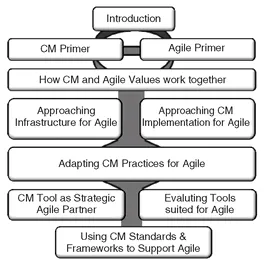
First identify the column that is aligned with your profession and read the navigational details.
| Agile Professional | CM Professional | Other Professional |
|---|---|---|
| If you are an Agile professional, first read the “CM Primer” section of the book. This will ensure you have a solid understanding of CM values and practices which will help you understand what CM areas and adaptations may help you in your work. | If you are a CM professional (you have experience as a CM engineer, build engineer, release engineer, CM coordinator, etc.), consider first reading the “Agile Primer” section of the book. This will ensure you have a solid understanding of Agile values, methods, and practices leading to an understanding of the Agile mindset. | Other professionals, (product manager/owner, VP of engineering, senior management, QA, project management, development, test, analyst, and architect, operations and infrastructure, and project stakeholders, etc.) should read the “Agile Primer” and the “CM Primer”. This will give you a background in both fields so that you can understand each perspective. |
Then review the following sections per your interest or current challenge.
• The “How CM and Agile Values Work together” chapter provides a merging of the minds and an understanding of how each are committed to change. This chapter includes recent survey results that highlight the importance of CM practices by Agile professionals while also providing an Agile perspective on the various CM practices.
• The “Approaching Infrastructure for Agile” chapter provides an understanding of the underlying structure that all products need and possible ways to approach this for Agile. Within this section, consider if you are introducing a brand new product line or are modifying an existing product line. If it is the former, visit the “Infrastructure Envisioning” section, or it is the latter, visit the “Infrastructure Refactoring” section.
• The “Approaching the CM Implementation for Agile” chapter provides guidance on implementing CM for Agile. Consider if you are implementing CM for a brand new product line that is following Agile methods or if you may need to adapt CM for an existing product line moving to Agile methods. If it is the former, visit the “CM Envisioning” section. If it is the latter (adapting CM for an existing product line), visit the “CM Refactoring” section. However, if you have CM standards within the organization that are expected to be applied to a new product line and you have not yet experienced implementing CM for a product line following Agile, then you may want to read both the “CM Envisioning” and “CM Refactoring” sections.
• Most importantly, read “Adapting CM Practices for Agile”. This will provide you with specific insight, guidance, and considerations for adapting CM for the various Agile practices and adapting CM practices in a leaner way.
• The “CM Tool as Strategic Agile Partner” chapter provides an understanding of the more modern CM features that can help with implementing Agile in an effective manner. Continued reading of “Evaluating Tools Suited for Agile” may help if you are considering an effective approach to evaluating tools that better align with your Agile needs.
• The “Using CM Standards and Frameworks to Support Agile” chapter helps if you are implementing Agile and must also implement an industry standard and/or framework. This will provide guidance in understanding the value of these standards and frameworks and how best to apply them in an Agile context.
Sprinkled throughout the book are “Pit Stops”. Pit Stops provide insightful information in bite-size chunks that highlight aspects of the section they are in. They should be part of the reading within each chapter. They may also be used as a means to browse through the book in order to get a sense of what each chapter and section therein is about.
1.4 Value of this Book
This book provides a number of valuable insights, details, guidanc...
Table of contents
- Title Page
- Copyright Page
- Dedication
- Acknowledgements
- Preface
- Acknowledgements
- About the Author
- Contributor Biography
- CHAPTER 1 - Introduction: Racing with Confidence
- CHAPTER 2 - CM Primer
- CHAPTER 3 - Agile Primer
- CHAPTER 4 - How CM and Agile Values Work Together
- CHAPTER 5 - Approaching Infrastructure for Agile
- CHAPTER 6 - Approaching the CM Implementation for Agile
- CHAPTER 7 - Adapting CM Practices for Agile
- CHAPTER 8 - CM Tool as a Strategic Agile Partner
- CHAPTER 9 - Evaluating Tools Suited for Agile
- CHAPTER 10 - Using CM Standards and Frameworks to Support Agile
- Bibliography
- Index
Trusted by 375,005 students
Access to over 1.5 million titles for a fair monthly price.
Study more efficiently using our study tools.
Frequently asked questions
Yes, you can cancel anytime from the Subscription tab in your account settings on the Perlego website. Your subscription will stay active until the end of your current billing period. Learn how to cancel your subscription
No, books cannot be downloaded as external files, such as PDFs, for use outside of Perlego. However, you can download books within the Perlego app for offline reading on mobile or tablet. Learn how to download books offline
Perlego offers two plans: Essential and Complete
- Essential is ideal for learners and professionals who enjoy exploring a wide range of subjects. Access the Essential Library with 800,000+ trusted titles and best-sellers across business, personal growth, and the humanities. Includes unlimited reading time and Standard Read Aloud voice.
- Complete: Perfect for advanced learners and researchers needing full, unrestricted access. Unlock 1.5M+ books across hundreds of subjects, including academic and specialized titles. The Complete Plan also includes advanced features like Premium Read Aloud and Research Assistant.
We are an online textbook subscription service, where you can get access to an entire online library for less than the price of a single book per month. With over 1.5 million books across 990+ topics, we’ve got you covered! Learn about our mission
Look out for the read-aloud symbol on your next book to see if you can listen to it. The read-aloud tool reads text aloud for you, highlighting the text as it is being read. You can pause it, speed it up and slow it down. Learn more about Read Aloud
Yes! You can use the Perlego app on both iOS and Android devices to read anytime, anywhere — even offline. Perfect for commutes or when you’re on the go.
Please note we cannot support devices running on iOS 13 and Android 7 or earlier. Learn more about using the app
Please note we cannot support devices running on iOS 13 and Android 7 or earlier. Learn more about using the app
Yes, you can access Adapting Configuration Management for Agile Teams by Mario E. Moreira in PDF and/or ePUB format, as well as other popular books in Computer Science & Software Development. We have over 1.5 million books available in our catalogue for you to explore.