Pick up any hydrology textbook and it will not be long before you encounter pages listing sequences of equations representing complex mathematical concepts. Students and practitioners of hydrology will not find this very helpful, as their aim, generally, is to study and understand hydrology, and not to find themselves confronted with material that even students of mathematics would find challenging. Often, equations appear to be copied and pasted into hydrological texts in an attempt to give a more rigorous scientific basis to the narrative. However, they are commonly wrong, poorly explained, without context or background, and more likely to confuse and distance the reader than to enlighten and engage them in the topic.
Understanding Mathematical and Statistical Techniques in Hydrology provides full and detailed expositions of such equations and mathematical concepts, commonly used in hydrology. In contrast to other hydrological texts, instead of presenting abstract mathematical hydrology, the essential mathematics is explained with the help of real-world hydrological examples.
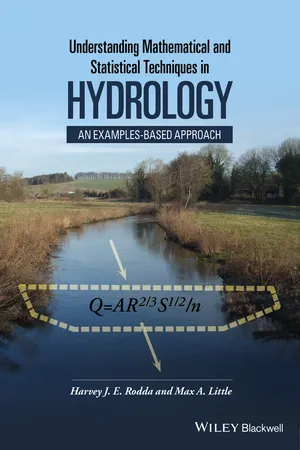
eBook - ePub
Understanding Mathematical and Statistical Techniques in Hydrology
An Examples-based Approach
- English
- ePUB (mobile friendly)
- Available on iOS & Android
eBook - ePub
Understanding Mathematical and Statistical Techniques in Hydrology
An Examples-based Approach
About this book
Information
CHAPTER 1
Fundamentals
1.1 Motivation for this book
Hydrology is the study of water, and in the International Glossary of Hydrology (UNESCO/WMO 1992) it is defined as ‘Science that deals with the waters above and below the land surfaces of the Earth, their occurrence, circulation and distribution, both in space and time, their biological, chemical and physical properties, their reaction with their environment, including their relation to living beings’. The movement and transformation of water within these processes as described in the definition, as a fluid, will obey the physical rules of fluid mechanics. Fluid mechanics, being a quantitative topic, requires heavy use of mathematical concepts, and these concepts are therefore naturally found in hydrology. These quite basic physical principles can be used effectively to model and hence predict and understand the behaviour of water under many useful circumstances.
Nonetheless, despite the essentially predictable behaviour of water that justifies the use of mathematical principles, often, the flow of water in practice is subject to forces that are beyond our ability to measure with any precision: for example, water in the atmosphere is heated, cooled, mixed with numerous gasses, and transported across large distances under the action of turbulent winds. Eventually, water condenses out of the atmosphere in the form of precipitation but exactly when, where, and how much water falls to the ground under gravity is often extremely uncertain. This uncertainty usually makes it useless to apply the basic physical principles of fluid mechanics to the flow of water in these circumstances. For this reason, hydrologists often turn to statistics, which can be considered as the application of mathematics to uncertain phenomena.
Quantitative hydrology is, therefore, based on an interesting mix of the two great branches of applied mathematics: physical laws (mathematical physics) and probability (mathematical statistics).
Mathematics is, perhaps, the archetypal example of a composite subject. This means that more complex concepts are built from many simpler ones, and so, in order to properly understand the more complex topic, it is necessary to understand the simpler ones from which it is constructed. Not all subjects are like this: it is possible to gain a deep understanding of many aspects of plant biology without having to know anything about mammals, for instance. But mathematics is unforgiving: one cannot understand the true meaning of equations of fluid transport without knowing calculus. Unfortunately, for many reasons, the chance to learn the basic mathematical concepts is not afforded to every student or practitioner of hydrology, and many find themselves at a loss when presented with more complex mathematical concepts as a result.
This book is therefore, intended as a guide to students and practitioners of hydrology without a formal or substantive background in either mathematical physics, or mathematical statistics, who need to gain a more thorough grounding of these mathematical tech...
Table of contents
- Cover
- Title Page
- Table of Contents
- Preface
- How to use this book
- CHAPTER 1: Fundamentals
- CHAPTER 2: Statistical modelling
- CHAPTER 3: Mathematics of hydrological processes
- CHAPTER 4: Techniques based on data fitting
- CHAPTER 5: Time series data
- CHAPTER 6: Measures of model performance, uncertainty and stochastic modelling
- Glossary
- Index
- End User License Agreement
Trusted by 375,005 students
Access to over 1.5 million titles for a fair monthly price.
Study more efficiently using our study tools.
Frequently asked questions
Yes, you can cancel anytime from the Subscription tab in your account settings on the Perlego website. Your subscription will stay active until the end of your current billing period. Learn how to cancel your subscription
No, books cannot be downloaded as external files, such as PDFs, for use outside of Perlego. However, you can download books within the Perlego app for offline reading on mobile or tablet. Learn how to download books offline
Perlego offers two plans: Essential and Complete
- Essential is ideal for learners and professionals who enjoy exploring a wide range of subjects. Access the Essential Library with 800,000+ trusted titles and best-sellers across business, personal growth, and the humanities. Includes unlimited reading time and Standard Read Aloud voice.
- Complete: Perfect for advanced learners and researchers needing full, unrestricted access. Unlock 1.5M+ books across hundreds of subjects, including academic and specialized titles. The Complete Plan also includes advanced features like Premium Read Aloud and Research Assistant.
We are an online textbook subscription service, where you can get access to an entire online library for less than the price of a single book per month. With over 1.5 million books across 990+ topics, we’ve got you covered! Learn about our mission
Look out for the read-aloud symbol on your next book to see if you can listen to it. The read-aloud tool reads text aloud for you, highlighting the text as it is being read. You can pause it, speed it up and slow it down. Learn more about Read Aloud
Yes! You can use the Perlego app on both iOS and Android devices to read anytime, anywhere — even offline. Perfect for commutes or when you’re on the go.
Please note we cannot support devices running on iOS 13 and Android 7 or earlier. Learn more about using the app
Please note we cannot support devices running on iOS 13 and Android 7 or earlier. Learn more about using the app
Yes, you can access Understanding Mathematical and Statistical Techniques in Hydrology by Harvey J. E. Rodda,Max A. Little in PDF and/or ePUB format, as well as other popular books in Technology & Engineering & Environmental Management. We have over 1.5 million books available in our catalogue for you to explore.