The AST Handbook of Transplant Infections
eBook - ePub

The AST Handbook of Transplant Infections

  1. English
  2. ePUB (mobile friendly)
  3. Available on iOS & Android
eBook - ePub

The AST Handbook of Transplant Infections

About this book

Whether you need to manage a post-transplant infection or reduce the possibility of infection, you will find effective guidance in this handbook. The work of the American Society of Transplantation Infectious Diseases Community of Practice, this reference exclusively uses tables and flowcharts to speed up decision making.

This distinguished group of investigators and teachers provide point of care information on optimum management of infection in adult and pediatric organ and stem cell transplant patients.  The unique tables and flowcharts are devised by the authors, backed up with extensive references, making the book a fully researched yet easy to use guide.  

The fast growing specialty of transplantation will be well served by this book as increasing numbers of successful procedures mean transplant teams have to be ever more alert to the possibility of and need for action in the event of ensuing infection.

Frequently asked questions

Yes, you can cancel anytime from the Subscription tab in your account settings on the Perlego website. Your subscription will stay active until the end of your current billing period. Learn how to cancel your subscription.
No, books cannot be downloaded as external files, such as PDFs, for use outside of Perlego. However, you can download books within the Perlego app for offline reading on mobile or tablet. Learn more here.
Perlego offers two plans: Essential and Complete
  • Essential is ideal for learners and professionals who enjoy exploring a wide range of subjects. Access the Essential Library with 800,000+ trusted titles and best-sellers across business, personal growth, and the humanities. Includes unlimited reading time and Standard Read Aloud voice.
  • Complete: Perfect for advanced learners and researchers needing full, unrestricted access. Unlock 1.4M+ books across hundreds of subjects, including academic and specialized titles. The Complete Plan also includes advanced features like Premium Read Aloud and Research Assistant.
Both plans are available with monthly, semester, or annual billing cycles.
We are an online textbook subscription service, where you can get access to an entire online library for less than the price of a single book per month. With over 1 million books across 1000+ topics, we’ve got you covered! Learn more here.
Look out for the read-aloud symbol on your next book to see if you can listen to it. The read-aloud tool reads text aloud for you, highlighting the text as it is being read. You can pause it, speed it up and slow it down. Learn more here.
Yes! You can use the Perlego app on both iOS or Android devices to read anytime, anywhere — even offline. Perfect for commutes or when you’re on the go.
Please note we cannot support devices running on iOS 13 and Android 7 or earlier. Learn more about using the app.
Yes, you can access The AST Handbook of Transplant Infections by Deepali Kumar,Atul Humar in PDF and/or ePUB format, as well as other popular books in Medicine & Surgery & Surgical Medicine. We have over one million books available in our catalogue for you to explore.

Information

PART I
General Issues and Infectious Syndromes
Chapter 1
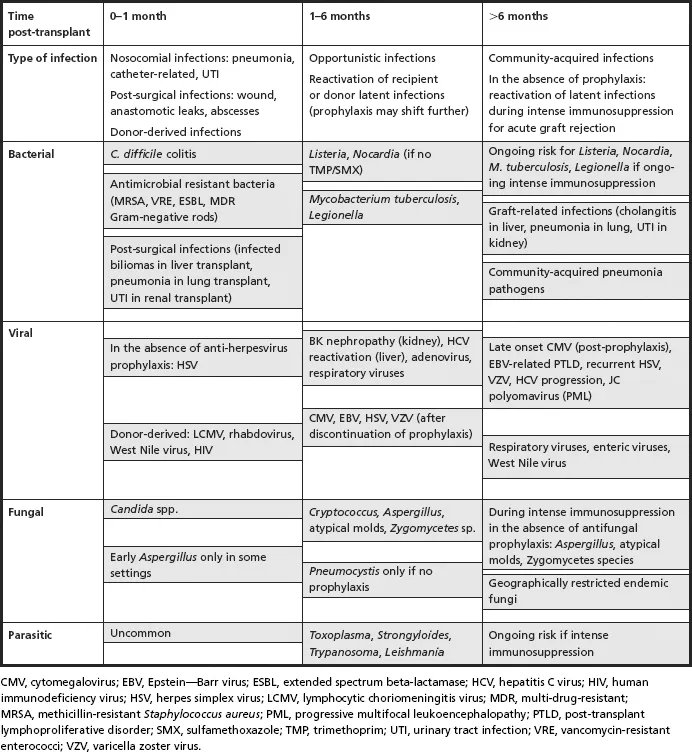
Timeline of Infections After Organ Transplant
Christian van Delden
image
Chapter 2
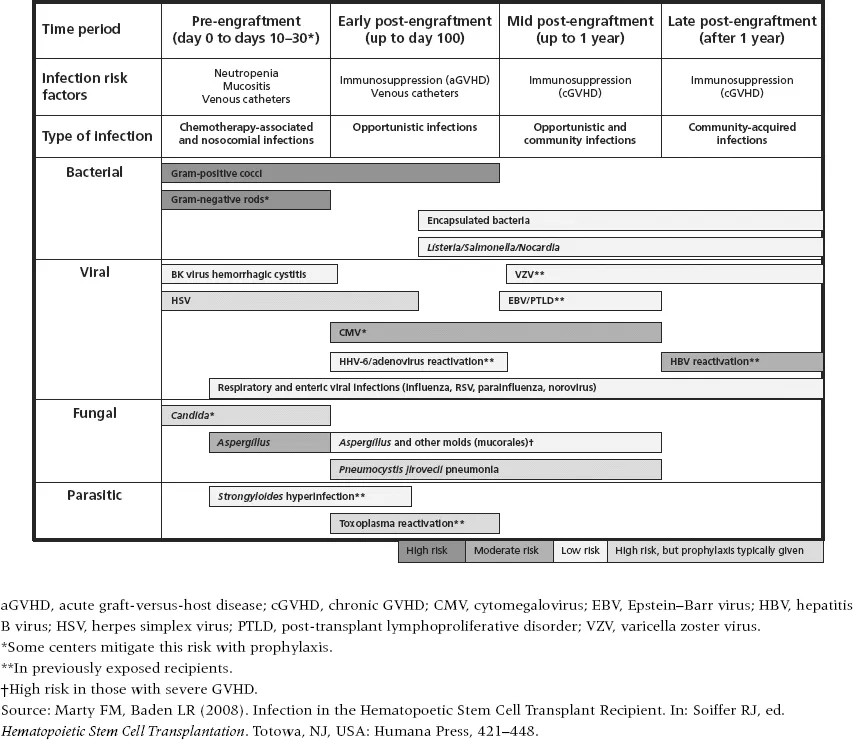
Timeline of Infections After Hematopoietic Stem Cell Transplant
Sarah P. Hammond & Francisco M. Marty
image
Chapter 3
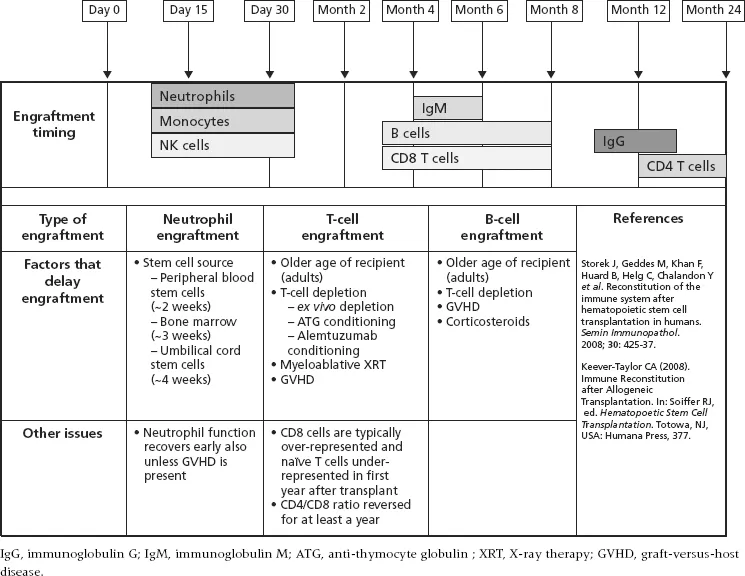
Immune Reconstitution After Myeloablative Stem Cell Transplant
Sarah P. Hammond & Francisco M. Marty
image
Chapter 4
Pre-transplant Infectious Disease Evaluation of the Organ Transplant Candidate
Staci A. Fischer
Routine screening Optional testing (if clinically indicated only) Organ-specific considerations
  • CMV antibody
  • EBV antibody
  • HIV antibody
  • Hepatitis C antibody
  • Hepatitis B surface antigen and antibody; hepatitis B core antibody
  • Rapid plasma reagin
  • PPD or interferon-release assay for latent tuberculosis
  • Toxoplasma antibody (in heart transplant candidates)
  • Recipients should be screened for protective antibody to vaccine-preventable viral infections, particularly varicella, measles and mumps. Those without IgG antibody should be vaccinated pre-transplant if not already on immunosuppressive therapy
  • A thorough history should be completed to identify potential exposures to infections with a latent or chronic phase which could reactivate on immunosuppressive therapy. Such infections include Mycobacterium tuberculosis, endemic fungi such as Coccidioides, and Strongyloides (see ‘Optional testing’ column)
  • Should an infection be identified in the screening of the potential organ transplant recipient, consultation with an infectious disease specialist may be indicated to guide pre-transplant treatment, timing of transplantation when delay is possible, and/or post-transplant monitoring
  • HSV antibody
  • HTLV-I/II antibody
  • Toxoplasma antibody (in non-heart transplant candidates)
  • Trypanosoma cruzi antibody in recipients from endemic areas (e.g. Mexico, Central America, South America)
  • Coccidioides antibody in recipients from endemic areas (e.g. south-western USA, Mexico, Central America, South America)
  • Histoplasma antibody in recipients from endemic areas (e.g. Ohio and Mississippi river valleys in the USA, other river valleys in North and Central America, Eastern and Southern Europe, Africa and Australia)
  • Strongyloides antibody in recipients from endemic areas (e.g. Appalachian USA, Central America, South America, sub-Saharan Africa, South-east Asia, Eastern Europe)
  • Brucella serology in recipients from endemic areas (e.g. Middle East, Mediterranean basin, eastern Europe, Asia, Africa, Central and South America). Ingestion of unpasteurized milk or chesses from endemic areas is a risk factor for infection
  • West Nile Virus serology
  • Human herpes virus-8 (HHV-8) serology
  • BK virus serology (kidney transplantation)
Patients with end-stage organ disease are susceptible to certain infections which should be diagnosed and treated prior to transplantation if at all possible. Specific considerations include the following:
  • Kidney – hemodialysis catheter-related bloodstream infections, peritonitis in peritoneal dialysis patients, hepatitis B, hepatitis C, complicated UTIs
  • Pancreas – wounds and osteomyelitis related to diabetic neuropathy
  • Heart – infection of ventricular assist devices (localized drive line infections or bloodstream infections mimicking endocarditis) should be aggressively treated but do not preclude transplantation. Chagas disease (trypanosomiasis) should be ruled out in the patient from an endemic area with dilated cardiomyopathy. Toxoplasmosis is a particular concern in cardiac transplantation, in which donor transmission can occur in the seronegative recipient of a seropositive heart, resulting in acute myocarditis or disseminated infection
  • Liver – hepatitis B, hepatitis C, cholangitis, spontaneous bacterial peritonitis, intravenous catheter-related infections, including candidemia
  • Lung – sputum cultures to determine colonizing bacteria, mycobacteria and fungi should guide perioperative antimicrobial choices
CMV, cytomegalovirus; EBV, Epstein–Barr virus; HSV, herpes simplex virus; HTLV, human T-cell lymphotrophic virus; IgG, immunoglobulin G; PPD, purified protein derivative; UTI, urinary tract infection.
References: [1] Am J Transplantation 2009; 9(s4): S7 (updated guidelines on screening donors and recipients); [2] Clin Infect Dis 2002; 35: 1513 (detailed discussion of screening of recipients prior to transplantation); [3] Clin Infect Dis 1997; 24: 18; [4] www.cdc.gov/travel/yellowbook/2010 (updated information on travel-related infections with details on areas of endemicity for the pathogens noted above).
Chapter 5
Pre-transplant Infectious Disease Evaluation of the Hematopoietic Stem Cell Transplant Candidate
Staci A. Fischer
Routine screening of all recipients Optional testing (if clinically indicated only) Comments
  • CMV
  • EBV antibody
  • HIV antibody, NAT
  • Hepatitis C antibody, NAT
  • Hepatitis B surface antigen and antibody; hepatitis B core antibody
  • HSV-1 and 2 antibody
  • Rapid plasma reagin
  • Varicella zoster virus IgG
  • PPD testing (the role of interferon-release assays for detection of latent tuberculosis in the potential HSCT recipient is currently unclear)
  • Hepatitis B NAT
  • HTLV-I/II antibodies
  • West Nile virus NAT
  • Toxoplasma IgG antibody
  • Trypanosoma cruzi antibody in donors from endemic areas (e.g. Mexico, Central America, South America)
  • Strongyloides antibody in recipients from endemic areas (e.g., Appalachian USA, Central America, South America, sub-Saharan Africa, South-east Asia, eastern Europe)
  • Coccidioides antibody in recipients from endemic areas (e.g. south-western USA, Mexico, Central America, South America)
  • Histoplasma antibody in recipients from endemic areas (e.g. Ohio and Mississippi river valleys in the USA, other river valleys in North and Central America, eastern and southern Europe, Africa and Australia)
  • Brucella serology in recipients from endemic areas (e.g. Middle East, Mediterrane...

Table of contents

  1. Cover
  2. Contents
  3. Title
  4. Copyright
  5. List of Contributors
  6. Preface
  7. Acknowledgements
  8. Part I: General Issues and Infectious Syndromes
  9. Part II: Specific Pathogens
  10. Part III: Donor Issues
  11. Part IV: Prevention of Infections after Transplantation
  12. Part V: Post-transplant Medications and Drug Interactions
  13. Index