![]()
Chapter 1
Introduction
1.1 Environment
The term environment, which etymologically means surroundings, is considered a composite term for the conditions in which organisms live. Thus, it encompasses air, water, food and sunlight, which are the basic needs of all living beings and plant life necessary to carry on their life functions. Environment can also be defined as “a holistic view of the world as it functions at any time with a multitude of special elemental and socioeconomic systems distinguished by quality and attributes of space and mode of behaviour of biotic and abiotic forms,” or as “the sum of all social, economical, biological, physical or chemical factors which constitute the surroundings of man, who is both creator and modulator of his environment”. The environment consists of the atmosphere, the hydrosphere, and the lithosphere in which the life sustaining resources of the earth are contained. The atmosphere is a mixture of gases extending outwards from the surface of earth that evolved from elements of the earth that were gasified during its formation and metamorphosis. It extends to a height of about 1600 km from the earth’s surface. The hydrosphere consists of the oceans, the lakes and streams, and the shallow ground water bodies. The lithosphere is the soil mantle that wraps the core of the earth. The lithosphere mainly contains three layers of crust, the mantle and outer and inner core. The biosphere, a shell that surrounds the earth, is made up of the atmosphere and lithosphere adjacent to the surface of the earth together with the hydrosphere. It is within the biosphere that the life forms of earth, including humans, live. Life sustaining materials in gaseous, liquid, and solid forms are cycled through the biosphere, providing sustenance to all living organisms.
1.2 World Water Distribution
Water is one of the most abundant compounds found in nature, covering approximately three fourths of the surface of the earth. However, despite the apparent abundance, several factors serve to limit the amount of water available for human use.
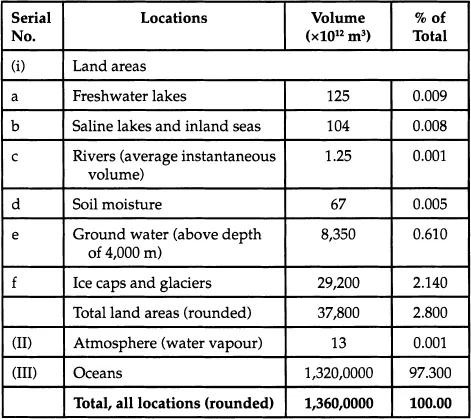
As shown in Table 1.1 [1] over 97% of the total water supply is contained in the oceans and other saline bodies of water, and is not readily available for most purposes. Out of the remaining 35%, a little over 2% is tied up in ice caps and glaciers and, along with atmospheric and soil moisture, is inaccessible. Thus, for their general livelihood and the support of their varied technical and agricultural activities, humans must depend upon the approximately 1.0% of remaining water found in fresh water lakes, rivers, and ground water supplies. Water is essential to life. Without it, the biosphere that exists on the surface of the earth would not be possible.
Table 1.1 World water distribution.
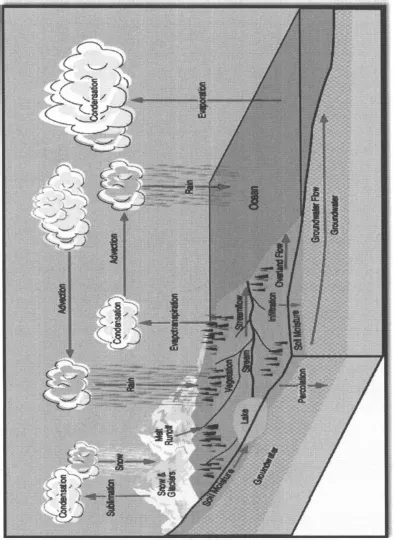
Water is in a constant state of motion (Figure 1). The hydro-logic cycle is a conceptual model that describes the storage and movement of water between the biosphere, atmosphere, lithosphere, and hydrosphere. Water on this planet can be stored in any one of the following reservoirs: atmosphere, oceans, lakes, rivers, soils, glaciers, snowfields, and groundwater. Water moves from one reservoir to another by way of processes such as evaporation, condensation, precipitation, deposition, runoff, infiltration, sublimation, transpiration, melting, and groundwater flow. The oceans supply most of the evaporated water found in the atmosphere.
Of this evaporated water, only 91% is returned to the ocean basins by way of precipitation. The remaining 9% is transported to areas over landmasses where climatological factors induce the formation of precipitation. The resulting imbalance between rates of evaporation and precipitation over land and ocean is corrected by runoff and groundwater flow to the oceans. Water as it is found in nature is almost pure in its evaporated state, contaminants are added as the liquid water travels through the remainder of the hydrological cycle and comes in contact with materials in the air and on or beneath the surface of the earth. Ultimately the contaminated water will complete the hydrological cycle and will be returned back to the atmosphere again as a relatively pure water molecule. However, it is the water quality in the intermediate stage which is of greatest concern because the quality at this stage will affect human use of the water.
1.3 Environmental Pollution
From the beginning of civilization, man has always been interfering with the environment. As a consequence of the industrial revolution over the last few decades, man has had an immense impact on the environment. This impact has resulted in the deterioration of water, air, and land quality. It has also had an adverse effect on living beings due to the disturbance of the ecological balance between the living and nonliving components of earth. Due to the introduction of undesirable components into the environment, undesirable changes take place in the physical, chemical, and biological characteristics of air, water, and land, causing harmful effects on living beings.
“Environmental pollution is any discharge of material or energy into water, land, or air that causes or may cause acute or chronic detriment to the Earth’s ecological balance or that lowers the quality of life.” Pollutants may cause primary damage, with a direct identifiable impact on the environment, or secondary damage in the form of minor perturbations in the delicate balance of the biological food web that are detectable only over long time periods.
Environmental pollution is the build-up and concentration of toxic levels of chemicals in the air, water, and land, which reduces the ability of the affected area to support life. Pollutants may be gaseous, e.g., ozone and carbon monoxide; liquids discharged from industrial plants and sewage systems; or solid waste landfills and junkyards.
Environmental pollution can be categorized as follows:
i. Air pollution
ii. Soil or land pollution
iii. Noise pollution
iv. Water pollution
1.3.1 Air Pollution
Once substances which have been emitted exist throughout the atmosphere, over and above the physical diffusion and deposition functions, chemical elimination functions and biological purification functions, and they are dispersed with their volume exceeding natural conditions. they have a direct influence on living beings. This is called air pollution, also defined as, “the accumulation in the atmosphere of substances that, in sufficient concentrations, endanger human health or produce other measured effects on living matter and other materials”.
Air pollutants can be divided in two categories, namely: primary pollutants such as carbon monoxide, hydrocarbons, nitrogen oxides, and sulfur dioxides, which are emitted directly from the sources; and secondary pollutants like photochemical oxidants, aerosols, and hydrogen chloride gas, which are created by chemical changes which occur in the atmospheric environment. Air pollution may be caused by natural sources such as volcanic eruptions, forest fires, soil debris, marsh gas, natural and inorganic decay, and cosmic dust. It may also be caused by anthropogenic sources such as deforestation, emissions from vehicles, combustion, manufacturing processes, agricultural activities, nuclear energy activities, and rapid industrialization.
1.3.2 Soil or Land Pollution
Soil/land pollution refers to the addition of solid and liquid wastes to soil, creating an imbalance in its natural composition and functions. Rapid urbanization due to an increase in population and building construction has resulted in the reduction of land. Deposition of different wastes onto land results in the deterioration of soil quality. The soil becomes polluted by hazardous chemicals resulting in microorganisms entering the food chain, air, and water to consequently be ingested by man. The main sources of this pollution are agricultural activities, industrial effluents, radioactive pollutants, solid wastes, urban activities, etc.
1.3.3 Noise Pollution
Noise pollution is a composite of sounds generated by human activities ranging from blasting stereo systems to the roar of supersonic transport jets. Although the frequency of noise may be of major importance, most noise sources are measured in terms of intensity, or strength of the sound field. The standard unit, one decibel (dB), is the amount of sound that is just audible to the average human. Noise may be generally associated with an industrial society, where heavy machinery, motor vehicles, and aircrafts have become everyday items. The most readily measurable physiological effect of noise pollution is damage to hearing, which may be temporary or permanent, and may cause the disruption of normal activities or just be a general annoyance. The effect is variable, depending upon individual susceptibility, duration of exposure, nature of noise (loudness), and time distribution of exposure such as steady or intermittent.
1.3.4 Water Pollution
The ‘once-through’ use of fresh water in many communities has approached or exceeded the limit of existing water supplies. With the growth of population and industries, it has become increasingly difficult to develop new sources of municipal and industrial water supplies. Water has been the most exploited natural system since the beginning of human civilization. Several industries have been set up in recent decades. This rapid technological development causes the deterioration of the water quality.
“Water pollution can be defined as any adverse change in conditions or composition of water so that it becomes less suitable or unsuitable for the purpose for which it would be suitable in its natural state”.
Water is the basis of all life and is an absolute necessity for all activities, namely domestic, industrial, and agricultural. Water pollution may be caused by natural processes like decomposed vegetables, animal and weathered products, or may be caused by anthropogenic processes such as agriculture, industry, radioactivity and mining sources. Some of the major sources of water pollution are industrial effluents, agricultural wastes, atmospheric gases, radioactive materials, thermal pollutants, heavy metals, and sewage and domestic waste [2, 3]. Natural waters are contaminated with several heavy metals arising from mining wastes and industrial discharges [4].
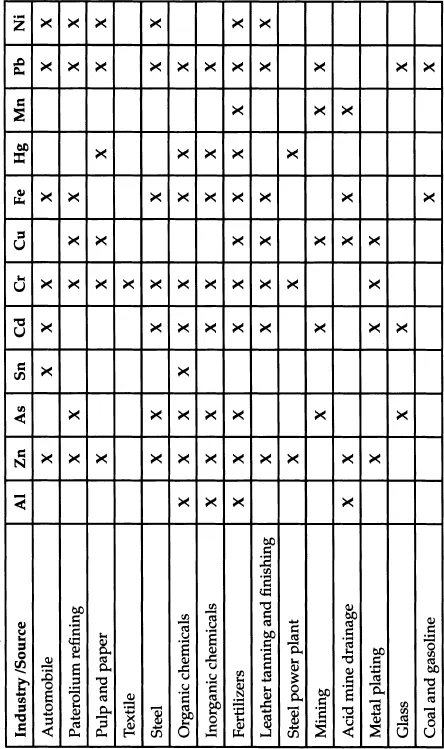
The tremendous increase in the use of heavy metals over the past few decades has eventually resulted in an increased flux of metallic substances in the environment. Heavy metals are the metals with specific gravities of ≥ 5.0 gm cm−3. Sometimes in their pure form these heavy metals are not very toxic, but when they come in contact with other components they reportedly act as very toxic pollutants. Large number of metals are commonly used in different industrial and agricultural activities. Some of them are Cr, Pb, Hg, As, Cd, Sb, Ni, Zn, Cu, and Co [5]. Chromium and nickel are widely used metals and have wide spread applications in different industries. Industrial processes that produce aqueous effluents enriched with heavy metals are shown in Table 1.2 [6, 7]. Table 1.2 also describes various metallic species and their application in industries.
Table 1.2 Heavy metals in some major industries.
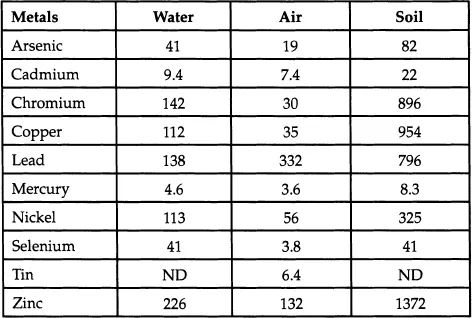
It is interesting to note that most of the metals have a variety of applications. Toxic heavy metals in air, soil, and water pose a serious threat to the environment. Global discharges of some commonly used toxic metals in water, air, and soil are given in Table 1.3 [8].
Table 1.3 Global discharges of trace metals (1000 metric tonnes/year).
It is clear from Table 1.3 that invariably the metal content is highest in soil. Like other pollutants, metallic elements are also classified as essential and non-essential metals. Essential metals are an integral part of the diet, but non-essential metals also enter the environment and pose health problems. Due to widespread application of heavy metal in different industrial activities, higher concentrations of metallic pollutants are continuously being discharged in water bodies. The United States Environmental...