This first textbook on both micro- and nanooptics introduces readers to the technological development, physical background and key areas. The opening chapters on the physics of light are complemented by chapters on refractive and diffractive optical elements. The internationally renowned authors present different methods of lithographic and nonlithographic fabrication of microoptics and introduce the characterization and testing of microoptics. The second part of the book is dedicated to optical microsystems and MEMS, optical waveguide structures and optical nanostructures, including photonic crystals and metamaterials. Each chapter includes exercises illustrating a sample approach to new and complex topics, making the textbook suitable for lectures on optics as part of a physics or electrical engineering course.
We begin with a brief sampler of some mathematical topics that are useful for reading the later chapters. The description does not aim at being rigorous nor comprehensive. Rather, the purpose is to allow the reader to quickly update his and her knowledge and also it serves the purpose of establishing the notation used in this book.
1.1 Complex Numbers
For the mathematical description of oscillations and waves, the use of complex exponential functions is very practical. For example, a plane wave traveling in x-direction can be represented mathematically by
(1.1)
This is the notation we will use in this book. Here, i denotes the imaginary unit defined by i2 = −1. In engineering, quite often, the letter j is often used instead of i to avoid confusion with the symbol for the electric current. It is also common to write
. This has no physical consequence, of course. However, it does make a difference in the mathematical formalism, when the first derivative (or, more general, uneven-order derivatives) occur, as it is the case, for example, in the paraxial wave equation.
A complex number z has a real part, denoted as
(z), and an imaginary part,
(z),
(1.2)
Here, a =
(z) and b =
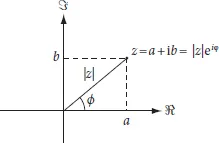
(z) are real-valued numbers. Using them like Cartesian coordinates, z is represented graphically by its position in the complex plane (Figure 1.1).
Figure 1.1 Graphical representation of a complex number in the complex plane.
For the description of a wave that is a harmonic oscillation in space and time, the use of complex exponential functions using polar coordinates is convenient as in (1.1). The exponential form of a complex number is introduced by Euler’s equation
(1.3)
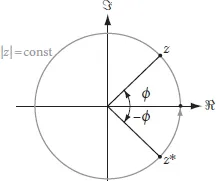
Here, |z| is the modulus of z with |z|2 = a2 + b2. ϕ is called the argument or the phase of z (Figure 1.2). It is ϕ = arg(z) = arctan(b/a). In turn, one obtains the Cartesian coordinates from the polar coordinates by a = |z| cos ϕ and b = |z| sin ϕ. By varying ϕ, z moves on a circle in the complex plane with a periodicity of 2π. Hence, there is an ambiguity in the polar representation: for a specific point in the complex plane described by the pair of coordinates (a,b), all polar coordinates of the form (r,ϕ + m2π) with m = 0, ±1, ±2, … also represent the same point. This 2π-phase ambiguity is an important aspect of all wave phenomena.
Figure 1.2 Graphical representation of a complex number z using polar coordinates. z* is the conjugate of z.
Finally, we introduce the conjugate of a complex number. Two numbers z1 and z2 are conjugate to each other if their real parts are the same and their imaginary parts differ by a minus sign. The complex conjugate number is denoted either by a bar,
, or by a star, z*. Here, we use the latter notation. Thus, we can wri...
Table of contents
Cover
Half Title page
Title page
Copyright page
How to Study This Textbook
Preface
List of Symbols
Acknowledgment
Chapter 1: Preliminaries
Chapter 2: Light Propagation
Chapter 3: Light as Carrier of Information and Energy
Chapter 4: Light Propagation in Free Space
Chapter 5: Refractive and Reflective Microoptics
Chapter 6: Diffractive Microoptics
Chapter 7: Micro- and Nanofabrication
Chapter 8: Tunable Microoptics
Chapter 9: Compound and Integrated Free-Space Optics
Chapter 10: Light Propagation in Waveguides
Chapter 11: Integrated Waveguide Optics
Chapter 12: Plasmonics
Chapter 13: Photonic Crystals
Chapter 14: Left-Handed Materials
Index
Trusted by 375,005 students
Access to over 1.5 million titles for a fair monthly price.
Study more efficiently using our study tools.
Frequently asked questions
Yes, you can cancel anytime from the Subscription tab in your account settings on the Perlego website. Your subscription will stay active until the end of your current billing period. Learn how to cancel your subscription
No, books cannot be downloaded as external files, such as PDFs, for use outside of Perlego. However, you can download books within the Perlego app for offline reading on mobile or tablet. Learn how to download books offline
Perlego offers two plans: Essential and Complete
Essential is ideal for learners and professionals who enjoy exploring a wide range of subjects. Access the Essential Library with 800,000+ trusted titles and best-sellers across business, personal growth, and the humanities. Includes unlimited reading time and Standard Read Aloud voice.
Complete: Perfect for advanced learners and researchers needing full, unrestricted access. Unlock 1.5M+ books across hundreds of subjects, including academic and specialized titles. The Complete Plan also includes advanced features like Premium Read Aloud and Research Assistant.
Both plans are available with monthly, semester, or annual billing cycles.
We are an online textbook subscription service, where you can get access to an entire online library for less than the price of a single book per month. With over 1.5 million books across 990+ topics, we’ve got you covered! Learn about our mission
Look out for the read-aloud symbol on your next book to see if you can listen to it. The read-aloud tool reads text aloud for you, highlighting the text as it is being read. You can pause it, speed it up and slow it down. Learn more about Read Aloud
Yes! You can use the Perlego app on both iOS and Android devices to read anytime, anywhere — even offline. Perfect for commutes or when you’re on the go. Please note we cannot support devices running on iOS 13 and Android 7 or earlier. Learn more about using the app
Yes, you can access Introduction to Micro- and Nanooptics by Jürgen Jahns,Stefan Helfert in PDF and/or ePUB format, as well as other popular books in Technology & Engineering & Electrical Engineering & Telecommunications. We have over 1.5 million books available in our catalogue for you to explore.