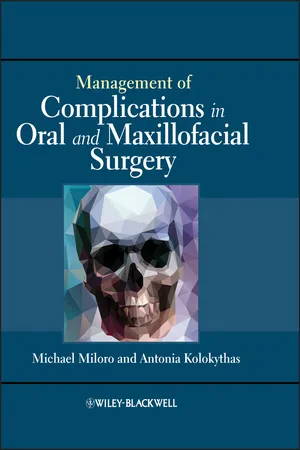
Drs. Miloro and Kolokythas address possible complications in every aspect of OMS, including anesthesia, third molar surgery, implant surgery, maxillofacial trauma, orthognathic surgery, temporomandibular joint surgery, cleft lip and palate surgery, head and neck oncologic surgery, soft and hard tissue reconstruction, free tissue transfer, and cosmetic facial surgery. The contributors to this textbook, recognized experts in their specific topic due to their surgical experience and expertise, focus on the prompt recognition of each complication, and consider preventative measures as well as precise management strategies considering the already compromised clinical circumstances.
eBook - ePub
Management of Complications in Oral and Maxillofacial Surgery
- English
- ePUB (mobile friendly)
- Available on iOS & Android
eBook - ePub
Management of Complications in Oral and Maxillofacial Surgery
About this book
Management of Complications in Oral and Maxillofacial Surgery is a comprehensive reference that covers the minor and major complications which may occur in all facets of oral maxillofacial surgery. Each chapter covers the potential complications encountered during the routine practice of oral and maxillofacial surgery, from the most commonly encountered complications, to those less frequent and more complex with which every competent oral and maxillofacial surgeon should be familiar.
Information
1
Ambulatory Anesthesia
INTRODUCTION
Ambulatory anesthesia is one of the more common adjunctive procedures performed by an oral maxillofacial surgeon (OMS) in private or academic practice. Anesthetic states ranging from mild sedation to general anesthesia are achieved, mainly through the use of intravenous agents but occasionally with inhalational agents as well. When indicated, the provision of anesthesia can greatly facilitate many dentoalveolar and other outpatient surgical procedures, and often enhances patient comfort and satisfaction as well as surgeon efficiency. Ambulatory anesthesia is frequently recommended to patients as an adjunct for particular procedures such as third molar removal, and many patients request anesthesia regardless of the planned surgical procedure. In the special case of pediatric patients, where patient cooperation can be unreliable and anxiety is frequently at a high level, the utility of ambulatory anesthesia can be even greater. In both children and adults, ambulatory anesthesia allows for more procedures to be performed in an outpatient setting that would otherwise require a trip to the operating room.
Given the many benefits of outpatient anesthesia, it is not surprising that a great number of anesthetics are performed each year by OMSs in outpatient settings. Adjunctive anesthesia is provided to thousands of patients per year, and the number of complications reported during the provision of ambulatory anesthesia remains quite low—less than 1% of anesthetic cases.1 Of these reported complications, serious adverse events make up an even smaller number. Much conscientious effort has gone toward ensuring the safety of ambulatory anesthesia, particularly in the areas of surgeon training, prevention, patient monitoring, and emergency protocols. While OMSs can exhibit confidence in the use and safety of ambulatory anesthesia, we must also maintain a high level of vigilance in order to prevent anesthetic complications and appropriately manage them in the cases when they arise.
Many OMSs who provide anesthesia in an outpatient setting also perform surgery in a hospital operating room (OR), and there is frequently overlap in the types of surgical procedures that are performed in either setting. However, there are some notable differences in the anesthetic as it is conducted in the OR versus an outpatient facility. In the OR, the anesthesia is nearly always provided by someone other than the surgeon—an anesthesiologist or certified registered nurse anesthetist (CRNA). This allows the surgeon to focus single-mindedly on the surgery at hand. In contrast, in outpatient anesthesia, the OMS typically acts as surgeon-operator, or the “operator-anesthetist” model, providing both the anesthesia and performing the surgery simultaneously. Support for this dual role of the OMS can be gleaned from data demonstrating a very low incidence of anesthetic-related complications in outpatient settings where surgeon-operators administered the anesthesia.1 The administration of outpatient anesthesia requires extra attention from the surgeon who must monitor both the anesthesia and the surgical procedure simultaneously. Maintaining this balance of attention can be challenging and may require a different set of skills than those utilized in the OR.
Other important differences between anesthesia administered in the OR and ambulatory anesthesia can contribute to the relative safety of outpatient anesthesia. Two important factors are the greater risk and complexity of surgical procedures performed in an OR setting, and the greater distribution of lower-risk patients (ASA I and II) in outpatient settings versus higher-risk patients (ASA III and above) who may be treated more frequently in the OR setting. These factors emphasize that careful patient and procedure selection contribute to the prevention of complications in outpatient anesthesia.
Lastly, emergency equipment and equipment available for patient monitoring is often more extensive in the OR than outpatient setting, though this difference is decreasing in large part due to the decreasing cost of equipment and technology. Certain invasive modes of patient monitoring, such as arterial or central venous lines, remain confined to the operating room; however, many of the same modalities of monitoring cardiac and respiratory function exist for both OR and outpatient use. In addition, the emergency equipment of the OR has been feasibly reproduced for efficient use in an outpatient setting. The OR, by virtue of being located within the hospital, will retain an advantage in terms of emergency preparedness, access to trained staff, blood and tissue products, and specialist consultation. However, anesthesia in the OR setting can have increased risk due to increased complexity of surgical procedures and/or higher-risk patient populations. These differences are important for the OMS who treats patients in both settings because they have important implications for the prevention and management of anesthetic complications.
PREVENTION OF COMPLICATIONS IN AMBULATORY ANESTHESIA
Patient Characteristics/Selection
The best and most effective management of anesthetic complications is to prevent their occurrence. There is well-documented evidence that certain perioperative patient characteristics contribute significantly to anesthetic and surgical risk. Some of these characteristics, such as patient age, are easy to quantify and have fairly predictable patterns of anesthetic risk. Other patient characteristics such as underlying medical conditions, medications, previous surgical history, allergies, cardiac and respiratory reserve, and body mass index can be more difficult to assign risk. A detailed history and physical examination with appropriate preoperative laboratory workup and communication with the primary care physician are paramount in identification of those patients who may safely undergo anesthesia in an outpatient setting.
Several algorithms and systems of classifying anesthetic risk based on patient characteristics are in common use, with the ASA (American Society of Anesthesiology) criteria being among the most widespread (see Table 1.1). The utility of the ASA classification has been shown in scientific literature that demonstrates a clear association between ASA status (I–V) and the risk of anesthetic complications.2 The ASA classification is widely recognized and simple to use, and it is a valid starting point into which other patient risk determinants can be incorporated. The Duke Activity Index is another useful measure of a patient’s physical status. It presents a functional assessment of physical capacity based on an individual’s exercise tolerance and ability to perform various activities of daily living (see Table 1.2). The ability to engage in exercise or everyday physical activities is inversely correlated with risk of anesthetic complications and provides an additional parameter for patient screening.
Table 1.1. ASA Physical Status Classification
| ASA I | No systemic disease |
| ASA II | Mild to moderate systemic disease, well-controlled disease states; e.g., well-controlled NIDDM, asthma or epilepsy; pregnancy |
| ASA III | Severe systemic disease that limits activity but is not incapacitating; e.g., IDDM; history of CVA, MI, or CHF >6 months ago; mild COPD |
| ASA IV | Severe systemic disease that limits activity and is a constant threat to life; e.g., history of unstable angina, CVA or MI within the past 6 months; severe CHF, severe COPD; uncontrolled DM, HTN, or epilepsy |
| ASA V | Patients not expected to survive 24 hours |
| ASA VI | Organ donors |
NIDDM: non-insulin-dependent diabetes mellitus; IDDM: insulin-dependent diabetes mellitus; CVA: cerebrovascular accident; MI: myocardial infarction; CHF: congestive heart failure; COPD: chronic obstructive pulmonary disease; DM: diabetes mellitus; HTN: hypertension
Table 1.2. Duke Activity Scale Index
| Functional Class | Metabolic Equivalents | Specific Activity Scale |
| I | >7 | Patients can perform heavy housework such as moving furniture or scrubbing floors, and can participate in moderate recreational activities such as bowling, dancing, skiing, or doubles tennis. |
| II | >5 | Patients can do light housework such as dusting or washing dishes, can climb one flight of stairs, can walk on level ground at 4 mph. |
| III | >2 | Patients can dress themselves, shower, make the bed, walk indoors. |
| IV | <2 | Patients cannot perform activities of daily living without assistance; may be bedbound. |
An adjunctive measure of patient risk for ambulatory anesthesia includes specific classification of the airway. Mallampati’s classification is a simple visual classification system, divided into four categories, which attempts to assess the posterior oropharyngeal airway patency based on the visibility of structures of the posterior oropharynx (uvula, fauces, soft and hard palates). The distance between the hyoid bone and the chin can be estimated as an additional, albeit crude, indicator of airway patency and ease of intubation with shorter mental-hyoid distances indicating greater airway risk. In addition, specific characteristics of patient body habitus such as obesity or the presence of a short, thick neck can be general predictors of risk of airway collapse during anesthesia.
Obesity, defined as a body mass index greater than 30, is a recognized risk factor for complications related to anesthesia. Obesity is associated with a decreased respiratory functional residual capacity (FRC) and can lead to an increased incidence of respiratory complications, particularly airway collapse and desaturation. Obese patients have a fourfold increased risk of respiratory complications during ambulatory anesthesia procedures.3 In the pediatric population as well, obesity has been recognized as a growing problem. A study by Setzer et al. found an increased incidence of respiratory complications and unexpected overnight hospital admission in a group of obese pediatric patients undergoing ambulatory anesthesia for dental surgery procedures (compared to their nonobese counterparts).4 Patient positioning during surgery may play a role in preventing adverse respiratory complications in obese patients, as a recent study demonstrates an increase in time to desaturation in obese patients who were preoxygenated in an upright (90-degree sitting) position prior to induction of general anesthesia.5 Maintaining obese OMS patients in an upright position during anesthesia may help to prevent respiratory complications by maximizing FRC and minimizing the effects of gravity on posterior oropharyngeal airway collapse.
Age is also an important determinant of anesthetic and surgical risk. Age is easily quantified and there is evidence that increased risk of complications occur at the extremes of very young and very old age. There is greatly increased risk associated with anesthesia and surgery in the first one month and one year of life.6 In terms of increasing age and risk of complications, there remains a strong positive correlation though the association is more gradual and progressive. In the very young, much of the increased anesthetic risk can be attributed to the relative anatomical and physiological immaturity of infants and very young children. This makes the mechanics of anesthesia more difficult (airway management, fluid replacement, patient monitoring) while the decreased therapeutic index of anesthetic drugs in small children greatly increases their toxic potential. At the other end of the spectrum, advanced age leads to an increase in medical comorbidities and decreased physiological reserve from the normal aging process. This likewise decreases tolerance for physiologic insults and lowers the therapeutic index of many drugs and interventions.
Aside from patient characteristics, another factor that can help prevent complications in the postoperative period is to ensure that patients will have a responsible adult who can accompany them home and care for them after the anesthesia and surgical procedure.7
Procedure Characteristics/Selection
In addition to appropriately screening patients for in-office procedures, it is also important to bear in mind the surgical complexity and length of time needed for the planned procedure. Certain procedures, such as third molar removal, are nearly always performed in an outpatient setting. Other surgical procedures, such as minimally invasive temporomandibular joint procedures (TMJ arthroscopy) and extensive bone grafting or implant procedures, can be performed either in the OR or in an outpatient setting. This is largely dependent upon the preference of the surgeon and patient, the availability of appropriate instruments and equipment, as well as financial issues. The most important consideration in preventing complications is to ensure that the surgical procedure planned is not more complex or lengthy than can be accommodated in a particular outpatient setting. Patient risk factors and procedure risk factors should be balanced such that longer and more complex procedures are avoided in patients who already represent increased surgical risk. Complex or lengthy procedures may benefit from having an additional practitioner or trained person to assist with the anesthetic management of the patient. This will help to offset some of the increased attention required for the surgery itself. With proper planning, a majority of routine OMS surgical procedures can potentially be accomplished in an outpatient setting.
Patient Screening
The goal of patient selection for ambulatory anesthesia procedures is to determine a particular patient’s risk factors for anesthesia and to identify those patients who may safely undergo the procedure in an outpatient setting. The first step is to perform a comprehensive history and targeted physical exam. Information to be elicited includes prior anesthetic experiences, prior hospitalizations, emergency room visits, prior surgeries, allergies or adverse reactions to any medications, and any and all medications taken (including over-the-counter medications and vitamins or herbal supplements). Herbal medications are surprisingly common (taken by almost 25% of patients) and garlic, ginkgo biloba, and ginseng (the “three Gs”) may be particularly risky when taken perioperatively as they affect platelet function and may increase bleeding risk.8
A review of systems can ascertain whether a patient has any undiagnosed medical conditions that could impact the planned anesthetic procedure. In particular, questions designed to elicit underlying respiratory, neurologic, or cardiac disease are especially important. A history of snoring, allergic rhinitis, wheezing, shortness of breath (exertional or s...
Table of contents
- Cover
- Title page
- Copyright page
- Dedications
- Contributors
- Preface
- 1 Ambulatory Anesthesia
- 2 Third Molar Surgery
- 3 Implant Surgery
- 4 Maxillofacial Trauma
- 5 Orthognathic Surgery
- 6 Distraction Osteogenesis
- 7 Obstructive Sleep Apnea
- 8 Cleft and Craniofacial Surgery
- 9 Cosmetic Surgery
- 10 Temporomandibular Joint Surgery
- 11 Ablative Oral/Head and Neck Surgery
- 12 Lip Cancer
- 13 Hard Tissue Reconstruction
- 14 Soft Tissue Reconstruction
- 15 Microvascular Composite Bone Flaps
- Index
Trusted by 375,005 students
Access to over 1.5 million titles for a fair monthly price.
Study more efficiently using our study tools.
Frequently asked questions
Yes, you can cancel anytime from the Subscription tab in your account settings on the Perlego website. Your subscription will stay active until the end of your current billing period. Learn how to cancel your subscription
No, books cannot be downloaded as external files, such as PDFs, for use outside of Perlego. However, you can download books within the Perlego app for offline reading on mobile or tablet. Learn how to download books offline
Perlego offers two plans: Essential and Complete
- Essential is ideal for learners and professionals who enjoy exploring a wide range of subjects. Access the Essential Library with 800,000+ trusted titles and best-sellers across business, personal growth, and the humanities. Includes unlimited reading time and Standard Read Aloud voice.
- Complete: Perfect for advanced learners and researchers needing full, unrestricted access. Unlock 1.5M+ books across hundreds of subjects, including academic and specialized titles. The Complete Plan also includes advanced features like Premium Read Aloud and Research Assistant.
We are an online textbook subscription service, where you can get access to an entire online library for less than the price of a single book per month. With over 1.5 million books across 990+ topics, we’ve got you covered! Learn about our mission
Look out for the read-aloud symbol on your next book to see if you can listen to it. The read-aloud tool reads text aloud for you, highlighting the text as it is being read. You can pause it, speed it up and slow it down. Learn more about Read Aloud
Yes! You can use the Perlego app on both iOS and Android devices to read anytime, anywhere — even offline. Perfect for commutes or when you’re on the go.
Please note we cannot support devices running on iOS 13 and Android 7 or earlier. Learn more about using the app
Please note we cannot support devices running on iOS 13 and Android 7 or earlier. Learn more about using the app
Yes, you can access Management of Complications in Oral and Maxillofacial Surgery by Michael Miloro, Antonia Kolokythas, Michael Miloro,Antonia Kolokythas in PDF and/or ePUB format, as well as other popular books in Médecine & Chirurgie et médecine chirurgicale. We have over 1.5 million books available in our catalogue for you to explore.