Data mining is well on its way to becoming a recognized discipline in the overlapping areas of IT, statistics, machine learning, and AI. Practical Data Mining for Business presents a user-friendly approach to data mining methods, covering the typical uses to which it is applied. The methodology is complemented by case studies to create a versatile reference book, allowing readers to look for specific methods as well as for specific applications. The book is formatted to allow statisticians, computer scientists, and economists to cross-reference from a particular application or method to sectors of interest.
eBook - ePub
A Practical Guide to Data Mining for Business and Industry
- English
- ePUB (mobile friendly)
- Available on iOS & Android
eBook - ePub
A Practical Guide to Data Mining for Business and Industry
About this book
Information
Part I
Data mining concept
- 1 Introduction
- 1.1 Aims of the Book
- 1.2 Data Mining Context
- 1.3 Global Appeal
- 1.4 Example Datasets Used in This Book
- 1.5 Recipe Structure
- 1.6 Further Reading and Resources
- 2 Data Mining Definition
- 2.1 Types of Data Mining Questions
- 2.2 Data Mining Process
- 2.3 Business Task: Clarification of the Business Question behind the Problem
- 2.4 Data: Provision and Processing of the Required Data
- 2.5 Modelling: Analysis of the Data
- 2.6 Evaluation and Validation during the Analysis Stage
- 2.7 Application of Data Mining Results and Learning from the Experience
1
Introduction
Introduction
- 1.1 Aims of the Book
- 1.2 Data Mining Context
- 1.2.1 Domain Knowledge
- 1.2.2 Words to Remember
- 1.2.3 Associated Concepts
- 1.3 Global Appeal
- 1.4 Example Datasets Used in This Book
- 1.5 Recipe Structure
- 1.6 Further Reading and Resources
1.1 Aims of the Book
The power of data mining is a revelation to most companies. Data mining means extracting information from meaningful data derived from the mass of figures generated every moment in every part of our life. Working with data every day, we realise the satisfaction of unearthing patterns and meaning. This book is the result of detailed study of data and showcases the lessons learnt when dealing with data and using it to make things better. There are many tricks of the trade that help to ensure effective results. The statistical analysis involved in data mining has features that differentiate it from other types of statistics. These insights are presented in conjunction with background information in the context of typical scenarios where data mining can lead to important benefits in any business or industrial process.
A Practical Guide to Data Mining for Business and Industry:
- Is built on expertise from running consulting businesses.
- Is written in a practical style that aims to give tried and tested guidance to finding workable solutions to typical business problems.
- Offers solution patterns for common business problems that can be adapted by the reader to their particular area of interest.
- Has its focus on practical solutions, but the book is grounded on sound statistical practice.
- Is in the style of a cookbook or blueprint for success.
Inside the book, we address typical marketing and sales problems such as ‘finding the top 10% of customers likely to buy a special product’. The content focuses on sales and marketing because domain knowledge is a major part of successful data mining and everybody has the domain knowledge needed for these types of problems. Readers are unlikely to have specific domain knowledge in other sectors, and this would impair their appreciation of the techniques. We are all targeted as consumers and customers; therefore, we can all relate to problems in sales and marketing. However, the techniques discussed in the book can be applied in any sector where there is a high volume of observed but possibly ‘dirty’ data in need of analysis. In this scenario, statistical analysis appropriate to data from designed experiments cannot be used. To help in adapting the techniques, we also consider examples in banking and insurance. Finally, we include suggestions on how the techniques can be transferred to other sectors.
The book is distinctly different from other data mining books as it focuses on finding smart solutions rather than studying smart methods. For the reader, the book has two distinct benefits: on the one hand, it provides a sound foundation to data mining and its applications, and on the other hand, it gives guidance in using the right data mining method and data treatment.
The overall goal of the book is to show how to make an impact through practical data mining.
Some statistical concepts are necessary when data mining, and they are described in later chapters. It is not the aim of the book to be a statistical textbook. The Glossary covers some statistical terms, and interested readers should have a look at the Bibliography.
The book is aimed at people working in companies or other people wanting to use data mining to make the best of their data or to solve specific practical problems. It is suitable for beginners in the field and also those who want to expand their knowledge of handling data and extracting information. A collection of standard problems is addressed in the recipes, and the solutions proposed are those using the most efficient methods that will answer the underlying business question. We focus on methods that are widely available so that the reader can readily get started.
1.2 Data Mining Context
Modern management is data driven; customers and corporate data are becoming recognised as strategic assets. Decisions based on objective measurements are better than decisions based on subjective opinions which may be misleading and biased. Data is collected from all sorts of input devices and must be analysed, processed and converted into information that informs, instructs, answers or otherwise aids understanding and decision making. Input devices include cashier machines, tills, data loggers, warehouse audits and Enterprise Resource Planning (ERP) systems. The ability to extract useful but usually hidden knowledge from data is becoming increasingly important in today’s competitive world. When the data is used for prediction, future behaviour of the business is less uncertain and that can only be an advantage; ‘forewarned is forearmed’!
As Figure 1.1 shows, the valuable resource of historical data can lead to a predictive model and a way to decide on accepting new applicants to a business scheme.
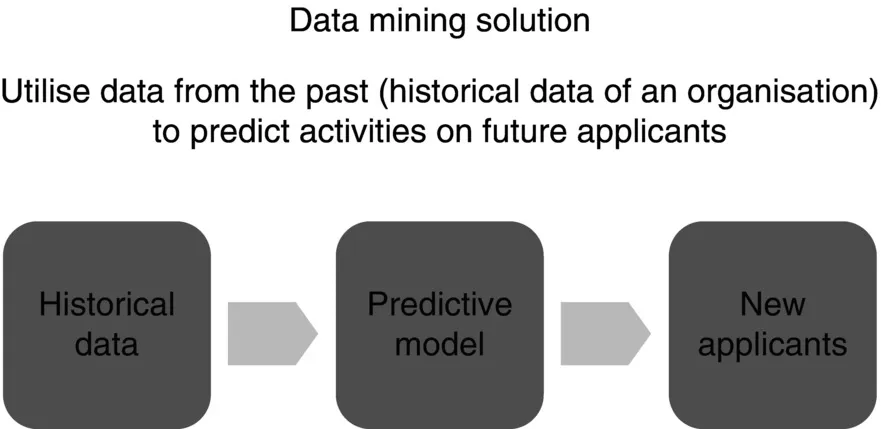
Figure 1.1 Data mining short process.
With technological advancements, the computer industry has witnessed a tremendous growth in both hardware and software sectors. Sophisticated databases have encouraged the storage of massive datasets, and this has opened up the need for data mining in a range of business contexts. Data mining, with its roots in statistics and machine learning, concerns data collection, description, analysis and prediction. It is useful for decision making, when all the facts or data cannot be collected or are unknown. Today, people are interested in knowledge discovery (i.e. intelligence) and must make sense of the terabytes of data residing in their databases and glean the important patterns from it with trustworthy tools and methods, when humans can no longer juggle all these data and analyses in their heads (see Figure 1.2).
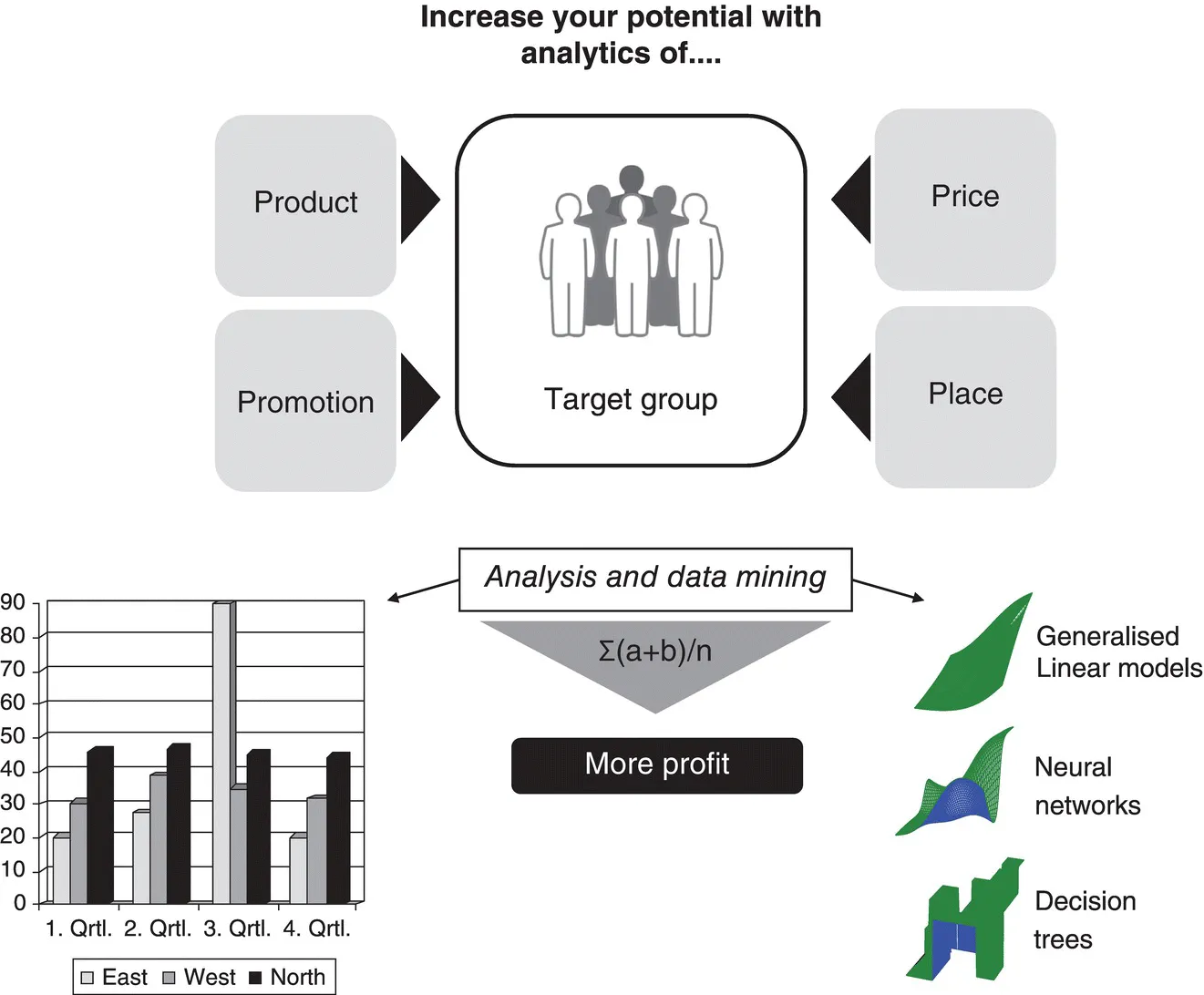
Figure 1.2 Increasing profit with data mining.
1.2.1 Domain Knowledge
We will refer to the concept of domain knowledge very often in the text to follow. Domain knowledge is all the additional information that we have about a situation; for example, there may b...
Table of contents
- Cover
- Title page
- Copyright page
- Glossary of terms
- Part I: Data mining concept
- Part II: Data mining Practicalities
- Part III: Data mining in action
- Bibliography
- Index
- End User License Agreement
Trusted by 375,005 students
Access to over 1.5 million titles for a fair monthly price.
Study more efficiently using our study tools.
Frequently asked questions
Yes, you can cancel anytime from the Subscription tab in your account settings on the Perlego website. Your subscription will stay active until the end of your current billing period. Learn how to cancel your subscription
No, books cannot be downloaded as external files, such as PDFs, for use outside of Perlego. However, you can download books within the Perlego app for offline reading on mobile or tablet. Learn how to download books offline
Perlego offers two plans: Essential and Complete
- Essential is ideal for learners and professionals who enjoy exploring a wide range of subjects. Access the Essential Library with 800,000+ trusted titles and best-sellers across business, personal growth, and the humanities. Includes unlimited reading time and Standard Read Aloud voice.
- Complete: Perfect for advanced learners and researchers needing full, unrestricted access. Unlock 1.5M+ books across hundreds of subjects, including academic and specialized titles. The Complete Plan also includes advanced features like Premium Read Aloud and Research Assistant.
We are an online textbook subscription service, where you can get access to an entire online library for less than the price of a single book per month. With over 1.5 million books across 990+ topics, we’ve got you covered! Learn about our mission
Look out for the read-aloud symbol on your next book to see if you can listen to it. The read-aloud tool reads text aloud for you, highlighting the text as it is being read. You can pause it, speed it up and slow it down. Learn more about Read Aloud
Yes! You can use the Perlego app on both iOS and Android devices to read anytime, anywhere — even offline. Perfect for commutes or when you’re on the go.
Please note we cannot support devices running on iOS 13 and Android 7 or earlier. Learn more about using the app
Please note we cannot support devices running on iOS 13 and Android 7 or earlier. Learn more about using the app
Yes, you can access A Practical Guide to Data Mining for Business and Industry by Andrea Ahlemeyer-Stubbe,Shirley Coleman in PDF and/or ePUB format, as well as other popular books in Mathematics & Probability & Statistics. We have over 1.5 million books available in our catalogue for you to explore.