![]()
Chapter 1
Why You Need to Become a Guerrilla Job Hunter
The New Global America
It’s not the strongest of the species, nor the most intelligent, that survive; it’s the one most responsive to change.
—Charles Darwin
The world is in the midst of a profound business transformation. America is under siege from layoffs, outsourcing, offshoring, rightsizing, downsizing, and bankruptcies. This is a result of developments in information and communications technologies, changing human values, and the rise of the global knowledge-based economy. The sheer complexity and technical sophistication of business has also transformed the job market. We are at a major crossroad in our history.
According to the U.S. Department of Labor there are 50 million employment transactions annually. Already reeling from the struggling economy, competition for the remaining jobs is tougher than ever, the rules for getting them have changed, and global competition ensures that the rules will change again tomorrow.
The current “jobless” recovery is a consequence of the economy’s rapid evolution from a natural resources- and manufacturing-based economy to a knowledge-based one. We are witnessing firsthand the information economy’s first full economic recovery.
You see, for most of the twentieth century, a recession was a cyclical decline in demand—the result of excess inventory that needed to be sold off. People were temporarily laid off—inventory backlogs were reduced and demand would snap back quickly. As product demand increased and shelves were once again filled, workers returned to their preexisting positions in factories---that, or they found an equivalent job with another company.
Over the past few years, dramatic advances in information technology have allowed companies to establish tightly integrated demand and supply chains and outsource manufacturing and low-end service jobs to save money and increase shareholder returns. Rightly or wrongly, many of the jobs that have entirely disappeared from North America have reappeared in India, China, and Latin America. This time, though, rather than getting furloughed, many people were let go, forcing them to switch industries, sectors, locations, or learn new skills to find a new job.
At the same time, job growth now depends on the creation of new positions; you should expect a long lag before employment rebounds because employers incur risks in creating new jobs and require additional time to establish and fill positions. Investment in new capital equipment is no longer a pendulum swinging from recession to recovery and back again.
Instead of resources or land, today capital means human capital. It doesn’t take a store to go into the shoe business—just ask Tony Hsieh, CEO of e-tailer Zappos.com. Nor do you need raw materials, a factory, or fleets of trucks. Nike became a shoe industry leader by concentrating on the value-producing capacity of its employees for design, marketing, and distribution know-how.
The real capital is intangible: a person’s knowledge level, combined with an aptitude for application.
OFFSHORING AND AMERICA’S FUTURE AS A GLOBAL INNOVATOR
Politicians always have a lot to say about the future of offshoring and what the practice of shipping jobs overseas means for the U.S. economy—especially when they want to get elected. But the rhetoric often dies after Election Day.
Politicians, economists, and futurists will argue the macroeconomics of today’s upside-down economy for years, because it makes good press. As a Guerrilla job hunter, you need only interest yourself in the microeconomic impact of offshoring and how it affects you and your career—in short, which jobs are likely to disappear over time and what industries are likely to benefit.
Your job is at risk for offshoring if:
- It can be broken down into many smaller tasks that can be redistributed to lower skilled, lower paid workers.
- Your company’s profits are under constant assault by low-cost competitors.
- Someone else with a high school education can do your job with less than a week’s training.
Here’s what you can bank on:
- The offshoring trend won’t stop anytime soon.
- Companies will continue to maximize profits and reduce costs.
- The government will not solve your career problems—at best it will provide limited retraining assistance.
THE PEOPLE WHO BEST MARKET THEIR TALENT WIN!
With a radically smaller pool of skilled workers and the increased demand for profits, the original War for Talent of the late 1990s has morphed from a quantitative to a qualitative one, best described as the War for the Best Talent by author Peter Weddle in Generalship: HR Leadership in a Time of War (Stamford, CT: Weddle’s, 2004). The old “bums on seats” mentality of many employers in the late 1990s is quickly being replaced by “brains on seats.”
Faced with stiffer competition and tougher hiring requirements, companies are single-minded about productivity and bottom-line performance. Consequently, competition for jobs is increasing as management seeks out and hires only those people who appear to have the most potential for helping to boost the company’s profits. For many companies, employees are now viewed as a variable cost—hence the term human capital—to remain on the books only as long as they continue to produce.
Looking for an old-fashioned job like the one Dad used to have is a waste of your time. All jobs are temporary in the new economy—henceforth you always need to be looking for the next opportunity.
WHY YOU NEED TO BE A GUERRILLA
The most qualified job hunter is rarely the one who wins. I can tell you from personal experience. The positions invariably go to the person who does the best job at positioning himself or herself as the solution to an employer’s problem.
The dramatic changes we are witnessing in the marketplace mean that the tried-and-true methods of finding a job will no longer suffice. They should remain a solid part of your plan, but they don’t provide an adequate amount of exposure to potential employers.
In 1997, Tom Peters introduced the concept of Brand U in his book Re-Imagine! (London: Dorling Kindersley, 2003). At the time, self-branding was an assertive marketing concept best reserved for high-flying techies and senior executives who wanted to maximize the financial returns of their biggest asset—their career. Today, personal branding is a matter of survival.
Becoming a Guerrilla job hunter is the only way to consistently move your career forward. The market is geared toward those who effectively brand and market themselves as the ultimate commodity across multiple distribution channels.
THE #1 SECRET TO GETTING HIRED
Have a plan and follow it. To succeed in today’s hypercompetitive job market where you are competing with the millions of unemployed people and millions more employed but dissatisfied people, you must have an awesome plan. Your plan must be clear and detailed in every way.
THE #2 SECRET TO GETTING HIRED
Are you ready for it? Show an employer that you are worth much more to them (value) than you cost (salary and benefits).
Too simple? Well, think about it for a minute. Do you know any sane person who wouldn’t trade a nickel for two bucks? Everyone wants a deal. As a Guerrilla job hunter you are going to learn how to package and promote yourself as a blue-chip stock—to appear like money in the bank to an employer. This is achievable when you plan every step, and that’s what we’re going to show you.
YOUR GUERRILLA PLAN
Your plan will include your:
- Top 10 target companies
- Guerrilla resume(s) and cover letter(s)
- Guerrilla tactics
- Follow-up activities
In short, everything you need to do to land a great job and guarantee a steady stream of future opportunities.
It will be:
- Clever
- Marketing oriented
- Inexpensive
- Realistic
- Results driven
GUERRILLA JOB SEARCH FLOW CHART
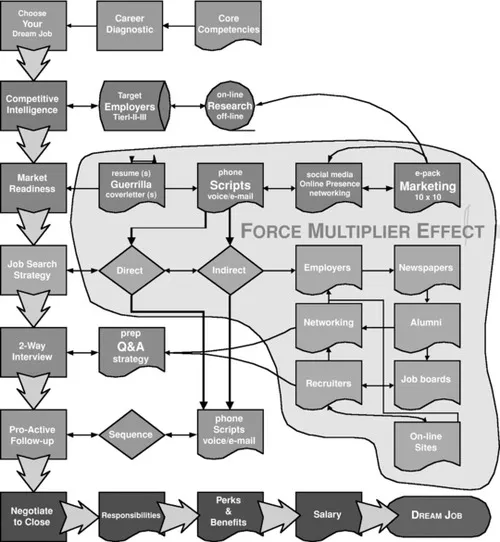
This flow chart shows you visually what you need to do and in what order you need to do it, so you can be successful in your job search. This flow chart is an integral part to all Guerrilla Job Search Boot Camps and presentations because it easily organizes what otherwise appears to be sheer chaos—the vastness of tools, tactics, and techniques available. Download the flow chart from the book’s web site. Print it. Hang it on your wall. Refer to it often to stay on track.
Guerrilla Intelligence
Win Before You Arrive
Wayne Eells
In order to win, one has to position oneself to win. It is not just about planning, tools, and practice. Winning requires you to position yourself. In marketing, positioning is one of the best tools for success. If I say “cola,” the majority of you will say “Coke.”
The wise Chinese General Sun Tzu said, “Victorious warriors win first and then go to war, while defeated warriors go to war first and then seek to win.” He understood positioning hundreds of years ago.
At a recent historical battle reenactment focusing on the period around the mid 1700s, I saw General Tzu’s quote become reality. The battlefield was full of noise and militia on both sides. Dozens of cannons were pounding at each other like they were playing a giant game of tennis. Hundreds of men with muskets took turns firing at each other, sounding like large claps of thunder. While this was going on, officers were yelling orders to the soldiers. It was a loud, smoky, haze covered, semiorganized, free for all. No one knew who would win.
Suddenly, in the distance you heard the sound of bagpipes over all the sounds of the battle. You could hear them coming for some time before you could see them. As the colonists heard the bagpipes you could see their fear. They knew hundreds of trained men in bright red coats were about to hit them head on. The best fighting machine in the world was about to take the field. When the lines of soldiers with flags flying high in the wind finally arrived and fired two volleys, the colonists were in chaos. The British fixed bayonets and began their push. It is amazing how quickly they cleared the field.
Searching for a job is just like that battlefield. It is full of chaos, shots from all sides, smoky haze, and everyone trying to be heard. A position is announced and the employer receives hundreds or even thousands of resumes. You need to approach your job like the British approached the battlefield. They were well researched and trained. They made mistakes and learned from th...