![]()
Chapter 1
Introduction to M2M
Emmanuel Darmois and Omar Elloumi
Alcatel-Lucent, Velizy, France
M2M (Machine-to-Machine) has come of age. It has been almost a decade since the idea of expanding the scope of entities connected to “the network” (wireless, wireline; private, public) beyond mere humans and their preferred communication gadgets has emerged around the notions of the “Internet of Things” (IoT), the “Internet of Objects” or M2M. The initial vision was that of a myriad of new devices, largely unnoticed by humans, working together to expand the footprint of end-user services. This will create new ways to care for safety or comfort, optimizing a variety of goods-delivery mechanisms, enabling efficient tracking of people or vehicles, and at the same time creating new systems and generating new value.
As with every vision, it has taken time to materialize. Early efforts concentrated on refining the initial vision by testing new business models, developing point solutions to test feasibility, and also forecasting the impact of insufficient interoperability. Over the past few years, the realization that there are new viable sources of demand that can be met and monetized has created the push for a joint effort by industry to turn a patchwork of standalone elements and solutions into a coherent “system of systems”, gradually turning the focus from the “what” to the “how” and developing the appropriate technologies and standards.
This chapter introduces the M2M concept and proposes a definition from the multitude of definitions available today. It outlines the main characteristics of the emerging M2M business and presents a high-level view of the M2M framework that is further analyzed and dissected in subsequent chapters. Moreover, this chapter analyzes some of the main changes that have occurred recently and that have largely enabled the development of M2M, namely the emergence of regulation and standards as market shapers. The role of standards is one of this book's central themes and a presentation of the main actors and the latest status of related work is provided as a guide through this complex ecosystem.
The reader will finally be introduced to the structure and content of this book, which is actually the first of a set of two. In the hands of the reader in paper format or on an eBook reader after being loaded by an M2M application, the first book M2M Communications: A Systems Approach essentially introduces the M2M framework—requirements, high-level architecture—and some of its main systems aspects, such as network optimization for M2M, security, or the role of IP.
The second book Internet of Things: Key Applications and Protocols will address more specifically the domain in which the “Internet of Objects” will be acting, namely the M2M area networks, in particular the associated protocols and the interconnection of such networks. It will also analyze, from this perspective, some of the future M2M applications, such as Smart Grids and Home Automation.
1.1 What is M2M?
Many attempts have been made to propose a single definition of the M(s) of the M2M acronym: Machine-to-Machine, Machine-to-Mobile (or vice versa), Machine-to-Man, etc. Throughout this book, M2M is considered to be “Machine-to-Machine”. This being decided, defining the complete “Machine-to-Machine” concept is not a simple task either: the scope of M2M is, by nature, elastic, and the boundaries are not always clearly defined.
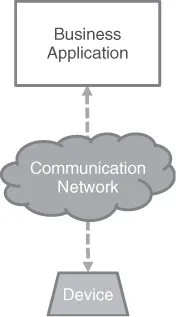
Perhaps the most basic way to describe M2M is shown in Figure 1.1 (the “essence” of M2M). The role of M2M is to establish the conditions that allow a device to (bidirectionally) exchange information with a business application via a communication network, so that the device and/or application can act as the basis for this information exchange. In this definition, the communication network has a key role: a collocated application and device can hardly be considered as having an M2M relationship. This is why M2M will often be a shortened synonym for M2M communications, which is itself a shortened acronym for M2(CN2)M: Machine-to-(Communication-Network-to-)Machine).
In itself, this description still does not fully characterize M2M. For instance, a mobile phone interacting with a call center application is not seen as an M2M application because a human is in command. Some of the more complex characteristics of the M2M relationship are discussed below in order to clarify this.
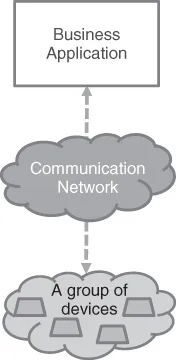
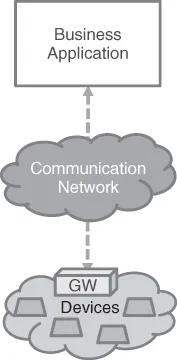
In many cases, M2M involves a group of similar devices interacting with a single application, as depicted in Figure 1.2. Fleet management is an example of such an application, where devices are, for example, trucks, and the communication network is a mobile network. In some cases, as shown in Figure 1.3, the devices in the group may not directly interact with the application owing to having only limited capacities. In this scenario, the relationship is mediated by another device (e.g., a gateway) that enables some form of consolidation of the communication. “Smart metering” is an example of such an application where the devices are smart meters and the communication network can be a mobile network or the public Internet.
To take this into account, the term “M2M area network” has been introduced by the European Telecommunication Standards Institute (ETSI). An M2M area network provides physical and MAC layer connectivity between different M2M devices connected to the same M2M area network, thus allowing M2M devices to gain access to a public network via a router or a gateway.
M2M's unique characteristic is largely due to the key role of the end-device. Devices are not new in the world of information and communication technologies (ICT), but with M2M that market is seeing a new family of devices with very specific characteristics. These characteristics are further discussed below, particularly their impact on the requirements for applications and networks that have not until now been fully taken into account.
- Multitude – This is the most advocated change brought about by M2M. It is generally agreed that the number of “devices” connected in M2M relationships will soon largely exceed the sum of all those that directly interact with humans (e.g., mobile phones, PCs, tablets, etc.). An increased order of magnitude in the number of devices results in significantly more pressure on applications architectures, as well as on network load, creating in particular scalability problems on systems that have been designed to accommodate fewer “actors” and far greater levels and types of traffic. One of the early instances of such problems is the impact of M2M devices on mobile networks that have not been designed with this set of devices in mind and are in the process of being adapted to allow large numbers of devices with non-standard usage patterns (this will be discussed later in this chapter).
- Variety – There are already a particularly large number of documented possible use cases for M2M that apply to a variety of contexts and business domains. The initial implementations of M2M applications have already led to the emergence of a large variety of devices with extremely diverse requirements in terms of data exchange rate, form factor, computing, or communication capabilities. One result of the wide variety is heterogeneity, which is in itself a major challenge to interoperability. This can be a major obstacle to the generalization of M2M. It is also a challenge for the frameworks on which M2M applications have to be built, in order to define and develop common-enabling capabilities.
- Invisibility – This is a strong requirement in many M2M applications: the devices have to routinely deliver their service with very little or no human control. In particular, this is preventing humans from correcting mistakes (and also from creating new ones). As a result, device management more than ever becomes a key part of service and network management and needs to be integrated seamlessly.
- Criticality – Some devices are life-savers, such as in the field of eHealth (blood captors, fall detectors, etc.). Some are key elements of life-critical infrastructures, such as voltage or phase detectors, breakers, etc, in the Smart Grid. Their usage places stringent requirements upon latency or reliability, which may challenge or exceed the capabilities of today's networks.
- Intrusiveness – Many new M2M devices are designed with the explicit intention to “better manage” some of the systems that deal with the end-users' well-being, health, etc. Examples are the eHealth devices already mentioned, smart meters for measuring and/or controlling electrical consumption in the home, etc. This in turn leads to issues of privacy. In essence, this is not a new issue for ICT systems but it is likely that privacy may present a major obstacle in the deployment of M2M systems. This may occur when the large deployment of smart meters demands prior arbitration between the rights of end-users to privacy and the needs of energy distributors to better shape household energy consumption.
In addition to the above-listed characteristics and their impact on the architecture of M2M systems, it is important to consider the other specificities of M2M devices that put additional constraints on the way they communicate through the network. This may require new ways to group the devices together (the “mediated” approach mentioned in Figure 1.3). Among other things, devices can be:
- limited in functionality – Most M2M devices have computational capabilities several orders of magnitude below what is currently present in a modern portable computer or a smart phone. In particular, devices may be lack remote software update capabilities. One of the main reasons for this design choice is cost, often because the business model requires very competitively priced devices (e.g., smart meters in many cases). Limited functionality also results from rational decisions based on the nature of the exchanged information and performable actions: most sensors are not meant to be talkative and operationally complex.
- low-powered – Although many M2M devices are connected to a power network, many of them have to be powered differently (often on batteries) for a variety of reasons. For instance, a large number of them are, or will be, located outdoors and cannot be easily connected to a power supply (e.g., industrial process sensors, water meters, roadside captors). This will reduce the amount of interaction between such devices and the M2M applications (e.g., in the frequency and quantity of information exchanged).
- embedded – Many devices are, and will be, deployed in systems with specific (hostile, secure) operating conditions that will make them difficult to change without a significant impact on the system itself. Examples are systems embedded in buildings or in cars that are hard to replace (e.g., when they are soldered to the car engine, as is the case with some M2M devices).
- here to stay – Last but not least, many of the new M2M devices are and will be deployed in non-ICT applications with very different lifetime expectancy. The rate of equipment change in many potential M2M business domains may be lower than in the ICT industry. This may be linked to cost issues due to different business models (e.g., no subsidization of devices by the operators), to the fact that they are embedded, but also to the complexity of evolution of the industrial process in which the device is operating (e.g., criticality of the service makes changing equipment in a electricity network very difficult, which leads to long life cycle of equipment in the field).
Two final remarks regarding the scope of M2M and the difficulty of defining clear-cut boundaries.
Firstly, a separation between “regular” ICT applications versus M2M applications is to a large extent purely artificial since, in some cases, devices are able to operate both in “regular” and M2M modes. A classical example of this is Amazon's Kindle™. Although it is a “regular” ICT device centered on both human-to-machine function (enabling eBooks) and interface (the eBook reader), it is also an M2M device in its role of providing an eBook to an end-user. When the end-user has decided to buy an eBook and clicks to get it, the Kindle™ device enters M2M mode with a server (providing the appropriate file with the appropriate format) and a network (a “regular” mobile network). This is perfectly transparent to the end-user, thanks to a set of enablers, including the SIM card in the device, the secure identification of the device by the network, and the pre-provisioning of the device in the operator network.
Secondly, it is important to outline some differences between M2M devices and what is referred to as “Things” or “Objects” in the so-called “Internet of Things” (IoT). Actually, M2M and IoT largely overlap but neither is a subset of the other and there are areas that are particularly specific to each:
- IoT is dealing with Things or Objects that may not be in an M2M relationship with an ICT system. An example of this is in the supermarket where radio-frequency identification (RFID) “tagged” objects are offered to the customer. These objects are “passive” and have no direct means with which to communicate “upstream” with the M2M application but they can be “read” by an M2M scanner which will be able to consolidate the bill, as well as making additional purchase recommendations to the customer. From this perspective, the M2M scanner is the “end point” of the M2M relationship.
- There are M2M relationships initiated by devices that are to be seen as direct human–machine...